
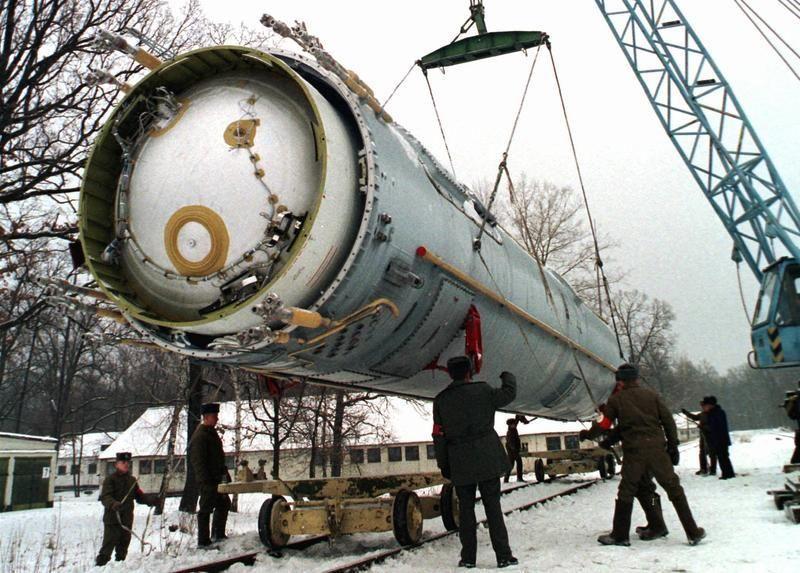
Russia's Dangerous Strategy of Nuclear Coercion
Published Oct. 19, 2015 • Read time: 6m
Despite being in the works for years, Mr. Putin feels now is a good time to call out US plans to modernize the B61 nuclear bombs stationed in Europe.
This included a statement last month by Kremlin spokesman Dmitry Peskov who proclaimed Russia will be forced to respond. “This could alter the balance of power in Europe…And without a doubt it would demand that Russia take necessary countermeasures to restore the strategic balance and parity." Russian observers noted the likely response would be a threat to relocate nuclear capable Iskander missiles to the Kaliningrad enclave, despite the fact that the Kremlin already planned to move Iskanders to Kaliningrad since May.
Brandishing veiled nuclear threats like Peskov’s has become a reoccurring tactic used by both senior Russian officials and generals since 2007. They fall within an increasingly frequent Russian strategy of using nuclear weapons well beyond means of sustaining mutual nuclear deterrence. Unlike the West, where nuclear weapons’ role are strictly to deter existential threats, Russian nuclear weapons are multifaceted instruments used to attain state goals.
This posture has three broad yet overlapping objectives.
The first is to deter. During Russia’s recent military action in the Crimea and eastern Ukraine a key function of the nuclear forces was to dissuade direct military support or intervention on behalf of the victims of Russian aggression. For example, during operations in the Donbass, Russian nuclear forces have visibly flexed their muscles by putting on massive military exercises and wargames. Putin even went so far as to say he considered putting the strategic forces on alert to discourage others from interfering in his seizure of Crimea. Reports of similar moves occurred during hostilities in South Ossetia and Abkhazia in 2008, and many Russians believe their nuclear deterrent prevented US involvement. In all instances, the signal was unmistakable: stay out of Russian affairs.
The second is to intimidate. Russia has felt the need to send grim reminders that its nukes can easily target anyone thinking of enacting undesirable policies. Nuclear threats have been used to bully those considering hosting missile defense assets, such as Poland, the Czech Republic, Denmark, and Ukraine, and provocative long-rang bomber flights recklessly buzz states’ airspace. Moreover, the Kremlin regularly threatens to forward deploy nuclear capable systems along its western borders as negative incentives to rebuff NATO policies. According to NATO Secretary General Jens Stoltenberg, such actions could “fundamentally change the balance of security in Europe.”
Finally, the most acute and precarious motive is to coerce. This was most salient during Russia’s annexation of Crimea. In order to prevent any attempt to retake the peninsula, Foreign Minister Sergei Lavrov issued statements implying nuclear weapons could be used to defend the conquered territory. Reported plans to station nuclear-capable aircraft and construct nuclear weapons handling facilities further solidified this threat.
By linking nuclear weapons use to its illegally acquired territory, Russia has assured the world that any attempt to reclaim the peninsula could be met with a nuclear response. This sets a dangerous precedent. As Sir Adrian Bradshaw warned, “the threat of escalation might be used to prevent re-establishment of territorial integrity.” Should Russia swallow up another neighbor, Moscow could consolidate its gains by threatening nuclear reprisals to anyone who dares to interfere. Simply put, the aggrieved party and/or its allies would be forced to choose between conciliation or nuclear war.
Taken together, these three objectives amount to an apparent acceptance of a new and more aggressive nuclear posture: one of nuclear coercion.
Mr. Putin is taking Russia down a dangerous path as the leadership appears willing to play the nuclear card at the drop of a hat, convinced the lopsidedness of the stakes and adversaries’ unwillingness to risk nuclear hostility is enough to force capitulation. Backed by the policy of limited nuclear strikes to “de-escalate” a conflict and an increasingly modernized arsenal, Russia is undeniably “playing with fire,” as Deputy Secretary of Defense Robert Work and then Vice Chairman of the Joint Chiefs of Staff Admiral James Winnefeld recently observed.
Alone, Russia’s nuclear threats could appear erratic and absurd, and are often chalked up to nothing more than bluster or reckless attempts to vex NATO. But nuclear coercion fits neatly into a larger and more complex web of intermingled components used to advance the Kremlin’s agenda. From cyber-attacks to gas wars, information warfare to military operations, Moscow skillfully employs these seemingly disconnected activities to form one coherent strategy. Its goals? To weaken Transatlantic solidarity, reassert itself as a major power, and ultimately establish recognition of Moscow’s right to a sphere of interest, something every Russian president has insisted upon.
It is in this light one must examine Russia’s threats against US modernization
For Russia, the tactical nuclear weapon issue has never been about stability. Rather, the “balance” Russia hopes to preserve is nothing short of maintaining Moscow’s current overwhelming imbalance of tactical nuclear weapons and their delivery vehicles (around a 10 to 1 difference), a key enabler of Russia’s nuclear coercion. Indeed, Russian exercises continue to prominently feature tactical systems, while defense firms pump out new weapons that can threaten large swaths of European territory. Given Moscow’s near monopoly on tactical nuclear weapons, US policymaker’s response options would be significantly restricted during a crisis, weakening deterrence.
As such, the political and military significance of nuclear modernization, along with participation from our European partners, is growing in importance for bolstering both deterrence and assurance. In order to maintain a credible deterrent to offset Russian nuclear coercion, the US must stay ahead of developing threats by improving our forces.
To be sure, our regional nuclear options are just one piece of the deterrence puzzle. The US and NATO should continue to examine how best to enhance forces across the entire spectrum of deterrence. But given Russian and other countries interest in exploiting the threat (or actual use) of nuclear strikes, nuclear modernization is becoming an increasingly critical component.
Secretary Robert Work and Admiral James Winnefeld highlighted this need in their recent testimony. They noted today’s evolving security environment requires a safe, secure, but most importantly an effective nuclear force. Russia’s apparent outright rejection of stability in favor of a policy of nuclear coercion only confirms their assessment.
Harrison Menke is currently a wargaming analyst at SAIC and a recent graduate of Missouri State Defense and Strategic Studies program headed by Dr. Keith Payne. Harrison's studies focused on nuclear deterrence and Russian nuclear strategy. His thesis examined Russian nuclear posture with regard to Europe and earned Thesis with Distinction honors. Harrison's writings have appeared in US News & World Report, Defense News, and the Missile Defense Review. His views are his own and do not represent those of organizations' he is affiliated with.

Why Iran Cannot Simply Surrender
By Eric Garland • RealClearDefense
The Formation Left Us Behind
By Mark W. Castillon • RealClearDefense
Can Commanders Tell When Artificial Intelligence Is Wrong?
By Jonathan K. Corrado • RealClearDefense
The Summit as Mirror
By Stephen Blank • RealClearDefense
The False Choice That Could Get Us Killed
By Adam Strickland • RealClearDefense
Why Iran Cannot Simply Surrender
By Eric Garland • RealClearDefense
U.S. Navy Cuts Submarine Maintenance Delays by 40%
By Ethan Gossrow, Naval News
Air Force Bets on Hybrid-Electric Aircraft for Transport
By L.C. Williams, Defense One
Roosevelt Joins 2 Other Carriers in Mideast As Pressure on Iran Rises
By Stars & Stripes
Fight Now? Time to beef up III MEF
By Marine Corps Compass Points