
Future of the All-Volunteer Force
Last updated 05:52 PM EDT • Read time: 4m
Washington, March 28 – A new working paper by the Center for a New American Security (CNAS) Military, Veterans, and Society Program highlights the strategic challenges facing the nation’s All-Volunteer Force. The paper outlines an agenda for military and civilian leaders to tackle in their effort to improve military effectiveness and better support our nation’s service members and their families. This working paper is designed to inspire and solicit feedback that will be incorporated into future CNAS efforts.
The new CNAS working paper is the product of a year-long effort focused on “AVF 4.0” – the next evolution of the nation’s all-volunteer military – which included extensive research and a monthly working group on the current status and future of the AVF. CNAS researchers Phillip Carter, Katherine Kidder, Amy Schafer, and Andrew Swick authored the report, with contributions from many other CNAS staff including three successive classes of military fellows.
The full report can be found here: https://www.cnas.org/publications/reports/avf-4-0-the-future-of-the-all-volunteer-force
Please find a summary of the paper and its diagnoses of the major problems below:
Over the past two years, the Pentagon’s leadership wrestled with AVF reform in the context of Defense Secretary Ashton Carter’s “Force of the Future” initiative. Although that effort generated much needed tactical reforms in a number of areas, it fell short of achieving true structural or strategic reform across the force, for a variety of institutional and political reasons. The CNAS AVF 4.0 project sought to diagnose the fundamental strategic challenges facing the AVF, in order to create a problem statement that could inform future reform efforts by subsequent leaders in the Pentagon and Congress. The report outlines nine strategic issues facing the All-Volunteer Force today:
1. Quality. Military manpower quality has generally improved over time, but it remains susceptible to economic factors and the popularity of military service. In addition, the services do very little to meaningfully measure quality after recruitment.
2. Developing Ideas and Innovation. The services generally fail to catalyze or incentivize innovation by individuals; professional military schools do a poor job of incubating innovation or ideas for how to fight and win future wars.
3. Lethargy. Today’s military personnel system is too slow to respond to new and rapidly changing requirements demanded by modern warfare.
4. Rigidity. The ability to adapt personnel career tracks or requirements are frustrated by the AVF’s bureaucracy, as illustrated by the “AfPak Hands” and cyber force case studies.
5. Compatibility. The AVF by its very nature must be different from the civilian labor force, yet its inability to acknowledge societal changes in favor of work-life balance, and secular, dual-income families may be costing it critical talent. Similarly, the standardized admittance and skill set requirements are at odds with the workforce today.
6. Waste and inefficiency. The AVF wastes billions of dollars each year because of its enormous personnel churn, massive turnover, first-term attrition, husbanding non-deployable personnel, and discarding of personnel through rigid promotion and retirement structures.
7. Costs. The per-service member cost of the AVF has increased tremendously over the past four decades, and particularly during the past 15 years of war, raising concerns about the sustainability of the AVF as an element of national power.
8. A Growing Civil-Military Divide. The U.S. military has grown increasingly insular during the four decades of the AVF’s life, the result of recruiting patterns and self-selection dynamics that result in a relatively narrow slice of America serving in uniform.
9. Transition. The military discharges nearly 200,000 veterans each year, but pays little attention to their success after service, despite linkages between the success (and perception thereof) of veterans and the propensity of future generations to serve, or future generations of veterans to recommend service to others.
The CNAS AVF 4.0 project will continue throughout 2017, with subsequent research focused on topics that include:
- Moving beyond the storefront model of recruitment
- Increasing the standardization of quality among commissioning sources
- Using civilian institutions (universities and private sector opportunities) to build the skillsets of service members
- Using better data analytics to drive efficiency and effectiveness in the system
- Slowing the pace of churn, both geographically and over the course of a career
- Increasing the diversity of experience and geography to drive innovation
CNAS would like to acknowledge and thank the National Defense Industrial Association (NDIA) for its support of the AVF 4.0 project. However, the opinions expressed in this paper are those of the authors alone and do not necessarily reflect the views of its funders, consistent with CNAS policies on intellectual independence and support, available online at cnas.org.

Trump's Disrupt First, Negotiate Second: Greenland in Focus
By Meda Parameswara Reddy • RealClearDefense
In Seeking Peace With Beijing, Taipei Is an Asset, Not a Burden
By Alexandru Filip • RealClearDefense
Strike First: Israel's Inevitable Doctrine for the Iranian Axis
By Lance Gordon • RealClearDefense
It’s Not President Trump but Thomas Friedman Who Should Be Ashamed
By Francis P. Sempa • RealClearDefense
Putin, Plague, and America’s Biodefense Gap
By Ryan Kane • RealClearDefense
U.S. and Japan Begin Naval Exercises Near Taiwan
By Mari Yamaguchi • Associated PressU.S. and Japan Begin Naval Exercises Near Taiwan
By Mari Yamaguchi, AP
U.S. Navy, Gecko Robotics Surge AI Maintenance Contract
By Ceder, Simkins, Navy T.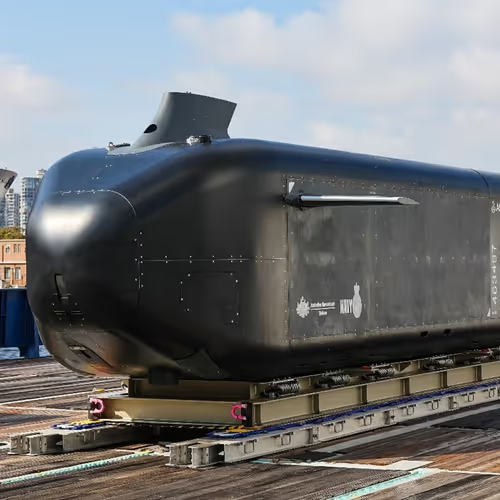
Ghost Shark XL-AUV Payload Bay Seen For First Time
By Thomas Newdick, The WarZone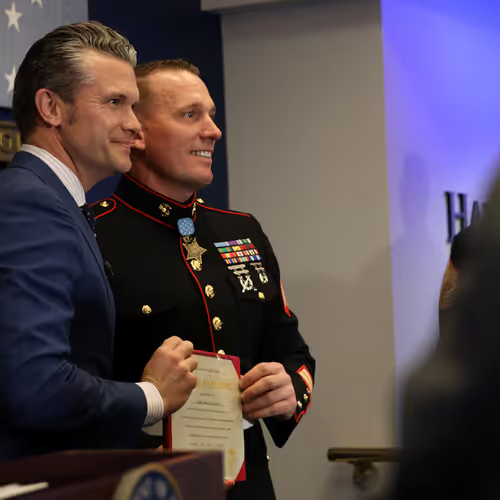
Dakota Meyer Tapped As Barracks Task Force Senior Advisor
By C. Stassis, MC Times