
Cyber Warfare
RealClear Context
Click below to continue reading this story, discover more Cyber Warfare stories from over 25 years of RealClear archives, or follow this topic to stay in the know.
Winning the AI Race Isn't Enough
The doctrine question, what American AI power is actually for, remains unanswered.
07/02/26Read it on RealClearDefense
An Acquisitions Process Built for Today's Contested Spectrum Battlefield
Russian jamming cut the effectiveness of precision artillery in Ukraine from 70 to 6 percent in six weeks. Spoofed navigation signals pulled a British tanker off course before Iran seized it in the Strait of Hormuz. Russian electronic warfare targeted Starlink terminals in Ukraine, disrupting the satellite communications Ukrainian forces relied on for battlefield command and control.
These incidents all highlight the nature of a contested spectrum battlefield. These were all different missions, platforms, and domains, yet each arose from the same vulnerability: the electromagnetic spectrum. The United States Department of War and its industrial base must adapt to this contested environment. If our warfighting systems are to succeed in the modern battlefield, acquisition processes must adapt to better judge RF systems under jamming and buy adaptive capability on commercial timelines.
An Acquisitions Process Built for Today's Contested Spectrum Battlefield
The United States Department of War and its industrial base must adapt to this contested environment.
8h agoRead it on RealClearDefenseNORTHCOM's JTF-Gold To Coordinate Cyber Warfare for Golden Dome
U.S. Northern Command's (NORTHCOM) task force for coordinating Golden Dome homeland air and missile defense capabilities across the Joint Force has...
8h agoRead it on Breaking DefenseArmy's Project Gatekeeper
The service's new cybersecurity testing sandbox will stand up on Oct. 23
1d agoRead it on Breaking DefenseArmy Sprinting to Field AI Agents to Counter Autonomous Cyberattacks
The Army has initiated three projects to develop artificial intelligence capabilities to enhance the service's cyber defenses
2d agoRead it on National Defense MagazineVideo Cameras Are Everywhere—and Now They Are Being Hacked for War
The highly vulnerable devices have turned into tools for combatants to track, surveil and attack the enemy
3d agoRead it on The Wall Street JournalSuspected Iranian Drone Plot in U.K. Raises Security Questions
The rise of drone warfare brings questions about how to protect large and expensive assets like bombers—even thousands of miles from front lines
6d agoRead it on The Wall Street JournalThe Silent Electronic Battleground Shaping the Future of Warfare
A silent electronic warfare battle is raging in the Russia-Ukraine war as both sides attack and defend communication signals on a massive scale
1w agoRead it on The Wall Street Journal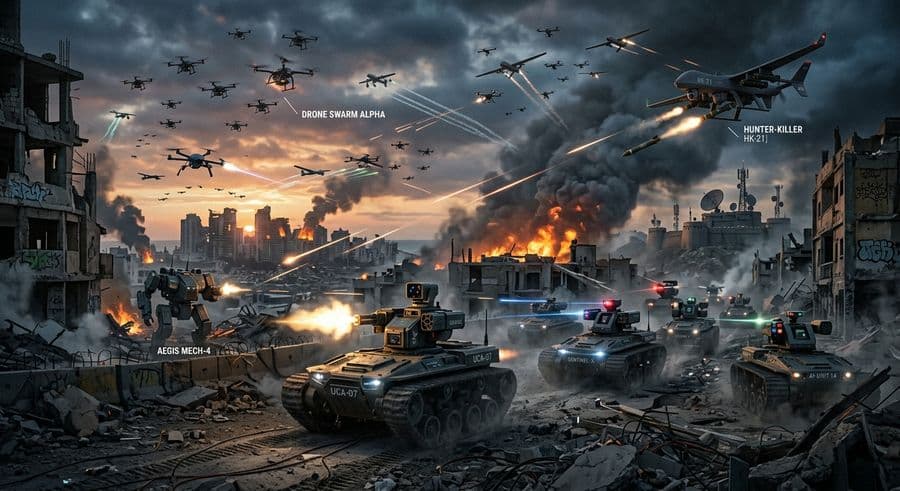
Autonomous Systems, Recoverable Data: AI Has Changed the Security Equation for the Battlefield Edge
The Department of War is undergoing one of the most significant transformations in military operations. Artificial intelligence is moving decision-making to the tactical edge. Autonomous systems are proliferating across every domain. Data is becoming as decisive as firepower. And military planners increasingly envision a future where thousands of unmanned and autonomous systems operate simultaneously across highly contested battlespaces. This transformation is reshaping not only how wars will be fought, but also where America's most valuable military information resides. Increasingly, it resides at the edge.
Artificial intelligence has fundamentally changed the architecture of military computing. Every AI-enabled unmanned aircraft, autonomous ground vehicle, maritime platform, ISR sensor, edge compute node, and autonomous command-and-control system now processes, stores, and acts on operational data locally rather than relying on centralized command centers. As AI pushes computing to the tactical edge, battlefield platforms have become repositories of some of the military's most valuable information.
Speed Over Judgement Is Winning the AI Arms Race
Machines can out-fly and out-shoot humans, but deterrence still runs on a very human ability to imagine what comes next.
2w agoRead it on The Interpreter
The Revolutionary War: When Strategic Options Share the Same Weakness
By Henry Yep • RealClearDefense
The Houthis Are Testing the Limits of Collective Defense
By Saima Afzal • RealClearDefense
Radio Frequencies in the Intelligence Ecosystem
By Craig Brower • RealClearDefense
An Acquisitions Process Built for Today's Contested Spectrum Battlefield
By John Malsbury • RealClearDefense
Who Shoots Down the Drone Over the Shipyard?
By John Ferrari & Dillon Prochnicki • RealClearDefense
Who Shoots Down the Drone Over the Shipyard?
By John Ferrari & Dillon Prochnicki • RealClearDefense
Northrop Grumman Breaks Out the Big Guns at AUSA
By Daniel Terrill, Defense News
Army Pursuing Diverse Array of New Anti-Air Interceptors
By Trevithick, The WarZoneWho Shoots Down the Drone Over the Shipyard?
By John Ferrari & Dillon Prochnicki, RCD
F-35C Lands for the First Time on a Ford-Class Aircraft Carrier
By The Aviationist