
The Race to Build Ukraine's Western Air Force
Last updated 02:48 AM EDT • Read time: 5m
The ongoing evolution of Ukraine's defense capabilities represents one of the most complex military transitions in modern history. Moving away from a legacy fleet of Soviet-era aircraft toward an integrated, Western-standard air defense architecture requires more than just the transfer of advanced multi-role fighters; it demands a holistic, international effort centered on human capital.
At the heart of this transformation is the Air Force Capability Coalition, a multinational initiative operating within the Ramstein format that has established a multi-layered ecosystem to train Ukrainian pilots, engineers, and support specialists across allied nations.
Fourteen partner nations stand behind this effort, each folding its own resources into the coalition's shared mission: Belgium, the United Kingdom, Denmark, Canada, Luxembourg, the Netherlands, Norway, Poland, Portugal, Romania, the United States, France, the Czech Republic, and Sweden. Rather than pooling into a single undifferentiated fund, each member contributes according to what it can best offer.
Some, like Canada, the United Kingdom, the United States, Belgium, and the Czech Republic, focus heavily on personnel training, running pilot and technical instruction pipelines on their own soil. Others, including the Netherlands, Denmark, Norway, Sweden, and France, are principally equipment donors, supplying or selling the F-16s, Gripens, and Rafales that will eventually fill Ukrainian squadrons.
A further group, among them Luxembourg, Poland, and Portugal, channels its support primarily into funding training programs and underwriting the broader coalition budget, while Romania anchors the effort's infrastructure dimension by hosting a dedicated regional training hub.
In practice, most members' contributions span more than one of these categories, but the division of labor allows the coalition to move on all fronts, personnel, equipment, funding, and infrastructure, simultaneously rather than sequentially.
Beyond supplying advanced combat platforms like the F-16, Rafale, Mirage 2000, and JAS 39 Gripen, the alliance tackles four vital operational fronts: developing aviation infrastructure, maintaining current capabilities, fostering defense-industrial cooperation, and training personnel.
Personnel training serves as the coalition's most critical pillar. Transforming pilots accustomed to Soviet avionics and tactical doctrines into proficient Western operators demands a rigorous, multi-level educational pipeline. This journey begins with intensive language proficiency courses, moves through comprehensive ground school and advanced simulator training, and culminates in practical flight hours on modern airframes.
International Hubs and Specialized Training Programs
To scale up training volume and accommodate pilots at various stages of readiness, partner nations have established dedicated facilities across Europe and North America.
A critical node in this international network is the European F-16 Training Center (EFTC) located in Romania. Designed as a regional hub, the center facilitates advanced tactical training for allied and Ukrainian aviators, ensuring a steady stream of qualified personnel ready to employ Western systems in contested airspace.
Simultaneously, traditional allies continue to play pivotal roles. The United Kingdom, the United States, Belgium, and Canada maintain active pipelines for Ukrainian pilots.
Complementing these efforts, the Czech Republic has integrated its own specific assets into the coalition framework. The Czech Republic committed to training Ukrainian F-16 pilots, leveraging its military educational infrastructure. Furthermore, the Czech Republic has contributed L-39 training-combat aircraft as a transitional platform, allowing pilots to bridge the gap between basic flight trainers and advanced Western multi-role fighters. In addition, the integration of light Alto NG aircraft aids in constructing a modernized training pipeline for young pilot candidates adhering directly to NATO methodologies.
Technological Enablers: Simulators and Transitional Platforms
Training military aviators during an active conflict presents severe logistical and resource constraints. To maximize safety, preserve airframe lifespans, and accelerate throughput, technological solutions have been heavily integrated into the curriculum.
Modern mobile F-16 simulators deployed within Ukraine and at partner facilities allow flight crews to maintain and hone their tactical skills according to NATO standards without relying entirely on physical combat aircraft. These simulators increase training intensity and allow pilots to rehearse complex tactical scenarios safely.
By combining traditional flight hours with advanced simulation and transitional platforms like the L-39, the coalition ensures that the bottleneck traditionally associated with pilot training aircraft availability and flight hours is systematically mitigated.
Building a Comprehensive Aviation Ecosystem
Pilot training does not occur in a vacuum; it is part of a broader, network-centric shift in Ukrainian military aviation. The graduation of trained aviators directly fuels an expanding operational framework designed to field multiple Western combat platforms on a structured timeline.
Ongoing phased deliveries of F-16 multi-role fighters from European coalition partners, including the Netherlands, Denmark, Norway, and Belgium, are scaling up progressively through multi-year schedules running through 2029.
These are joined by the upcoming arrival of Swedish JAS 39 Gripens, starting with the delivery of 16 donated Gripen C/D fighters beginning in early 2027, followed by 16 newly purchased Gripen E variants starting in 2029.
Further expanding this multi-tier approach, France and Ukraine formalized a roadmap for an initial batch of 16 Dassault Rafale F4 fighters under a European loan framework, with pilot training commencing in France and initial aircraft projected to become operational around 2028-2029.
Complementing these platforms are additional tactical assets, such as French Mirage 2000-5F fighters and advanced airborne early warning systems like the Saab ASC 890.
Together, these multi-tier combat deployments generate an unprecedented, long-term demand for highly skilled pilots capable of executing complex Western tactical doctrines across a unified, NATO-compatible architecture.
As international partners continue to expand their training footprints in Romania, Canada, the Czech Republic, and beyond, the structural transformation of Ukraine's Air Force moves closer to completion. Through sustained multinational cooperation, the coalition is building not just a cadre of skilled pilots, but a resilient, self-sustaining aviation ecosystem capable of securing Ukraine's skies for the future.
Bruce Allen Lubbering held several management positions with aerospace manufacturing companies in a career that lasted over 30 years.
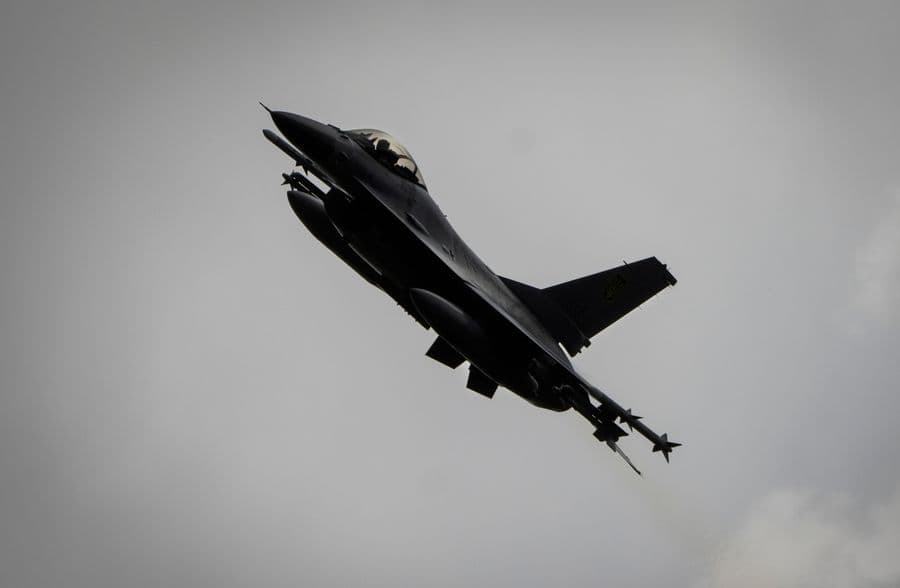
image: The Ukrainian Air Force's F-16 fighter jet flies in an undisclosed location in Ukraine, Sunday, Aug. 4, 2024. The F-16 fighter jets that have been delivered to Ukraine by Western countries will be flying sorties in Ukrainian skies and helping the country's current fleet of Soviet-era jets to counter Russia's invasion. (AP Photo/Efrem Lukatsky)