
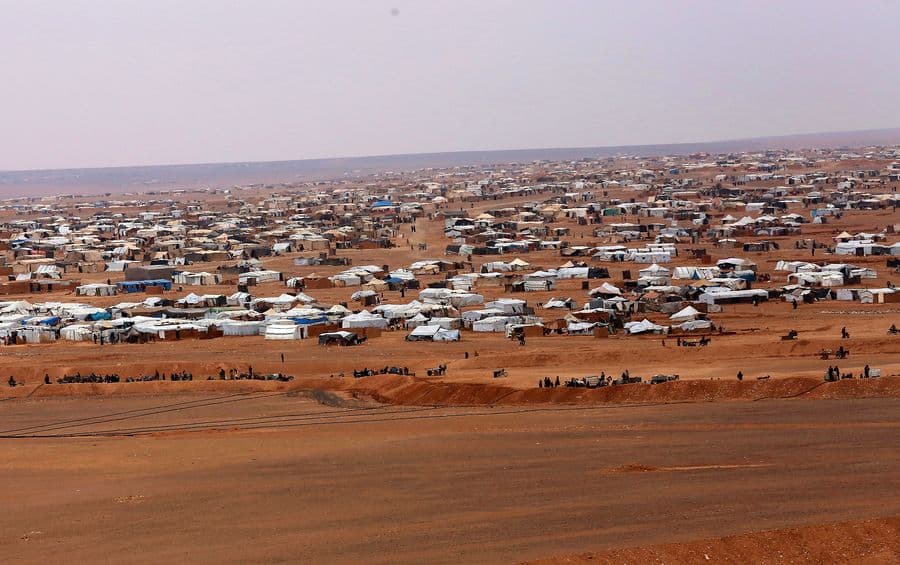
Al-Hawl: Creating the Next Generation of Terrorists
Last updated 06:20 AM EDT • Read time: 4m
It has been more than two years since ISIS was ousted from the last of its territorial strongholds in northeast Syria, but the group and its affiliates remain a persistent threat to the U.S. and our allies. The most recent ISIS-K terrorist attacks at Kabul’s airport, resulting in the senseless and tragic deaths of 13 U.S. service members, are a somber reminder of this fact. Two decades after 9/11, we’re still losing American lives to violent Islamic terrorist organizations—and that will continue if we don't learn from past mistakes and implement practical solutions to prevent the next generation of radicals.
The al-Hawl refugee camp currently houses approximately 60,000 ISIS family members, many of whom are women and children. Due to the limited resources of the Autonomous Administration of North and East Syria (AANES), which controls the perimeter of al-Hawl, the camp has become notorious as a place where ISIS supporters can brutally impose their ideology on camp residents—often killing non-supporters to create a climate of fear.
Al-Hawl is a modern-day Camp Bucca, where Abu Bakr Al-Baghdadi, unknown at the time, first arrived in 2004. By 2014, he would head ISIS as the most infamous terrorist leader alive. Firsthand accounts recall that the environment of Camp Bucca as a U.S. military-run prison gave its inmates opportunities to plan, coordinate, and build bonds they would not otherwise have. Today, lone actors inspired by ISIS propaganda remain the “most serious threat” to U.S. and European security, according to the Defense Intelligence Agency. There will be a steep price to pay in the next few years if the international community does not take steps to defuse the ticking time bomb that is al-Hawl.
In April, I met with the al-Hawl camp director, Rojhat Ali, just one day after raids rooted out ISIS leadership and affiliates. Ali expressed his frustration with the lack of action taken by the international community—there are no real processes in place to protect children from violent Islamic ideological influence. Currently, his only weapon to battle ISIS is a handful of brochures aimed at reducing radicalization. As the population in al-Hawl matures, those children are growing up in an atmosphere guaranteed to enlist them as the next generation of terrorists.
The international community has largely created this problem and is reluctant to be part of the solution. The UN, NGOs, USAID, and countries of the European Union have created a catch-22 for the AANES governing body. They ridicule AANES for al-Hawl while making it politically impossible for them to facilitate any changes to the organization or operations of the camp.
The commander of U.S. Central Command (CENTCOM), General Kenneth McKenzie, has undertaken small amounts of repatriation as a solution to the growing terrorist threat but has noted that the process is moving too slowly. While the repatriation of camp refugees is by no means easy, immediate steps can be taken to avert this disaster in the making.
Al-Hawl contains around 22,000 Syrian nationals who could be integrated back into society far more quickly and safely than other foreign refugees. AANES has already developed an internally displaced persons (IDPs) registry, including 42,000 IDPs from all parts of Syria with confirmed identities.
A sponsorship system – wherein Syrians are paired with IDPs from the same communities or with existing local connections – would provide accountability and help facilitate an effective reintegration back into Syrian society. This program would need incentives for participation, such as economic or educational benefits for sponsors to be effective. It must also include multi-step security and deradicalization processes.
Such a program would safely remove about one-third of al-Hawl residents from the sprawling camp, freeing up resources and clearing the way for a greater focus on the remaining refugees. However, it would need focused international funding to be enacted.
When 9/11 occurred, there were no wars in Iraq, Afghanistan, Syria, Libya, or Yemen. Now, there are conflicts and hotspots on almost every continent. This instability has given rise to growing stretches of ungoverned territories, which afford terrorists the safe havens they need to grow and plan attacks. Today, terrorist leaders like Osama Bin Laden and Abu Bakr Al-Baghdadi may be dead, but their ideas still live. Inside al-Hawl lives a young man—whose name you haven’t yet heard—who is their successor. He is being fed, protected, and brainwashed by an inept system, that while full of good intentions, is nonetheless fostering the next generation of terrorists.
Dominique L. Plewes is special advisor to Freedom Research Foundation and founder of 501(c)3 Special Operations Forces (SOF) Support Foundation, dedicated to educating Americans on the purposes and uses of our special operations forces.
Reflecting on an Epic Horse Campaign in the Mountains of Afghanistan
By Brian Glyn Williams • RealClearDefense
The Godfather of American Foreign Policy Realism Speaks to Today’s World
By Francis P. Sempa • RealClearDefense
In Pursuit of Nuclear Abolition
By Peter Huessy • RealClearDefense
Innovation Alone Won’t Prepare the U.S. for the Future Battlefield
By Joshua Segal • RealClearDefense
The sUAS Tactical Trifecta
By Bryan T. Woody • RealClearDefense
Navy Civilianizes Six Former Flag Billets, Reduces Six to Captains
By Mongilio, USNI N.
Raytheon's $8B Contract for Strategic Comms Terminal Modernization
By M+A El
America’s Maritime Moment Will Not Wait
By CDR Salamander
Armor Up?
By Marine Corps Compass Points
Who Shoots Down the Drone Over the Shipyard?
By John Ferrari & Dillon Prochnicki • RealClearDefense