


On February 24, an emotional Russian President Vladimir Putin announced the start of a “special military operation” to ‘denazify’ Ukraine. After massing nearly 190,000 troops, Putin launched a short air campaign followed by a ground invasion to seize the capital, Kyiv. Many considered this Russian juggernaut invincible. One Russian media outlet even mistakenly posted its Russian victory op-ed just two days after the start of the campaign. Yet, questions about Russian performance have emerged as the Russian “operation” continues to struggle. If, as many pundits had assumed, Russian military superiority would lead to a quick Russian victory, why has the operation stalled?
While we certainly do not have a complete picture of Russian performance, we offer some initial considerations on the Russian military’s planning, integration of key enablers, maneuver, and tactical proficiency after one week to explain some key shortcomings.
Planning
It appears that the Russian General Staff designed the invasion as two main operational campaigns composed of multiple Combined Arms Army (CAA) groupings. The main effort appears to be in the north to seize Kyiv along with the government of President Volodymyr Zelenskyy. The supporting effort is in the south and east; it is designed to encircle the largest concentration of Ukrainian forces that comprise the Joint Forces Operation against the two Russian-supported, breakaway republics and establish a land bridge from Crimea to Russia.
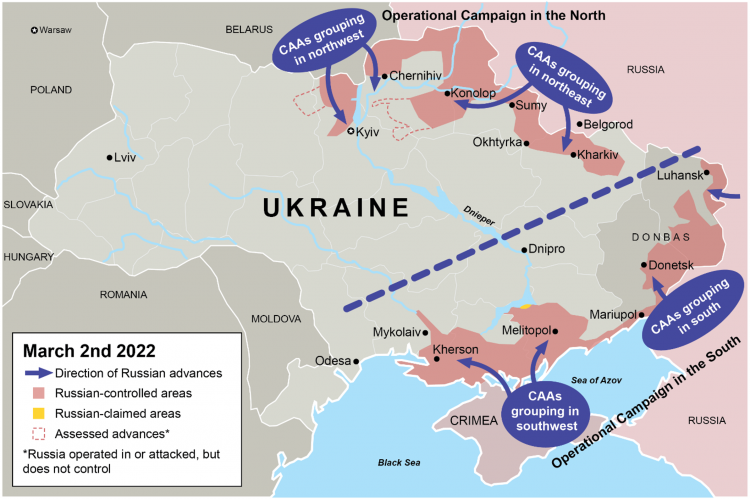
Given the sheer number of units pulled from across Russia for the invasion, planning for the operation would have been a central military task for the General Staff. However, as the war grinds on, we are beginning to see cracks in the Russians’ planning. The opening air and missile attacks appear to have failed to defeat the Ukrainian air force and air-defense forces. Russian logistics planning may not have accounted for fuel shortages stemming from combat losses of transport vehicles or soldier indiscipline. Russian planners also seem to have underestimated the will of the Ukrainians to fight, the effectiveness of Western anti-tank and man-portable anti-aircraft weapons, and the will of the European nations to continue arming a defiant Ukrainian state.
Integration of Combat Multiplying Enablers
Contrary to the initial expectations of many military pundits, the Russian Army has not appeared to integrate a number of key combat multipliers effectively—good examples are coordinating airstrikes and employing electronic warfare (EW). The absence of overwhelming Russian airpower is perplexing. Reasons might include a lack of confidence in the coordination between Russian air and Ground Forces’ air defense units, the continued presence of Ukrainian anti-aircraft weapons, and the influx of Stinger anti-aircraft missiles to Ukraine. Commanders may also lack confidence in pushing too many aircraft into airspace filled with indirect artillery and rocket fires, especially given the vast number of firing units. We have previously seen the Russians use basic coordination and deconfliction measures to address this—they simply ceased indirect fires when supporting aircraft were in the area.
Finally, Russian forces used EW against Ukrainian forces in 2014 but have not effectively integrated or employed it in the current fight. While this may be a reflection of hastily prepared plans, poor staff training and integration, or the desire to conceal a potent enabler for the Russian armed forces, it may indicate that Russian commanders do not want to disrupt the command and control of their own units, some of which are reportedly using commercial analog two-way radios.
Maneuver
The Russians are operating with a complete absence of operational surprise. Commercial satellite imagery provides a fairly accurate picture of current Russian force dispositions, and every local Ukrainian with a cell phone has the ability to film and post Russian movements in real time. Journalists and pundits operating on social media further analyze these posts to geolocate and confirm their authenticity.
“Rasputitsa” is the Russian word for the spring and fall seasons of the year when cross-country mobility becomes difficult; traditionally, the spring Rasputitsa lasts to May. Along with an apparent lack of basic vehicle recovery procedures, this has resulted in Russian tracked and wheeled vehicles becoming stuck and often abandoned in muddy fields. Due to a lack of off-road mobility, the Russians are now road bound, making control of road networks and air superiority even more vital. This results in every road intersection becoming vital terrain; increases the impact of indirect fires, anti-tank weapons, unmanned combat aerial vehicles; and favoring the defender.
The absence of cross-country mobility also requires control of urban areas in order to move combat forces and their logistics elements through these potential choke points. Alarmingly, the Russians are now shifting from controlling to destroying Ukrainian cities despite early assurances that Russian forces would target neither civilians nor civilian infrastructure.
Tactical Proficiency
The initial phase of the first large-scale Russian military operation in decades has been revealing and raises questions about the efficacy of Russian military training. The Russian 12-month conscription term is too short to acquire advanced skills, leaving most conscripts to fill basic jobs like driver or crewman in the battalion tactical groups. Additionally, it is still early in the Russian winter training cycle, leaving many of the conscripts not fully trained.
Accounting for approximately a third of the Russian military force, conscripts are prohibited from serving abroad. However, in an attempt to fully man units deploying to the Ukrainian border, it appears that Russian officials fraudulently signed up conscripts as “kontraktniki,” or contract soldiers, which made them legally available to deploy outside the Russian Federation. With conscripts spread throughout the invasion force, this may be the first real visibility at how the Russian Army operates en masse compared to smaller expeditionary operations like Syria.
This includes poor convoy procedures, vehicles breaking down or running out of fuel, and soldiers reportedly surrendering or damaging their vehicles to avoid combat. While this indicates an inadequate level of the individual soldier and small unit training, it may also indicate a morale issue among the junior officers responsible for leading these small units. This may help explain the lack of initiative, dearth of tactical proficiency, and low morale observed in combat arms and transportation units.
Military Staffs Matter
Initial observations of the Russian operation indicate that planning for the early stages of the operation was faulty. Command and control was overly simplified, maneuver was constrained, and tactical proficiency lacking.
Viewed collectively, these shortcomings likely point to insufficient training or experience in military staffs. Past large-scale exercises were often scripted. This may be the first time many of the Combined Arms Army and lower echelon staff have planned such a complex operation. While many of the Russian commanders and surely select staff officers have combat experience in Syria, the majority of the staff likely do not. Deploying individual officers or select tactical units does not directly translate into experienced, functioning staff able to plan and execute combined arms combat operations, often while on the march.
Before drawing final conclusions on the Russian military performance, it will be imperative to fully understand the impacts of the unique conditions in this war. One should always be cautious about underestimating the enemy.
The coming days or weeks will show whether the Russians will address their current challenges or eschew any changes and press on with sheer mass and indiscriminate firepower. These observations are in no way meant to dismiss the considerable success that Ukraine has achieved to date. Significantly outnumbered and outgunned but defending their homeland in an unjust war, the Ukrainian military and citizens are responsible for revealing the Russian shortcomings.
Taft Blackburn, a retired 30-year Army and Eurasian Foreign Area Officer (FAO), Taft currently works as a Research Staff Member at the Institute for Defense Analyses (IDA) where he analyzes Russian and Ukrainian national security issues. Taft served as the Army Attaché at the U.S. Embassy in Moscow and was also the Defense Attaché and Senior Defense Official in Serbia, Tajikistan, and Moldova. Prior to being assigned as a FAO, he deployed to Haiti as a cavalry troop commander and fought in Desert Storm as an armor platoon leader.
Keith Detwiler is a Research Staff Member at the Institute for Defense Analyses (IDA). He served in the U.S. Army for 30 years as an Infantry and Foreign Area Officer, including assignments as Liaison Officer to the Russian Airborne Brigade during peacekeeping operations in Bosnia and Defense Attaché in Belarus. His assignments as a Colonel included Chief of Staff, U.S. Army North (Fifth Army) and three deployments to Afghanistan in command and staff positions.
Alex Shykov is a researcher at the Institute for Defense Analyses with native proficiency in Ukrainian and Russian languages. His research focuses on European and East Asian security issues, U.S. foreign policy, and nuclear weapons and operations. He earned his master’s degree from the Fletcher School of Law and Diplomacy at Tufts University.
