
Freedom Haulers: A Real Readiness Fix Hiding Inside a Jobs Program
Last updated 06:40 AM EDT • Read time: 6m
My youngest brother spent his career as a Green Beret weapons sergeant, and men like him get the movies, the recruiting posters, and the glory they have earned. The soldiers nobody makes documentaries about are the ones who make sure the shooters have bullets, fuel, and food waiting for them when they need it. Logistics and transportation troops run an unglamorous mission that decides whether the glamorous one succeeds. That is the lens I bring to the White House's new Freedom Haulers campaign, and it is why the defense and national security crowd should take a look, not just the immigration desk.
On July 30, President Trump stood at the White House with Transportation Secretary Sean Duffy, VA Secretary Doug Collins, and acting Labor Secretary Keith Sonderling to launch an interagency push to move military veterans into commercial trucking. The federal government extended the Military Skills Test Waiver window from one year to two years after separation, added seven states to the Even Exchange knowledge-test waiver program to bring the total to 34, and let active-duty troops test for a CDL where they are stationed instead of traveling back to their home state. Werner Enterprises pledged to hire 1,400 veterans and military spouses in 2027. Duffy put the pitch plainly, saying veterans "are the right people for the job."
The timing is not an accident. Since last summer, about 26,000 truckers have been pulled off the road for failing English proficiency tests, and the Transportation Department says another 30,000 commercial licenses were canceled for having been issued illegally. Non-domiciled CDLs, the license category available to certain visa holders, cover roughly 200,000 drivers, about 5% of all CDL holders even though immigrants make up something like a fifth of the trucking workforce overall. A new federal rule narrows eligibility to three visa categories: H-2A agricultural workers, H-2B seasonal workers, and E-2 treaty investors. Everyone else ages out as their existing licenses expire. As Cole Stevens, chief strategy officer at the trucking firm bearing his family's name, put it, veterans bring "integrity, accountability, and mission-first mindset."
Zoom out and the trucking industry's problem is bigger than any single enforcement action. The American Trucking Associations puts the 2026 shortfall at roughly 82,000 drivers, projects the industry will need to hire 1.2 million new drivers over the next decade, and reports that large truckload carriers still see annual turnover north of 90%, with more than a third of new hires quitting inside their first 90 days. The average driver is pushing 50. This is not a recruiting problem so much as a revolving door nobody has figured out how to slow down, and no waiver program fixes a door that keeps spinning by itself.
Here is where my day job colors how I read this differently than a labor reporter would. I spend my time advising fiduciaries and institutions on risk they cannot see coming until it lands on the balance sheet, and civilian trucking is exactly that kind of risk for the country's defense posture. A federal watchdog once found that the Pentagon pays commercial carriers to move almost 90% of its domestic freight, because the military never built or kept the organic trucking fleet to do that job itself. Little has changed about that structural dependence since. A mobilization that requires moving ammunition, fuel, medical supplies, and equipment across the continental United States runs largely on the same commercial carrier base that is short 82,000 drivers and turning over 90% of its workforce every year. A fragile civilian trucking sector means fragile surge capacity, full stop. Veterans arrive with documented safety records, discipline under load, and often the security clearances and comfort with sensitive cargo that defense freight already demands. Recruiting them into trucking is not charity. It is an investment in the connective tissue between the defense industrial base and the battlefield.
To be sure, not everyone in the industry thinks Freedom Haulers move the needle much. Trade press coverage has pointed out that the skills-test waiver has produced roughly 40,000 veteran CDL holders across its entire operating life, a few thousand a year, against a gap the administration's own non-domiciled CDL rule is expected to widen by more than 194,000 drivers, and that most of what changed on July 30 extended existing programs rather than creating new authority. Some immigrant advocacy groups argue Sikh truckers in particular are being unfairly singled out following two high-profile crashes, and the underlying CDL restrictions remain tangled in litigation in California and New York. Those are legitimate points, and Freedom Haulers by itself will not close an 82,000-driver gap. But the safety argument holds regardless of who is making it. As OOIDA President Todd Spencer said of veteran drivers, they are "the safest operators of the 80,000-pound commercial vehicles" on American roads.
The retention math matters too, and no press release fixes it. A veteran hired into a badly run fleet with lousy home time and stagnant pay walks away from the job just like anyone else does. Recruitment gets people in the seat. Pay, predictable schedules, and decent treatment keep them there. If Washington wants Freedom Haulers to be more than a marketing campaign wrapped around programs that mostly already existed, it needs to pair the waiver expansions with real pressure on the industry's retention problem, because the discipline this campaign is selling does not survive contact with a broken business model any better than it would survive contact with a broken supply line.
Peace through strength does not stop at the flight line or the motor pool gate. It runs down every highway an 80,000-pound rig travels, carrying the fuel, parts, and equipment that keep the country, and the force that defends it, moving. Freedom Haulers is a modest step, not a solution, but it points in the right direction: toward men and women who already know how to move heavy iron under discipline, put to work keeping America's supply lines intact. I trained behind a rifle rather than a steering wheel, but I recognize logistics discipline when I see it, and I would rather see more of it on our highways than less.
Jay Rogers is a financial professional with more than 30 years of experience in private equity, private credit, hedge funds, and wealth management. He has a BS from Northeastern University and has completed postgraduate studies at UCLA, UPENN, and Harvard. He writes about issues in finance, constitutional law, national security, human nature, and public policy.
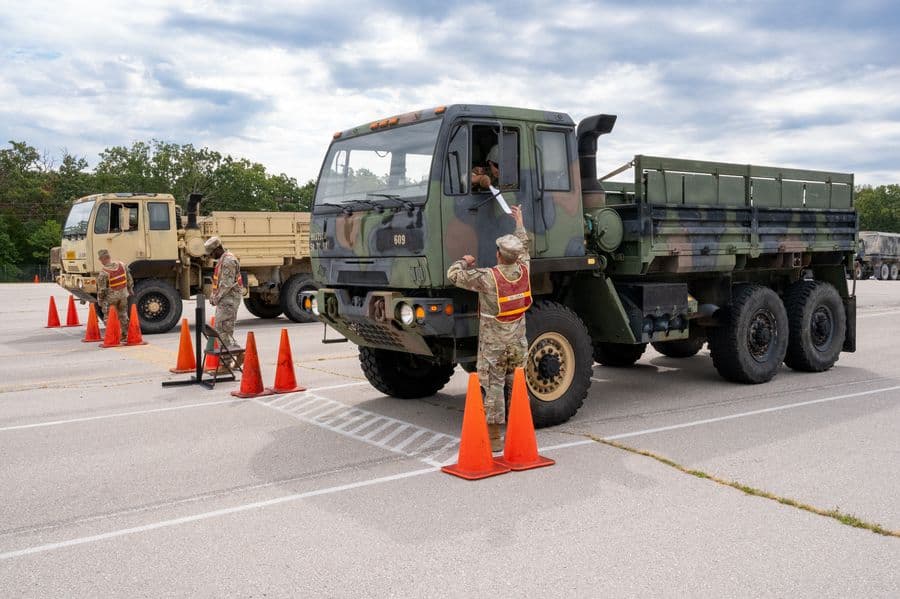
image: Instructors of the 58th Transportation Battalion’s 88M Motor Transport Operator Course help Soldiers in advanced individual training learn to operate 5-ton medium tactical vehicles Sept. 2 at Fort Leonard Wood Training Area 251. (U.S. Army)