
Between Entrapment and Abandonment: The Mecca Pact Faces Its First Serious Test
Last updated 06:40 AM EDT • Read time: 9m
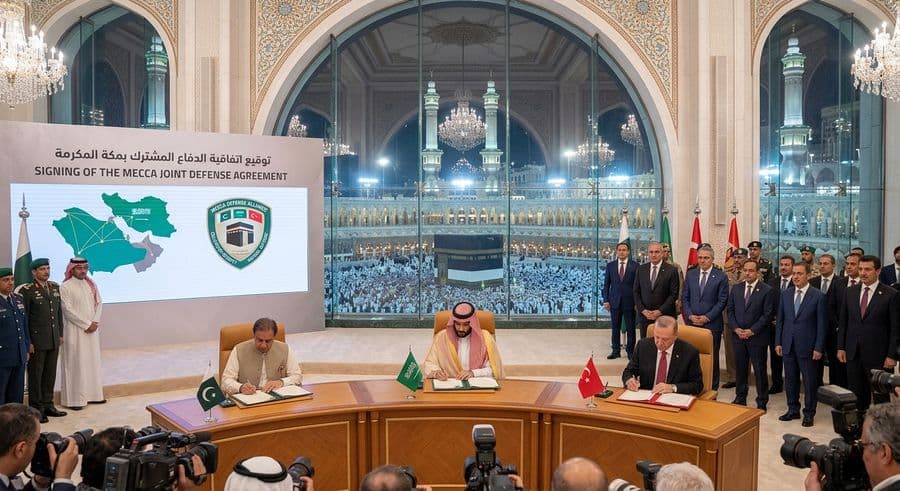
Saudi Arabia, Pakistan, and Türkiye made an unusually sweeping promise to one another when they signed the Mecca Joint Defense Agreement on August 7: an armed attack on one would be treated as an attack on all three. The agreement seeks to strengthen collective deterrence by confronting potential adversaries with the combined power of three of the Muslim world’s most consequential states.
Less than two months later, that promise is facing its first serious test. Houthi missiles and drones have repeatedly targeted Saudi Arabia. Pakistan has carried out air and drone strikes inside Afghanistan amid escalating cross-border violence. And Türkiye’s increasingly adversarial relationship with Israel has taken on a dangerous military dimension in Syria.
These developments expose a dilemma built into the pact from the start. Make the guarantee broad enough to deter, and the three countries risk being drawn into wars arising from threats they do not share. Limit it enough to preserve strategic autonomy, and the pact risks losing the credibility that gives collective defense its deterrent power.
Alliance theory has long grappled with this tension. Glenn Snyder described alliances as caught between abandonment and entrapment: states seek commitments strong enough to ensure that allies will defend them, but not so expansive that they are dragged into conflicts in which their own vital interests are not at stake. Deterrence makes this balancing act harder. As Thomas Schelling argued, a commitment deters only when an adversary believes it will be honored. A military alliance therefore derives much of its value from the credibility of its promise to act together.
For the Mecca pact, therein lies the dilemma: the more unequivocal the promise, the greater the risk of entrapment; the more discretion members preserve, the greater the risk that adversaries doubt the promise altogether.
The difficulty is magnified because the three states operate in largely distinct threat environments. Pakistan’s overriding external concern remains India, its nuclear-armed rival to the east. The two countries fought major wars in 1947–48, 1965, and 1971; clashed in Kargil in 1999; and have experienced repeated military crises since, including their brief but intense confrontation in May 2025. Pakistan also faces militant violence and chronic insecurity along its western frontier. Saudi Arabia confronts Iran, the Houthis, and broader Gulf security challenges. Türkiye faces Kurdish armed groups, instability in Syria, Black Sea security concerns, NATO obligations, and an increasingly difficult relationship with Israel.
Such differences are not unusual among allies. NATO members have long disagreed over particular threats and regions. The harder problem for the Mecca pact is that its broad defense guarantee attempts to bridge three substantially different security environments. One member’s most important crisis may therefore create expectations of military support in a conflict the other two have powerful reasons to avoid.
The Houthi campaign provides the clearest indication yet of how this dilemma operates in practice. Since the Houthis declared a naval blockade of the kingdom in July, their missile and drone attacks have targeted Saudi cities, energy sites, and shipping. On September 19, Saudi air defenses intercepted a missile aimed at Riyadh. A week later, they intercepted two drones heading toward Riyadh and two ballistic missiles aimed at Khamis Mushait.
The alliance has begun responding. Türkiye’s foreign minister said on September 19 that Ankara was ready to help meet Saudi Arabia’s military needs, particularly on technical issues. On September 25, the Saudi, Pakistani, and Turkish defense chiefs and chiefs of general staff met in Riyadh under the Mecca agreement. They reviewed threats facing the kingdom and discussed intelligence cooperation, military coordination, and integration of capabilities. They also pledged to “immediately begin” translating the pact’s commitments into effective military cooperation.
But there is a meaningful difference between helping Saudi Arabia defend itself and entering another Yemen war. Pakistan and Türkiye may be willing to provide intelligence, air-defense capabilities, technical assistance, logistics, or other defensive support. Direct combat against the Houthis is another matter, and neither government has publicly announced plans to join it.
Pakistan demonstrated something similar under its bilateral defense relationship with Saudi Arabia during this year’s Iran war. Reuters reported in May that Islamabad had deployed roughly 8,000 troops, a fighter squadron, two drone squadrons, and an HQ-9 air-defense system to the kingdom, with personnel primarily serving in advisory and training roles. Pakistan, meanwhile, mediated between Washington and Tehran rather than joining offensive operations against Iran.
This is precisely where Snyder’s dilemma interacts with Schelling’s. Limited involvement reduces the danger of entrapment. Yet each limitation also communicates something about what “an attack against all” means in practice. If attacks on Saudi territory produce intelligence cooperation, air defense, and technical assistance but not direct military action against the attacker, allies and adversaries alike learn something about the boundaries of the guarantee.
Pakistan’s escalating confrontation with Afghanistan exposes the same problem from the opposite direction. Islamabad struck targets in eastern Afghanistan on September 21 and, three days later, said it had struck ten locations it described as launch and storage sites for drones used against Pakistan. Kabul rejected Pakistan’s account and said four civilians were killed.
There is no evidence that Pakistan has invoked the Mecca agreement over Afghanistan, nor that Saudi Arabia or Türkiye has been asked to participate. Pakistan is helping to operationalize collective defense in support of Saudi Arabia while confronting a serious security challenge of its own. If the confrontation with Afghanistan escalates, Riyadh and Ankara could eventually face the same question Islamabad now confronts over Saudi Arabia: how far does collective defense extend when an ally’s security crisis grows out of a complicated cross-border conflict? Supporting Pakistan’s territorial defense is one thing; becoming implicated in a Pakistan-Afghanistan conflict is another.
Türkiye presents a potentially more dangerous version of the dilemma. Its relationship with Israel has deteriorated sharply, and Syria has emerged as a possible military flashpoint. In mid-August, Israel struck Syria’s Abu al-Duhur airbase, saying Damascus was on the verge of allowing Turkish troops to deploy there. Syria’s foreign minister said no Turkish base was planned, and Türkiye’s defense ministry denied that a Turkish delegation was present at the site. Washington has said it is working to establish a deconfliction mechanism among Israel, Syria, and Türkiye, but the episode shows how competing Turkish and Israeli objectives in Syria could produce a military confrontation.
A direct Turkish-Israeli confrontation would pose difficult choices for Riyadh and Islamabad. Türkiye also belongs to NATO, so an attack on Turkish territory could, depending on the circumstances, generate consultations and political pressures under two alliance frameworks. NATO’s Article 5 obliges allies to assist an attacked member but leaves each ally discretion over the action it considers necessary, including whether to use armed force. The Mecca pact could therefore face both the problem of entangling its members in one another’s conflicts and the complications of overlapping collective-defense commitments.
Pakistan’s nuclear arsenal raises the stakes further. Nothing publicly available establishes that Islamabad has formally extended a nuclear guarantee to Saudi Arabia or Türkiye, and assuming otherwise would be a mistake. Yet deterrence operates partly through perception. Pakistan is one of nine nuclear-armed states and the pact’s only nuclear-armed member. Its arsenal was developed primarily to deter India, not to underwrite contingencies in the Gulf or the Levant. Will adversaries nevertheless perceive it as standing somewhere behind the promise that an attack on one will be treated as an attack on all?
If they do, deterrence could strengthen – but so could the consequences of entrapment. A conventional crisis involving Saudi Arabia or Türkiye could acquire a nuclear shadow none of the three governments intended.
These cases point to the same structural trade-off. A broad guarantee gives potential adversaries more reason to hesitate but expands the range of conflicts capable of implicating all three allies. A narrow guarantee protects strategic autonomy but reveals where collective action stops. The Mecca pact therefore becomes most effective as a deterrent precisely when it becomes most dangerous as an alliance.
Here the effort to avoid entrapment creates a second danger: a credibility trap. Limited involvement allows a state to avoid an unwanted war, but each limitation reveals something about how far the alliance is prepared to go. Allies may fear abandonment while adversaries learn where collective defense stops. What begins as useful strategic ambiguity can gradually become a map of the pact’s boundaries.
The three governments appear to recognize the problem. At the inaugural meeting of the pact’s Strategic Political and Defence Committee in Istanbul on August 31, their foreign and defense ministers and senior military leaders agreed to further institutionalize cooperation, establish a permanent secretariat in Saudi Arabia, strengthen defense capabilities, and ensure the “credibility and effectiveness” of collective deterrence and defense. They also stressed de-escalation and restraint. The September 25 meeting of their military chiefs suggests this process is moving from institutional design toward operational coordination.
That makes clarification, not maximal commitment, the signatories’ most important task. They need not promise to fight every war together, nor eliminate strategic ambiguity; some uncertainty can strengthen deterrence. But they do need a common understanding of what constitutes an armed attack, what forms of assistance members can expect, when defensive support might become direct military participation, how the pact interacts with Türkiye’s NATO obligations, and whether Pakistan’s nuclear status has any bearing on the agreement.
None of this makes the Mecca pact empty symbolism. Its members bring complementary capabilities: Saudi Arabia offers financial resources and strategic geography; Türkiye, a sophisticated defense-industrial base and one of NATO’s largest militaries; Pakistan, large armed forces, substantial operational experience, and the pact’s only nuclear arsenal. Combined, those assets create real deterrent potential. But capability becomes collective defense only when adversaries believe members are prepared to use it for one another.
When the Mecca pact was signed, the dilemma between entrapment and abandonment could be illustrated mainly through hypothetical wars. Less than two months later, its members are confronting separate crises pointing in different directions: Saudi Arabia faces the Houthis; Pakistan faces militant violence and an escalating confrontation with Afghanistan; and Türkiye faces a potentially dangerous rivalry with Israel.
The pact’s first tests will therefore begin to define what the agreement actually means. Its durability will depend on whether Riyadh, Islamabad, and Ankara can occupy the narrow ground between abandonment and entrapment: making their commitment credible enough that adversaries believe it, but bounded enough that all three governments remain willing to honor it when the conflict is not originally theirs.
Dr. Arian Sharifi is a former Assistant National Security Advisor to the President of Afghanistan and a former lecturer at Princeton University’s School of Public and International Affairs. He holds a PhD in international security from The Fletcher School at Tufts University. His research and policy work focuses on national security, terrorism, and the politics of South Asia and the broader Middle East.