
Russo-Ukraine War
Ukraine's Drones Knock Out AI Data Center Belonging to 'Russia's Google'
One damaged data center has supercomputers used for training Yandex's AI model.
2d agoRead it on Ars TechnicaRussian Offensive Campaign Assessment
Russian President Vladimir Putin used his phone call with US President Donald Trump on October 9 to falsely blame Ukraine for the lack of peace...
3d agoRead it on Institute for the Study of WarWorld Wars Don't Start All At Once
Writing in the online journal 1945, Ted Galen Carpenter reminds us that world wars don't start all at once. Carpenter cites reports that Russia is...
3d agoRead it on RealClearDefense
World Wars Don't Start All At Once
Writing in the online journal 1945, Ted Galen Carpenter reminds us that world wars don’t start all at once. Carpenter cites reports that Russia is launching drone attacks in Poland and Germany, two NATO countries that have actively helped Ukraine launch similar attacks on Russia. He characterizes these acts of belligerency as “gray-zone warfare,” and warns that such actions are “inherently reckless” and “can easily get out of hand, leading to a cycle of escalation that culminates in full-scale warfare.” The actions on both sides, he writes, are part of a “geostrategic game of ‘chicken’” which should stop before we all go off a cliff “into an abyss.”
The abyss Carpenter warns about is an expanded war involving nuclear-armed powers. History is replete with regional wars and crises that escalate into global conflicts. In 1754, fighting between British colonists and French settlers, with their respective native-American allies, in the Ohio Valley ignited the Seven Years War that engulfed much of Europe and India until it ended in 1763. Many historians consider this the first global war. That war, as J.R. Seeley explained in The Expansion of England, was simply the latest in a series of 18th century wars between Britain and France for the control of North America. “These wars,” Seeley wrote, “group themselves very symmetrically, and the whole period stands out as an age of gigantic rivalry between England and France, a kind of second Hundred Years’ War.” The American War of Independence was also part of that larger geopolitical rivalry.
World Wars Don't Start All At Once
Writing in the online journal 1945, Ted Galen Carpenter reminds us that world wars don't start all at once. Carpenter cites reports that Russia is...
5d agoRead it on RealClearDefenseThe New Nineteenth Century
It was a long time in coming, but with the still ongoing conflict in Iran and in Ukraine, it is not unreasonable to talk about the end of the...
5d agoRead it on The Realist ReviewUkrainian Strikes Blast Russian Frigates at Novorossiysk
A single Ukrainian drone attack on Novorossiysk has significantly degraded the land-attack cruise missile capability of Russia's Black Sea Fleet
6d agoRead it on UK Defence JournalThe Closing of the Russian Mind (Doesn't Bode Well for the Future)
Bogged down militarily in Ukraine, with Russia's economy in a shambles and Ukrainian drones penetrating ever deeper into the heartland and causing...
6d agoRead it on The Strategist (ASPI)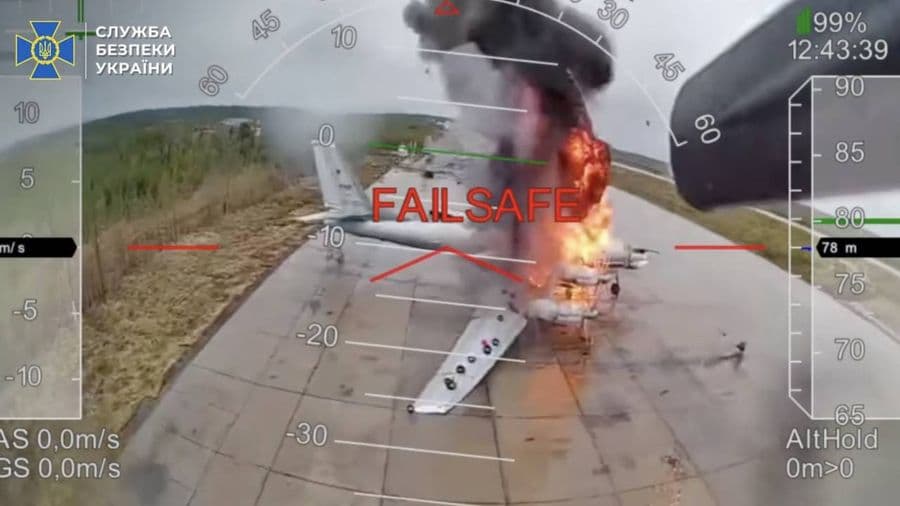
The Kill Web May Already Be Inside the Perimeter
Operation Spiderweb showed that an attacker can cross geography before combat begins. NATO’s counter-drone buildout should test rear-area command handoffs and decision latency, not only sensors and interceptors.
Ukraine’s 2025 Operation Spiderweb changed more than the range of drone warfare. Ukrainian operatives moved first-person-view drones close to Russian strategic air bases inside wooden structures carried by trucks, then launched them near their targets. Reuters later reported that U.S. officials assessed the operation had destroyed around ten Russian aircraft and damaged as many as twenty.

The Revolutionary War: When Strategic Options Share the Same Weakness
By Henry Yep • RealClearDefense
The Houthis Are Testing the Limits of Collective Defense
By Saima Afzal • RealClearDefense
Radio Frequencies in the Intelligence Ecosystem
By Craig Brower • RealClearDefense
An Acquisitions Process Built for Today's Contested Spectrum Battlefield
By John Malsbury • RealClearDefense
Who Shoots Down the Drone Over the Shipyard?
By John Ferrari & Dillon Prochnicki • RealClearDefense
Who Shoots Down the Drone Over the Shipyard?
By John Ferrari & Dillon Prochnicki • RealClearDefense
Northrop Grumman Breaks Out the Big Guns at AUSA
By Daniel Terrill, Defense News
Army Pursuing Diverse Array of New Anti-Air Interceptors
By Trevithick, The WarZoneWho Shoots Down the Drone Over the Shipyard?
By John Ferrari & Dillon Prochnicki, RCD
F-35C Lands for the First Time on a Ford-Class Aircraft Carrier
By The Aviationist