
Exemptions and Enablers: The Accountability Gap in Unmanned Warfare
Last updated 05:38 AM EDT • Read time: 5m
From the comfort of an office, a drone operator executed a lethal standoff strike in Yemen on Anwar al-Awlaki, a senior al-Qaeda operative and U.S. citizen, from the other side of the planet in real-time. He was killed in a non-battlefield environment using Hellfire missiles fired from a remotely operated MQ-9 Reaper drone under secret executive authority. The mission was a collaboration between the CIA and Joint Special Operations Command.
Conducted under Title 50 covert action authority, the operation circumvented the requirement for public Congressional debate and authorization. Therein lies the issue where current laws are ill-equipped to govern the proliferation of unmanned systems. Title 50 authority governs intelligence community operations that can be authorized by the President without Congressional approval. Conversely, the 1973 War Powers Resolution represents a failure of legal limits on Executive conflict-related powers. Together, they create a ‘grey zone’ that is easily exploitable by unmanned systems.
The 1973 War Powers Resolution mandates that before the President commits troops abroad, Congress should first be consulted. The Resolution states that Congress must be notified within 48 hours if the President has already deployed U.S. forces. The President then has 60 days to cease action or have the use of armed forces terminated, unless Congressional approval has been given. The concept of the Resolution is rooted in the declining public tolerance for U.S. casualties. Often, the administrations will take advantage of the specific language used in the Resolution to circumvent limits on their actions. The Resolution’s statutory triggers rely on introducing armed forces into ‘hostilities’ or imminent danger. By decoupling military force from physical risk to U.S. personnel, unmanned systems allow the Executive to contend that standoff strikes fall outside the text of Section 4(a)(1), effectively neutering Congressional oversight.
Unmanned systems, including drones and munitions that are controlled remotely, muddy the waters of deployment, harm’s way, and hostilities. The strikes conducted against Venezuelan drug-running boats are prime examples of unmanned systems skirting the legal boundaries of conflict. While there was a massive buildup of naval assets in the area, whether those assets were in harm’s way and engaged in hostilities became a point of contention. By striking targets from afar and in singular instances, notions about dangers towards personnel and engaging in hostilities enter the grey zone. Though substantively thin, the Executive’s argument remains defensible by focusing strictly on a narrow interpretation of the Resolution’s text.
Title 10 and Title 50 of the U.S. Code establish the distinct legal frameworks governing the Department of War and the intelligence community, respectively. Each provides a legal framework for responsibilities and processes within their defined roles. However, operations conducted by either community are often jointly run. Unlike traditional military operations under Title 10, Title 50 covert actions allow the Executive to bypass public debate and statutory notification limits. While statutory reporting to key intelligence leaders is required under 50 U.S.C. § 3093, the Executive retains total unilateral authority to initiate lethal force without prior legislative approval.
Operational overlaps occur whenever the CIA employs military platforms to execute missions under Title 50 authority. As a Title 50 authority, they avoid additional constraints Title 10 military operation would adhere to. For example, a Title 50 operation may use Air Force Reaper drones equipped with Hellfire missiles for targeted killings, making extensive use of military assets. Despite the significant role of the military, Title 50 authority dictates the level of oversight and approval needed.
The War Powers Resolution’s inherent flaws have effectively neutered Congressional oversight of the Executive's military reach. Title 50 further compounds this issue, granting the President vast discretion to launch military-staffed operations under the expansive, often secret, umbrella of intelligence authority. Combined, these statutory loopholes grant the Executive sweeping latitude to deploy lethal force while insulating operations from public debate. The proliferation of unmanned systems, specifically drone technology, has only broadened the ability of the Executive to operate in this grey zone. By decoupling personnel from physical risk and expanding the operational reach of the intelligence community, unmanned systems have become the primary instruments for taking advantage of this legal grey zone.
Both legal clarification and Congressional committees are necessary for superior oversight. First, the definition of hostilities should be expanded to include unmanned systems and similar distance-operated technology. Modifying the Resolution to extend Congressional approval to every strike may hinder national security efforts. Balancing the need for haste, a dedicated joint oversight committee which rapidly addresses pressing issues involving limited military use would be more efficient. The committee would also oversee intelligence operations utilizing extensive military assets. The joint aspect of the committee would prevent forum shopping within Congress. Such a mechanism ensures that technological speed never outpaces statutory accountability, bringing the 'grey zone' back under the umbrella of Constitutional law.
The ‘grey zone’ represents a fundamental challenge to the traditional balance of power. As technology decouples military force from physical risk, the statutory triggers for oversight are increasingly misaligned with reality. Implementing a specialized joint committee ensures that technological speed does not outpace constitutional accountability. Together, these proposals would prevent limited lethal force from becoming a routine tool of policy without blocking the ability of the Executive to act rapidly when necessary.
Brandon Rowley is a recent M.A. graduate in International Security from the Schar School of Policy and Government at George Mason University. His research specializes in Arctic security dynamics, unmanned military systems, and strategic competition.
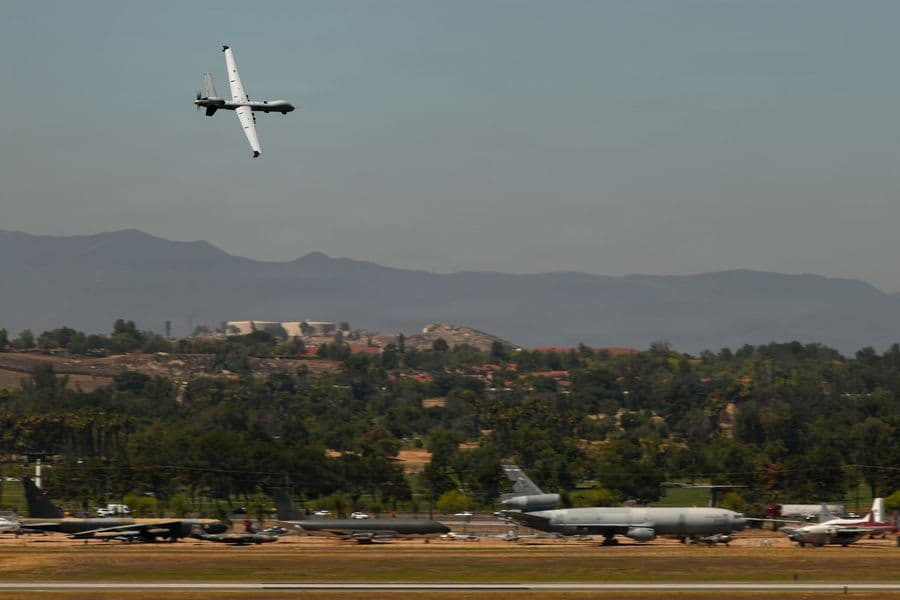
image: An MQ-9 Reaper aircraft from the 163d Attack Wing takes off at March Air Reserve Base, Calif., July 9,, 2026. The MQ-9 Reaper is an armed, multi-mission, medium-altitude, long-endurance remotely piloted aircraft that is employed primarily against dynamic execution targets and secondarily as an intelligence collection asset. Given its significant loiter time, wide-range sensors, multi-mode communications suite, and precision weapons, it provides a unique capability to perform strike, coordination, and reconnaissance against high-value, fleeting, and time-sensitive targets. (U.S. Air National Guard photograph by Senior Master Sgt. Julianne Sitterding)