
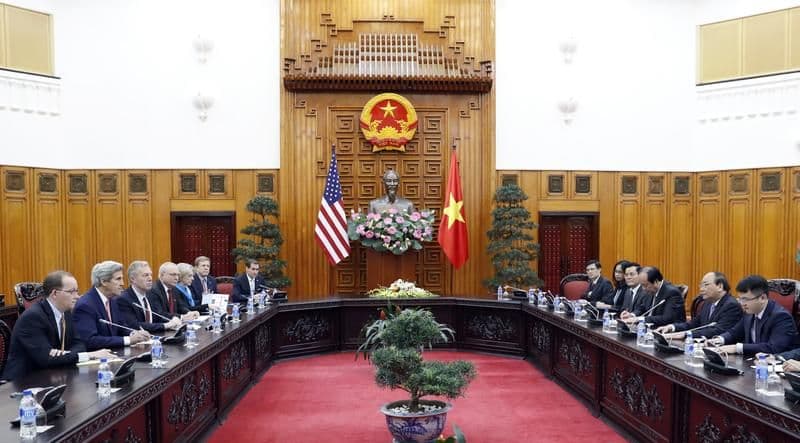
Time for a Closer U.S.-Vietnam Relationship
Last updated 05:52 PM EDT • Read time: 5m
The United States has a curious history of forging particularly close relationships with countries with which it was once at war – just ask Germany, Japan, and the United States’ colonial parent the United Kingdom. Recent trends suggest that it is time for the United States to add Vietnam to that list. Officially Communist, Vietnam might seem like an odd partner for the United States. However, U.S. security interests in Southeast Asia, the clear preference of Vietnamese officials for closer ties, and the opportunity to improve governance and human rights protections in Vietnam should make a U.S. push for closer relations, an uncontroversial priority.
The top question to ask of any new international relationship is what interest it serves that would not be met otherwise. U.S. economic and security interests in Southeast Asia are immense, with over 60 percent of U.S. exports flowing throughout the broader Asia-Pacific region. Vietnam is strategically located next to the Southeast Asian trade choke points and the South China Sea. Given China’s role as both a top trade partner and frequent geopolitical rival of the United States, its reliance on shipments of oil and other goods through the South China Sea only magnifies the area’s importance.
Historically, the United States has relied on the Philippines and Thailand as key Southeast Asian partners, but the reliability of these partnerships has been called into question. Philippine President Rodrigo Duterte has made recurring statements for downgrading U.S. ties. Additionally, given the potential instability of Thailand’s military Junta, especially without the steady hand of the now deceased long-time ally King Bhumibol Adulyadej, the future of the country’s relationship is unclear. The unstable and uncertain nature of these historical alliances should motivate the United States to diversify its partnerships in that region. Vietnam is well positioned to step into the gap as a strong and stable regional trade and security partner.
Vietnamese leaders have already demonstrated a concrete interest in closer economic and security ties with the United States. In 2015, the Vietnamese Communist Party General Secretary, Nguyen Phu Trong, visited the United States as part of an unprecedented high-level meeting aimed at strengthening relations. This was in part an attempt by Vietnamese leaders to reduce their country's dependence on (and resulting vulnerability to) their powerful Chinese neighbors. In addition to Vietnam's disproportionate economic dependence on China, the two countries remain locked in a tense territorial dispute in the South China Sea. Perhaps reflecting these concerns, polls show that the Vietnamese public’s opinion of the United States is much more favorable than its opinion of China. The combination of clear strategic incentives for Vietnam, support for closer ties with Vietnamese leaders, and a positive view of the United States among the Vietnamese public should make the opportunity to tighten the relationship a clear case of low-hanging fruit for U.S. policymakers and diplomats.
Vietnam’s poor human rights record remains the main sticking point for US policymakers. However, past U.S. policy toward the Vietnamese government has failed to produce any serious improvement in the country’s human rights situation in the decades since the Vietnam War. In fact, the primary leverage that the United States has over Vietnamese policy is precisely through the potential economic and security benefits that a closer bilateral relationship would offer. The United States, therefore, has a chance to incentivize improved human rights practices in Vietnam through carrots instead of sticks.
There are several ways in which U.S. policymakers can capitalize on this opportunity. Although the Vietnamese government seems to have reduced its focus on the Trans-Pacific Partnership (TPP) since it became clear that the United States would not participate, it remains committed to boosting international trade as an economic priority. U.S. and Vietnamese officials could revisit some of their respective proposals and goals from the recent TPP negotiations as a starting point for a new bilateral trade agreement. Additionally, the Obama Administration ended a long-standing U.S. arms embargo on Vietnam in 2016, which opened the door for defense procurement deals and other forms of military cooperation. The United States could work to secure Vietnamese participation in multilateral exercises, such as the Rim of the Pacific drills. Offering incentives on both the economic and military fronts in exchange for U.S. expert assistance on issues like the rule of law, human rights, and transparency in daily governance, for example, could prove more effective than top-down mandates on human rights issues directed at senior leaders in Hanoi.
So far, the Trump administration has provided little detail on how it will approach issues in Southeast Asia, beyond taking a tough line on China’s expansive territorial claims in the South China Sea. The administration should recognize the opportunity that strengthened bilateral ties with Vietnam would provide to secure US interests and positions in this critical region.
Robert C. Thomas is an Asia-Pacific Fellow at Young Professionals in Foreign Policy (YPFP). He is also a government security contractor and the Managing Editor of Parabellum Report. Robert expects to receive his MA in Ethics and Public Affairs from George Mason University in 2017.
The First Test of Peace Lies in Ukraine's Borderlands
By Dennis T. Cosgrove • RealClearDefense
The VFW’s Gambling Addiction Victimizes Veterans
By Jack Yoest • RealClearDefense
Superintelligence Exposes a Gap in the Law of Delegated Authority
By Sue Ghosh Stricklett • RealClearDefense
When the Network Goes Dark, Who Controls the Battlefield?
By Jonathan K. Corrado • RealClearDefense
We Cannot Build Tomorrow's Weapons With Yesterday's Alloys
By Joseph F. Krause • RealClearDefense
When the Network Goes Dark, Who Controls the Battlefield?
By Jonathan K. Corrado • RealClearDefense
Air Force Should Buy 250 Blended-Wing Tankers, as 2027 Demo Looms
By A&SF Mag.
Long Deployments to Be Navy Standard For Next Couple Years
By Mongilio, USNI NewsWhen the Network Goes Dark, Who Controls the Battlefield?
By Jonathan Corrado, RCD
Marines Deploy Neros Archer Drone in Live Fire Exercise for First Time
By USNI News