
The Illusion of BMD Testing in Ships
Last updated 09:05 AM EDT • Read time: 8m
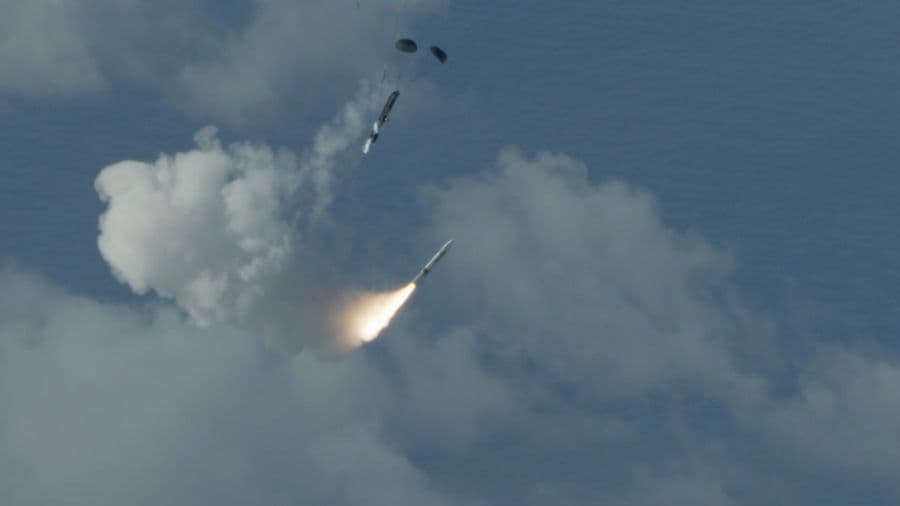
"In a unique demonstration of advanced missile defense capabilities, the U.S. Navy executed a groundbreaking test in which a two-stage ballistic missile was dropped from a C-17 Globemaster III transport aircraft using parachutes before being launched directly into the air. This innovative approach, part of Flight Test Other-40 (FTX-40), codenamed Stellar Banshee, was designed to evaluate the Aegis Combat System aboard the Arleigh Burke-class destroyer USS Pinckney (DDG 91) against a live medium-range ballistic missile (MRBM) threat simulating hypersonic characteristics… The test scenario offered an unprecedented degree of realism. The missile, after being stabilized mid-air by parachutes, ignited vertically to replicate the flight profile of an operational MRBM. The USS Pinckney Arleigh Burke-class destroyer successfully tracked the threat using its onboard Aegis system and executed a simulated engagement using a virtualized SM-6 Block IAU interceptor. Although no physical interceptor was launched, the test validated the ship's ability to detect, process, and prepare for high-speed missile threats under realistic conditions." (Naval News Navy - Global Defense News).
I was not there for "Stellar Banshee," but I was the Commanding Officer of USS Shiloh (CG 67) for "Stellar Predator." Stellar Predator, or FTM-10, was the first test of the Aegis BMD 3.6 Combat System; the capability that allowed the ship to employ the Standard Missile-3 Block IA anti-ballistic missile. As for the target at Stellar Predator, it was a live ballistic missile.
FTM-10, like FTX 40, was an unqualified success, paving the way for delivery of Shiloh to Forward Deployed Naval Forces, Japan. There she would serve as the Navy's big Ballistic Missile Defense (BMD) gun in the 7th Fleet for the next decade.
Here's the problem: These much-vaunted tests are misleading, at best, and illusory at worst. They create the impression that these systems are fully ready for crew use in real-world situations, and to this date, we simply do not know that to be true.
It is important to understand that each of these tests costs tens of millions of dollars to execute and takes years to plan and carry out. Failing one of these tests is an utter catastrophe for the agencies involved, and so, every effort is undertaken to ensure that the test doesn't fail, even to the point that it all becomes anything but realistic. Success is paramount, not just because the Navy wants to prove the system, but because deployments of the capability are at stake. Had Shiloh failed FTM-10, she would not have been able to relieve USS Chancellorsville (CG 62) in Japan, creating an extraordinary chain of crisis that would have gone far beyond a simple missile shot test failure. Everyone knew this, and so, no effort was considered a bridge too far when it came to guaranteeing that it would be a smashing success.
Just before the shoot, Shiloh completed a yard availability in which the new, SM-3 capable, BMD computer programs had been installed and tested. One might presume that this installation and testing were sufficient for the task. One might presume that process alone would be sufficient to render the ship BMD-capable. After all, follow-on ships getting these new capabilities were, and are, thought to be fully capable right out of the box. However, that belief was, and is, largely based upon Stellar-series testing, which is little more than a system test conducted under the most artificial, and controlled circumstances: Circumstances that have virtually nothing to do with operating the system under real-world conditions.
How artificial is an FTM/X? For quite literally months before the shoot, actual, Ph. Ph.D.-level rocket scientists worked up Shiloh's systems to ensure that they were as near to perfection as could be had. This "buffing" ranged far beyond the Combat Systems of the ship. For example, when it was discovered that the ship's Air Conditioning and Refrigeration (AC&R) plant was operating at a level that might sub-optimal to properly cool the SM-3 seeker, before launch, the entire plant was rebuilt, at great and unplanned cost. However, follow-on ships getting these BMD capabilities have no such specialized care and feeding before assignment to the Fleet.
Further, you may think that these tests have something to do with training the crew to properly employ the new system. They don't. That training doesn't exist, other than as part of the initial installation. In FTM/X events, it is not the ship's company sitting at the consoles, rather it is test-engineers. Sailors are allowed to sit next to these engineers, but they play no role in the event. You see, we simply cannot have a Sailor making a mistake in these tests. It's too big for that. Then, in the periodic recertification process for a BMD-capable ship, it is, again, assumed that the ship can do it. There is no specialized certification for BMD capability in ships once they're in the Fleet.
Moreover, the test environment is stringently controlled to ensure that no exogenous issue might interfere with success. These tests occur north of Hawaii where there is little to no air traffic or shipping. Data Links, which ships depend upon to fully grasp the world around them, are typically messy. Sailors work hard to clarify the data coming into and out of ships, but the picture, particularly in a real-world environment, is always a thorny problem. Consider the USS Gettysburg (CG 64) shootdown of the friendly F/A-18F in December 2024. A problematic data link picture contributed fundamentally to that disaster.
Messy data links (just like live Sailors and working with the systems as provided) are the nature of the real world. In the case of an FTM/X the only units allowed into the data link are the ship, and the shore station controlling the ballistic missile target. And this is in the largely empty air space at the Pacific Missile Range Facility (PMRF). It is all supremely unrealistic.
As for the target – and Shiloh, unlike Pinckney, had an actual target - it bore only the most passing resemblance to a real ballistic missile threat. It was, in Navy air defense test shot parlance, a "grape." Without going into detail, a real ballistic missile threat is a spectacularly difficult target, and for many reasons. The targets employed in these missions, however, are designed to be as unchallenging as a ballistic missile target can be made. Success, not realism, is paramount.
The bulwark of our Navy's air defense is the Aegis Weapons System (AWS). This system was designed and extensively tested against "air-breathing" or "endo-atmospheric" threats, like aircraft and cruise missiles. Real Sailors, in real ships, have engaged hundreds of high-end threats, proving and re-proving the system under grueling conditions. However, AWS was not initially designed to engage ballistic missiles which are "exoatmospheric." That sort of threat is a completely different animal. So, while the AWS is now modified to engage ballistic missiles, the totality of testing this capability is limited to the Stellar series – which, again, takes place in the most artificial laboratory vacuum.
Here is why this is a real-world problem. The AWS is designed to "gracefully degrade." In other words, you can ride it hard, put it away wet, in combat situations, or on long deployments, and it will still kill air breathers like nobody's business. However, think of the BMD capability as sitting on top of AWS. It interfaces with AWS. Problematically, unless AWS is tuned to the highest attainable levels – levels only existent in an artificial lab environment – it is completely unclear that graceful degradation will cut the mustard for the BMD job. Evidently, BMD capability can't hack less than the maximum AWS. So, while the ship will still tear apart a drone, cruise missile, or tactical aircraft, once deployed, and "degrading" it may rapidly fall below the level required for an FTM/X. Can it do it, anyway? Perhaps. We simply don’t know. But what we do know is that to do it reliably, will it require a level of maintenance, testing, and crew training absolutely not available in the Fleet.
Read this again: "USS Pinckney (DDG 91) … executed a simulated engagement using a virtualized SM-6 Block IAU interceptor. Although no physical interceptor was launched, the test validated the ship's ability to detect, process, and prepare for high-speed missile threats under realistic conditions."
We need to understand that these tests are little more than a theatrical demonstration of potential. They are not a certification that these ships can do the job in the real world. Once deployed with this capability, there is no further proof of this BMD capability. None. We just assume that it all works, based on a few highly controlled lab experiments at sea.
Shiloh has been at sea with BMD capability for 15 years. She was deployed in Japan for ten years, standing the BMD watch. She's in Hawaii now. I am certain that if you take her out, with no additional maintenance or training, she could successfully engage the hardest air-breathing target on the missile range. But…take her out to the next BMD shot, even in the lab conditions at PMRF, and let her shoot as she is?
I'm certain that you wouldn't like the result.
Captain Eyer served as a Surface Warfare Officer for twenty-seven Years. He served in seven cruisers and commanded three Aegis cruisers: USS Thomas S. Gates (CG 51), USS Shiloh (CG 67), and USS Chancellorsville (CG 62).