
National Security Starts With Battery Security
Last updated 06:54 AM EDT • Read time: 5m
Batteries now sit at the center of the systems that define national power.
They support military readiness, data infrastructure, grid stability, and industrial competitiveness. Washington has started to respond, but the pace of policy and investment still lags the scale of the shift.
Recent federal action points in the right direction. The Department of Energy has committed up to $500 million to expand domestic battery materials processing and manufacturing, linking that investment directly to defense and energy security. At the same time, Congress is moving to limit the Department of Defense’s reliance on foreign battery suppliers through the FY2026 National Defense Authorization Act.
The message is becoming clearer. Batteries are moving into the category of strategic infrastructure.
Without a secure domestic supply chain, the United States cannot fully control the systems that rely on stored energy. That includes defense platforms, the electric grid, and the computing infrastructure behind AI.
A foundational shift in how power is delivered
Modern defense systems are more distributed, more autonomous, and more electrified than at any point in history. That evolution has made batteries mission critical.
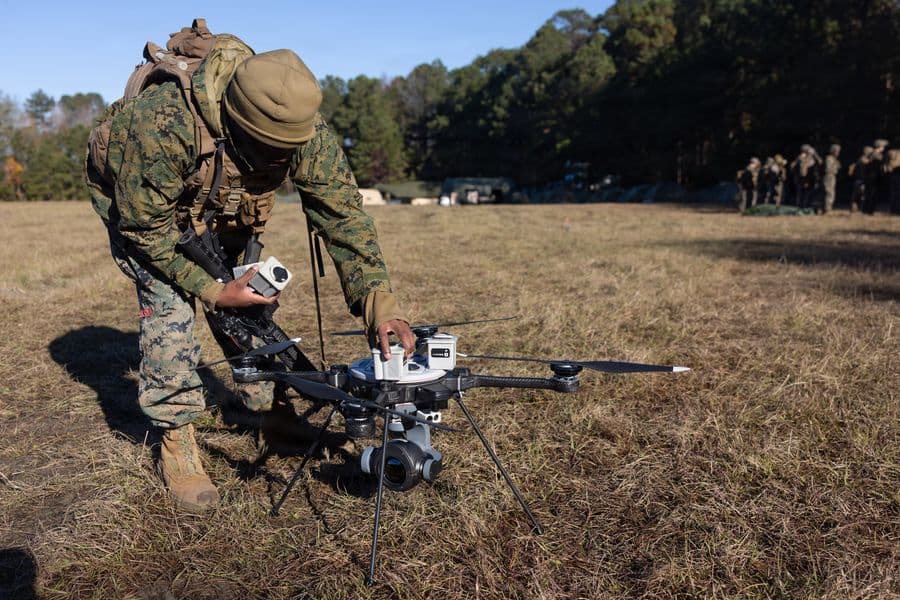
They power drones, communications systems, sensors, and electronic warfare platforms. They support satellites and enable operations in environments where traditional fuel logistics are constrained. The same dependence is emerging in civilian systems that carry national importance. Data centers require continuous uptime. The grid increasingly relies on storage to manage volatility and peak demand.
Battery demand is expanding well beyond electric vehicles. Growth in AI infrastructure and grid storage is reshaping the market and raising the stakes for supply security, with battery demand increasingly driven by data centers and energy storage, not just EVs.
Capacity now maps directly to capability.
A supply chain the U.S. does not control
The United States pioneered lithium-ion battery technology, but it did not industrialize or scale it.
That happened elsewhere. Japan moved early to commercialize the technology, while South Korea and China built the manufacturing base that now defines the global supply chain.
The result is structural dependence. The United States relies heavily on foreign cell makers across automotive, consumer, and industrial applications.
In commercial markets, that reliance has been manageable. In national security contexts, it carries more risk.
Modern defense systems, along with data and medical infrastructure, depend on batteries that must be secure, reliable, and trusted. Today, U.S. defense and AI systems remain heavily dependent on Chinese battery supply chains, and America’s defense infrastructure continues to rely on foreign-made batteries.
This is ultimately a question of control. Strengthening domestic capacity will require not just continued innovation, but the ability to industrialize and scale battery production at home.
Policy is catching up, but slowly
Over the past year, policymakers have started to treat batteries as part of the national security framework.
The FY2026 NDAA restricts defense procurement from foreign entities of concern. Federal funding is increasingly directed toward domestic processing, recycling, and manufacturing. There is also renewed focus on critical minerals and supply chain resilience.
These are meaningful steps. They signal alignment between energy policy, industrial policy, and defense priorities.
Execution will determine whether that alignment translates into real capacity. Building a domestic supply chain takes time, coordination, and sustained investment.
Capital is available. Confidence is the constraint
The U.S. energy storage sector has outlined plans for up to $100 billion in battery manufacturing and deployment across the United States and allied markets. That level of investment could support hundreds of thousands of jobs and establish a fully domestic supply base for grid storage within the next decade.
What remains uncertain is whether policy will stay consistent enough to support it.
Large-scale manufacturing investments depend on long timelines and stable signals. Companies need confidence that incentives will persist, that permitting will move at a reasonable pace, and that demand will be there once facilities come online.
Performance will shape the next phase
As defense systems become more autonomous and more distributed, the requirements placed on batteries become more demanding. Range, weight, and reliability all affect operational capability. Small improvements can translate into meaningful advantages in the field.
Advances in battery design are beginning to address those needs. Solid-state systems, for example, offer the potential for higher energy density and improved safety. That matters for applications where endurance and reliability are tightly linked.
The next phase of competition will hinge on both scale and technical capability.
What policy should prioritize next
Batteries should be treated as core infrastructure, with procurement strategies that reinforce domestic production. Investment in critical materials needs to connect directly to manufacturing capacity. Permitting and deployment timelines should be streamlined to reduce friction.
Just as important, policy needs to remain predictable. Long-term clarity is what allows private capital to move at scale.
Support for next-generation technologies should continue alongside efforts to expand manufacturing. Innovation and production need to advance together.
A narrowing window
The next phase is more difficult. It requires building capacity, aligning stakeholders, and sustaining momentum over time.
Decisions made now will shape how the U.S. powers its economy and supports its defense systems in the years ahead.
Siyu Huang, Ph.D. is the co-founder and CEO of Factorial Energy, a solid-state battery leader advancing U.S.-driven technology on a global stage.

In Pursuit of Nuclear Abolition
By Peter Huessy • RealClearDefense
Innovation Alone Won’t Prepare the U.S. for the Future Battlefield
By Joshua Segal • RealClearDefense
The sUAS Tactical Trifecta
By Bryan T. Woody • RealClearDefense
The Revolutionary War: When Strategic Options Share the Same Weakness
By Henry Yep • RealClearDefense
The Houthis Are Testing the Limits of Collective Defense
By Saima Afzal • RealClearDefense

Who Shoots Down the Drone Over the Shipyard?
By John Ferrari & Dillon Prochnicki • RealClearDefense
Northrop Grumman Breaks Out the Big Guns at AUSA
By Daniel Terrill, Defense News
Army Pursuing Diverse Array of New Anti-Air Interceptors
By Trevithick, The WarZoneWho Shoots Down the Drone Over the Shipyard?
By John Ferrari & Dillon Prochnicki, RCD
F-35C Lands for the First Time on a Ford-Class Aircraft Carrier
By The Aviationist