
Critical Minerals
Mining Is Not a Supply Chain
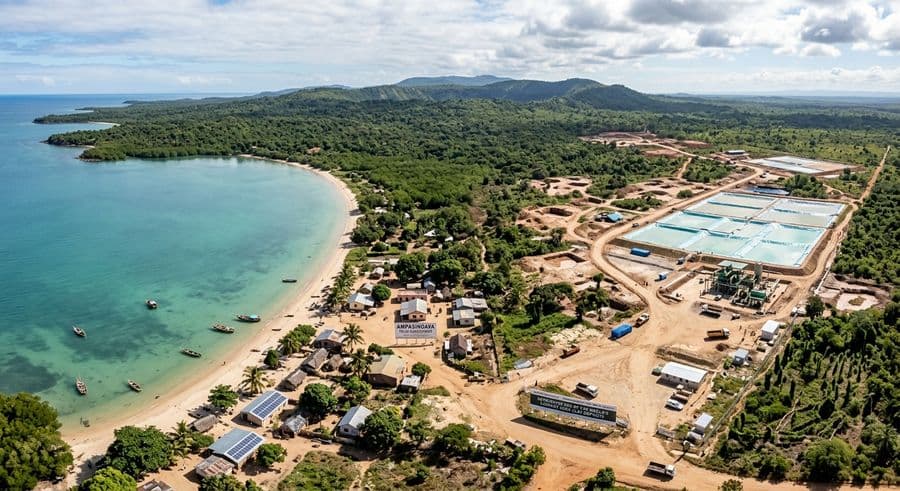
On July 22, 2026, the Australian mining company Harena announced it had signed a Project Development Funding Agreement with the U.S. International Development Finance Corporation (DFC) for up to $4.84 million. The money will fund permitting, environmental and social studies, laboratory work, and pilot-plant development at Ampasindava, a rare-earth deposit on the northwest coast of Madagascar. On paper, American capital backing a non-Chinese source of the minerals needed for everything from fighter jets to wind turbines is a great success, but zooming on the deal exposes critical oversights in Washington’s strategy.
The United States is increasingly backing African critical-mineral projects to reduce its dependence on China. But Ampasindava shows why securing access to ore is not the same as securing access to usable rare-earth materials. Washington is addressing the former much faster than the latter.
Mining Is Not a Supply Chain
The Weak Link in America's Rare-Earth Strategy in Africa
2d agoRead it on RealClearDefenseChina's Sneak Attack on the Battery American Taxpayers Paid For
Technology that is developed with U.S. taxpayer money should be manufactured in America, not China.
1w agoRead it on The National Interest
America's Freedom to Slow AI Is Priced in Magnets
For a week in May 2025, Ford stopped building Explorers in Chicago because it could not get rare-earth magnets. China had restricted their export the month before. Two months later, Washington moved to resume sales to China of Nvidia's H20 AI chip, which it had restricted in April. Commerce Secretary Howard Lutnick tied the reversal to the rare-earth negotiations: "We put that in the trade deal with the magnets." An AI-chip restriction and a car part had been exchanged for each other. That trade, not the state of the technology, is the real test for anyone who wants America to slow the development of its most advanced AI systems.
In September, Anthropic Chief Executive Dario Amodei argued for pacing advances in frontier AI so that safety work has time to catch up. An extra year or two, he suggested, could help. Progress would not stop; its leading edge would be held back. But the proposal is feasible only if America keeps its lead over China, and America keeps its lead partly through restrictions on advanced chips, chipmaking equipment, and access to computing power.
Partnering With the Taliban
A Mutual Benefit Agreement
2w agoRead it on RealClearDefenseAmerica's Freedom to Slow AI Is Priced in Magnets
Having a lead and keeping the policies that protect it are different problems, and they run on different clocks
2w agoRead it on RealClearDefense
Memory Chip Shortage Requires Investment and Teamwork
Artificial intelligence (AI) data centers are popping up across the country. The AI infrastructure buildout is critical to our economy, our technological leadership, and our national security, and the Trump administration is right to encourage historic investments in America’s future. But as we build, Washington and industry need to address a fast-emerging constraint that could slow that progress and raise costs for American families: a shortage of memory chips.
Graphics processing units (GPUs) and central processing units (CPUs) from Nvidia and other chipmakers are the central brains of an AI system. But they need to be surrounded with large volumes of memory chips to do their work. Memory chips are also used in virtually every piece of electronics, including laptops, smartphones, home routers, and of course the large servers that go into AI data centers. The shortage of memory chips has emerged as the largest bottleneck for the AI buildout.
How the United States Can Stop China's Rare-Earths Squeeze
When China threatens to close its fist, the world listens
09/15/26Read it on CIMSEC
America Can't Import Its Way out of the Critical Minerals Crisis
The U.S. defense industrial base today faces a critical minerals challenge—one with serious national security implications.
On August 4, media reports indicated that a major U.S. defense contractor is, for the first time, planning to source germanium and scandium—critical minerals used to build high-end defense items—from American firms. Here’s the problem: the prospective supplier does not have an operational mine—and will not until at least 2028. To highlight the scope of this challenge, consider the fact that the United States has not mined scandium since the 1960s.

In Pursuit of Nuclear Abolition
By Peter Huessy • RealClearDefense
Innovation Alone Won’t Prepare the U.S. for the Future Battlefield
By Joshua Segal • RealClearDefense
The sUAS Tactical Trifecta
By Bryan T. Woody • RealClearDefense
The Revolutionary War: When Strategic Options Share the Same Weakness
By Henry Yep • RealClearDefense
The Houthis Are Testing the Limits of Collective Defense
By Saima Afzal • RealClearDefense

Who Shoots Down the Drone Over the Shipyard?
By John Ferrari & Dillon Prochnicki • RealClearDefense
Northrop Grumman Breaks Out the Big Guns at AUSA
By Daniel Terrill, Defense News
Army Pursuing Diverse Array of New Anti-Air Interceptors
By Trevithick, The WarZoneWho Shoots Down the Drone Over the Shipyard?
By John Ferrari & Dillon Prochnicki, RCD
F-35C Lands for the First Time on a Ford-Class Aircraft Carrier
By The Aviationist