
Quantum Leap for Modern Military Forces
Last updated 05:53 AM EDT • Read time: 16m
Introduction
Quantum technologies are moving from fundamental science into applied domains, creating conditions in which defense structures encounter a new class of threats. These threats are rooted in physical principles that cannot be bypassed with conventional protection methods. Quantum computing, quantum sensing, and quantum communication are shaping an operational environment where classical approaches to intelligence, stealth, and protection lose their effectiveness.
The practical significance of quantum processes became evident after 1994, when American mathematician Peter Shor, then a theoretical researcher at AT&T Bell Laboratories, published “Algorithms for Quantum Computation: Discrete Logarithms and Factoring.” In that work, he demonstrated that quantum computation can solve factoring and discrete logarithm problems far faster than classical methods. This result was the first to link quantum mechanics with applied cryptography and revealed a potential vulnerability in defense communications.
In the following years, prototypes of quantum sensors and early demonstrations of quantum communication confirmed the transition of quantum technologies into practical application. Today, these developments influence the resilience of cryptography, the stealth of undersea and airborne platforms, the security of communications, and the precision of navigation. This requires defense organizations to understand the risks, countermeasures, and strategic implications associated with the adoption of quantum technologies.
This material provides an integrated view of emerging quantum threats, practical directions for counter‑quantum measures, and the strategic architecture of quantum defense, expanding the analysis through new aspects of quantum processes that affect modern defense systems.
Quantum Risks for Defense
Quantum technologies are moving from experimental research into applied use. This means that defense structures are confronted with a new class of threats that differ fundamentally from familiar digital or electronic risks. Quantum systems operate on physical principles that cannot be bypassed with conventional protection methods. For this reason, defense specialists must understand what threats are emerging, how they manifest, and what strategic consequences they carry.
Below are the primary risk directions, supported by factual research, operational prototypes, and documented results.
Quantum Computing and the Cryptographic Vulnerability of Defense Systems
Modern defense cryptography relies on mathematical problems that are difficult for classical computers to solve — specifically, large‑number factorization and discrete logarithms. Peter Shor’s algorithm enables these operations to be performed far faster on a quantum computer. This is not a theoretical hypothesis; the algorithm is mathematically proven and has been implemented in limited form on existing quantum devices.
For defense, this means:
- RSA, ECC, and DH cryptosystems lose resilience once an adversary possesses a sufficiently powerful quantum computer;
- secure communication channels become accessible for decryption;
- intercepted data archives may be decrypted in the future if an adversary follows a “harvest now, decrypt later” strategy;
- satellite command channels using classical cryptographic schemes become vulnerable.
These risks are already acknowledged at the governmental level. U.S. and U.K. agencies have formally begun transitioning to post‑quantum cryptographic standards, indicating that the threat is considered real and strategically significant.
Quantum Sensors and the Collapse of Stealth Concepts
Quantum sensors use atomic and quantum‑state properties to measure gravitational and magnetic fields with extreme precision. In recent years, operational prototypes of gravimeters and magnetometers have emerged from university laboratories and research centers.
Factual examples:
- atomic gravimeters developed at Imperial College London and Stanford can detect gravitational‑field variations caused by large objects underwater or underground;
- NV‑center diamond magnetometers created at MIT and Harvard can detect weak magnetic signatures characteristic of low‑noise platforms;
- DARPA and IARPA research programs are exploring quantum‑sensor applications for detecting submarines at significant depths;
- Canadian research groups are developing quantum radar principles capable of detecting low‑reflectivity objects.
These developments fundamentally alter the concept of stealth. Submarines, stealth aircraft, and underground facilities may become detectable even without active emissions from an adversary.
Quantum Communication and Strategic Asymmetry in Command‑and‑Control
Quantum communication relies on transmitting quantum states that cannot be intercepted without disturbing their structure. This is not theoretical — in 2016, China conducted a successful experiment with the “Micius” satellite, transmitting quantum keys between space and a ground station. Europe is developing the EuroQCI project to establish a quantum communication network.
Documented results show:
- quantum channels enable key distribution without the possibility of covert interception;
- any attempt at interference is detected automatically because it disturbs the quantum state;
- such channels allow secure troop movement and autonomous‑system control without risk of compromise;
- a state possessing quantum communication gains strategic advantages in operational planning.
This technology creates asymmetry between nations that possess quantum infrastructure and those that do not.
Quantum Cryptography and the Disappearance of Classical SIGINT
Quantum cryptography uses physical properties of quantum particles to generate keys. If a key is transmitted through a quantum channel, it cannot be intercepted covertly. This is confirmed by experiments and practical deployments.
Documented facts:
- quantum key distribution (QKD) makes covert interception physically impossible;
- any interference alters the quantum state and is detected automatically;
- classical “man‑in‑the‑middle” attacks become infeasible;
- packet substitution is impossible without destroying the channel.
Countries implementing quantum cryptography become nearly inaccessible to classical radio‑electronic interception, creating a new strategic reality for intelligence operations.
Artificial Intelligence as an Amplifier of Quantum Threats
AI is already used to optimize quantum circuits and analyze quantum‑sensor data. This is confirmed by publications from research laboratories at Google, IBM, MIT, and other organizations.
Practical directions of application:
- optimization of quantum algorithms to accelerate computation;
- analysis of quantum‑sensor signatures to improve object‑detection accuracy;
- management of quantum communication networks;
- automation of cryptanalysis for classical systems;
- modeling quantum processes to forecast the behavior of complex objects.
The combined use of AI and quantum technologies creates a new level of threat that directly affects the strategic architecture of defense.
New Directions in Countering Quantum Threats
Quantum technologies create not only new risks but also new opportunities for defense. In recent years, a distinct field has begun to form — counter‑quantum measures. This is not electronic warfare and not cyber defense. It is a set of approaches based on physical principles that influence quantum states, quantum sensors, and quantum communication channels.
Below are the directions that have factual grounding in experimental work, prototypes, and research programs.
Counter‑Quantum Operations (CQO): Disrupting Adversary Quantum Processes
Counter‑quantum operations aim to disrupt or destabilize an adversary’s quantum processes. Quantum states are highly sensitive to external influences, and loss of coherence renders a system non‑functional.
Key CQO methods:
- suppression of quantum states through controlled noise;
- disruption of entanglement via decoherence injections;
- creation of “quantum traps” — zones where qubits lose coherence;
- use of magnetic and gravitational anomalies to destabilize quantum channels.
These approaches form the foundation of CQO and create conditions in which an adversary’s quantum devices lose effectiveness.
Quantum Communication Disruption (QCD): Measures Targeting Adversary Quantum Channels
Quantum communication cannot be covertly intercepted, but it can be disrupted. Research shows that quantum channels are sensitive to external influences that induce transmission errors.
Key QCD methods:
- creation of high‑decoherence zones;
- directed electromagnetic impulses that induce phase shifts;
- quantum jammers (Q‑jammers);
- attacks on quantum‑repeater infrastructure.
These approaches form the QCD domain — methods for disrupting an adversary’s quantum communication.
Quantum Navigation Spoofing (Q‑spoofing): Measures Affecting Quantum‑Based Inertial Navigation
Quantum navigation systems (Q‑INS) rely on ultra‑precise sensors and do not depend on satellite navigation. However, they are sensitive to external influences that can generate false data.
Key Q‑spoofing methods:
- creation of false gravitational gradients;
- magnetic traps;
- structured vibrational fields that interfere with atomic interferometers;
- use of materials with anomalous quantum properties.
These approaches form the basis of Q‑spoofing — targeted distortion of an adversary’s quantum navigation.
Q‑Forensics: Detecting Quantum Systems
Quantum devices leave weak but detectable traces in their surrounding environment. This creates the possibility of forming quantum forensics.
Key Q‑forensics methods:
- analysis of secondary electromagnetic signatures;
- detection of anomalous gravitational micro‑oscillations;
- identification of zones with unnaturally low noise levels;
- monitoring phase shifts in the environment;
- use of AI to classify quantum traces.
These approaches form the Q‑forensics domain — methods for detecting an adversary’s quantum devices.
Q‑Signature Analysis: Identifying Quantum‑System Signatures
Artificial intelligence is becoming a key instrument for working with quantum data. It is used to analyze signatures, model processes, and manage complex systems.
Factual basis for AI‑QCI:
- research from Google, IBM, and MIT shows that AI optimizes quantum algorithms;
- AI accelerates quantum simulations, enabling modeling of quantum‑device behavior;
- AI predicts quantum‑channel resilience and potential error conditions;
- AI analyzes quantum‑sensor data, identifying weak signatures.
Key AI‑QCI capabilities:
- detection of quantum anomalies;
- signature classification;
- forecasting zones of quantum activity;
- modeling quantum‑sensor behavior;
- management of counter‑quantum operations.
These approaches form the AI‑QCI domain — the use of AI in counter‑quantum activity.
Strategic Quantum Opacity (SQO): Non‑Transparency in Quantum‑Enabled Environments
Quantum technologies create strategic opacity — a condition in which classical intelligence methods lose effectiveness.
Key elements of SQO:
- Quantum communication infrastructure places a state outside the reach of classical SIGINT collection;
- Quantum‑enhanced sensing capabilities improve detection of low‑observable and concealed platforms;
- Quantum‑grade cryptography hardens national command‑and‑control against interception.
SQO establishes a new strategic defense architecture in which quantum technologies serve as a core component.
All listed counter‑quantum directions represent pathways for the practical development of quantum technologies. Their implementation will depend on the level of quantum‑system maturity available at each stage of deployment. As technological progress continues, these approaches may evolve from experimental concepts into applied methods, shaping the evolution of counter‑quantum capabilities.
The Strategic Architecture of Quantum Defense
Quantum technologies are shaping a new strategic environment in which classical methods of intelligence, stealth, and protection are no longer sufficient. States that possess quantum infrastructure gain advantages that are difficult to offset with traditional means. This requires revising defense doctrines, updating infrastructure, and forming new directions in force and staff training.
Below are the key elements of the strategic architecture of quantum defense, grounded in factual research, operational prototypes, and documented quantum‑technology development programs.
A New Strategic Reality
The emergence of quantum communication, quantum sensors, and quantum cryptography creates conditions in which classical intelligence methods lose effectiveness. Quantum communication channels cannot be intercepted covertly. Quantum sensors can detect objects previously considered concealed. Quantum cryptography renders classical attacks on communications ineffective.
This reality is already confirmed by practical results. The “Micius” satellite experiment demonstrated the ability to transmit quantum keys between space and Earth. European programs for building quantum networks show a clear intent to establish protected infrastructure. Research on quantum sensors indicates that submarines and low‑noise platforms can be detected without active emissions.
These facts create strategic opacity. A state possessing quantum technologies becomes less observable and more capable of covert command‑and‑control.
Doctrinal Changes
Quantum technologies require revising defense doctrines. Classical approaches to intelligence, stealth, and protection must be supplemented with new directions based on physical principles.
Defense structures must account for the fact that quantum sensors can detect objects previously considered inaccessible. This requires changes in approaches to camouflage, force movement, and infrastructure protection.
Quantum communication creates conditions in which an adversary can control autonomous systems without risk of interception. This requires revising electronic‑warfare methods and developing new ways to influence quantum channels.
Quantum cryptography makes classical communication attacks ineffective. This requires forming new intelligence directions focused on analyzing secondary signatures and weak indicators of quantum‑device activity.
These changes form the foundation of a new defense doctrine in which quantum technologies become a central element.
New Infrastructure Requirements
Quantum technologies require updating communication, navigation, and surveillance infrastructure. Classical systems must be supplemented with capabilities that account for quantum‑process characteristics.
Communication systems must incorporate post‑quantum cryptography resilient to quantum computation. This direction is already advancing through NIST programs and government initiatives in the U.S. and U.K.
Navigation systems must account for potential interference with quantum sensors. This requires developing protection methods against false gravitational gradients, magnetic traps, and vibrational disturbances.
Surveillance systems must include means for detecting quantum devices. This direction is forming based on research into secondary electromagnetic signatures, gravitational micro‑oscillations, and low‑noise zones.
These requirements form the foundation for building infrastructure resilient to quantum threats.
Quantum Superiority as a Factor of Power
States that adopt quantum technologies first gain strategic advantage. This advantage is based on the practical capabilities of quantum communication, quantum sensors, and quantum cryptography.
Quantum communication enables concealed troop movement and autonomous‑system control without interception risk. Quantum sensors enable detection of objects previously considered hidden. Quantum cryptography makes communications resilient to interference.
These capabilities form strategic superiority that is difficult to compensate with classical means. States that do not adopt quantum technologies find themselves in a less favorable position.
Quantum Defense as a New Discipline
Research shows that quantum technologies require the formation of a new discipline — quantum defense. This discipline includes counter‑quantum operations, methods for influencing quantum navigation, techniques for detecting quantum devices, and the use of artificial intelligence to analyze quantum data.
Counter‑quantum operations create conditions in which an adversary’s quantum devices lose effectiveness. Methods for influencing quantum navigation allow generating false signals that lead to navigation errors. Techniques for detecting quantum devices enable identification of quantum‑infrastructure activity. Artificial intelligence enables analysis of weak signatures and forecasting quantum‑system behavior.
These directions form the foundation of a new discipline that becomes a central element of defense architecture.
Strategic Implications for NATO and Other Structures
Quantum technologies create conditions in which classical intelligence and electronic‑warfare methods lose effectiveness. This requires revising strategic approaches and forming new development directions.
NATO structures already consider quantum technologies a key element of future defense. Programs for quantum communication, research on quantum sensors, and development of post‑quantum cryptography demonstrate a clear intent to build resilient infrastructure.
These facts confirm that quantum technologies are becoming a strategic factor that influences the balance of power and shapes a new defense architecture.
A New Approach to Building High‑Efficiency Quantum Systems
Quantum Architecture of Cyclo‑Ring Gates (QACRG)
Modern quantum engineering develops under a paradox: the more powerful quantum systems become, the more they depend on external error‑correction mechanisms. This dependence has turned into a dogma, yet it is not inevitable. The Quantum Architecture of Cyclo‑Ring Gates (QACRG) proposes a different principle — stability that emerges from within the computational process rather than being imposed externally. The proposed concept is introduced as a conceptual quantum architecture, emphasizing stability as an intrinsic structural property rather than an external mechanism.
QACRG is based on the idea that stability does not have to be an external layer but can instead be a structural property of the gate organization itself. The architecture is formed by three interconnected elements: Cyclo‑Ring, Chain‑Layer, and Overlap‑Matrix. Their interaction creates a system capable of operating stably, multidimensionally, and without excessive external stabilizers.
The Role of GATE in the QACRG Architecture
In QACRG, the key element is the GATE. The gate defines the structure, dynamics, and stability of the system. In classical quantum engineering, a gate is a one‑time linear operation. In QACRG, the gate receives a different status: it becomes a structural unit of stability, forming a sustained dynamic instead of a single computational step.
The architecture is based on three structural elements — G‑circle, G‑chain, and G‑overlap — each contributing to stability, scalability, and multidimensional expansion.
G‑circle: Cyclic Gate Structures for Intrinsic Stability
A G‑circle is a continuous, cyclic sequence of gates in which operations repeat in a structured loop. This approach leverages known physical principles: cyclic gate sequences reduce error accumulation, stabilize logical states, and partially recycle coherence.
Key properties of G‑circle:
- Intrinsic stability through repetition Recurrent gate sequences reduce the probability of decoherence by reinforcing the logical state at each cycle.
- Coherence recycling Cyclic operations can partially restore coherence, similar to dynamical decoupling techniques.
- Logical‑state reinforcement Each cycle strengthens the encoded logical state, increasing its resilience to noise.
- Scalability to higher‑dimensional carriers Cyclic structures naturally extend to qutrits (3‑level quantum states), ququads (4‑level quantum states), qudits (d‑level quantum states), and higher‑order quantum states.
G‑chain: Multi‑Layer Gate Chains for Error Suppression
A G‑chain is a sequence of multiple G‑circles connected into a stabilizing chain. This structure resembles multi‑layer stabilizers and tensor‑network architectures used in advanced quantum systems.
Advantages of G‑chain:
- Multi‑layer stability Each layer stabilizes the previous one, reducing the probability of logical‑state collapse.
- Error‑rate reduction The ratio of errors to total operations decreases as stabilizing layers accumulate.
- Redundancy encoding Repeated operations across layers create natural redundancy, improving fault tolerance.
- Compatibility with multidimensional quantum carriers G‑chains can operate across qubits, qutrits, ququads, qudits, and extended states, increasing the expressive power of the system.
- Structured coherence management Layered chains distribute coherence across multiple stabilizing segments, reducing vulnerability to localized noise.
G‑overlap: Overlapping Chains for System‑Level Resilience
The G‑overlap principle introduces partial intersection between multiple G‑chains. This creates a multilayer stabilizing configuration similar to interleaved circuits and overlapping tensor networks.
Benefits of G‑overlap:
- System‑wide stability Overlapping chains compensate for local errors, increasing global resilience.
- Resistance to external interference Multi‑layer overlap makes the system less sensitive to environmental noise and targeted disruption.
- Expanded cryptographic space Overlapping multidimensional states create an exponentially larger space of quantum configurations, enhancing cryptographic strength.
- Cross‑chain coherence reinforcement Intersections allow coherence to propagate across chains, reducing the probability of decoherence in any single segment.
Advantages of the QACRG concept
The combined use of G‑circle, G‑chain, and G‑overlap forms a new class of quantum architectures with properties not achievable in classical two‑dimensional systems.
Key advantages:
- Intrinsic stability without external error‑correction codes Stability emerges from the structure of computation itself.
- Reduced error‑correction overhead Fewer external stabilizers are required, improving efficiency.
- Scalability to multidimensional quantum carriers Qutrits, ququads, qudits, and higher‑order states expand the computational space.
- Enhanced fault tolerance through redundancy Repeated and overlapping operations create natural stabilizing redundancy.
- Improved resilience to environmental noise Multi‑layer structures distribute coherence and reduce vulnerability.
- Expanded cryptographic potential Multidimensional overlapping states create a larger space of secure configurations.
- Compatibility with modern quantum‑engineering approaches The architecture aligns with variational circuits, tensor‑network methods, and structured error‑suppression techniques.
Strategic Implications
The QACRG concept demonstrates how quantum architectures may evolve beyond classical error‑correction paradigms. By treating stability as a structural property of computation, the QACRG opens the path toward next‑generation quantum platforms that are:
- more stable,
- more scalable,
- more multidimensional,
- and more resilient to external interference.
This architecture complements existing methods and represents a promising direction for future quantum‑processor development.
Conclusion
Quantum technologies are reshaping the strategic environment faster than any previous technological cycle. Quantum computing threatens classical cryptography. Quantum sensors make stealth more difficult. Quantum communication eliminates interception. These developments require revising doctrines, updating infrastructure, and forming new approaches to operational resilience.
The emergence of counter‑quantum operations, methods for influencing quantum navigation, techniques for detecting quantum devices, and the use of artificial intelligence to analyze quantum data is forming a new discipline — quantum defense. It is becoming a key element of strategic architecture, determining the resilience of forces, infrastructure, and communications.
Alongside these developments, new architectural concepts are beginning to appear, including the author’s conceptual QACRG — a gate‑structured approach to intrinsic quantum stability. Such architectures illustrate how quantum technologies may evolve beyond classical error‑correction paradigms and become foundational elements of next‑generation quantum platforms.
States that adopt quantum technologies first gain strategic advantage. In the coming years, quantum developments — including new computational architectures — will become one of the primary factors influencing the balance of power and the formation of defense strategies.
Sergey E. Ivashchenko is a strategic analyst working at the intersection of escalation dynamics, information strategy, and long‑range strategic forecasting.
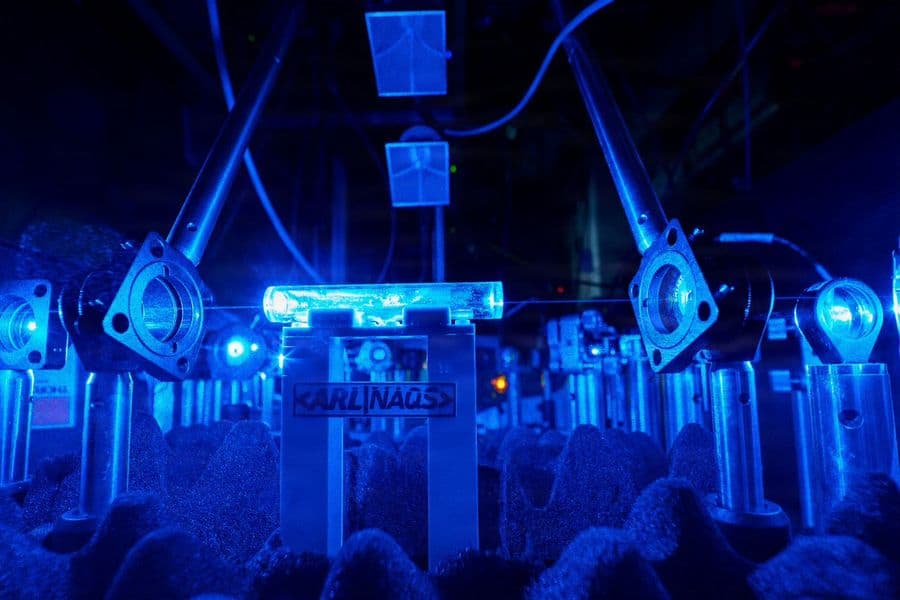
image: A glass cell containing rubidium atoms sits at the heart of ARL's Rydberg quantum sensor. Lasers excite the atoms to highly sensitive Rydberg states, enabling detection of the full 3D direction of incoming radio-frequency signals from the horn antennas visible in the background. (Army Research Laboratory)

Innovation Alone Won’t Prepare the U.S. for the Future Battlefield
By Joshua Segal • RealClearDefense
The sUAS Tactical Trifecta
By Bryan T. Woody • RealClearDefense
The Revolutionary War: When Strategic Options Share the Same Weakness
By Henry Yep • RealClearDefense
The Houthis Are Testing the Limits of Collective Defense
By Saima Afzal • RealClearDefense
Radio Frequencies in the Intelligence Ecosystem
By Craig Brower • RealClearDefense

Who Shoots Down the Drone Over the Shipyard?
By John Ferrari & Dillon Prochnicki • RealClearDefense
Northrop Grumman Breaks Out the Big Guns at AUSA
By Daniel Terrill, Defense News
Army Pursuing Diverse Array of New Anti-Air Interceptors
By Trevithick, The WarZoneWho Shoots Down the Drone Over the Shipyard?
By John Ferrari & Dillon Prochnicki, RCD
F-35C Lands for the First Time on a Ford-Class Aircraft Carrier
By The Aviationist