
The Next Era of Deterrence Will Be Engineered, Not Acquired
Last updated 08:02 AM EDT • Read time: 6m
For decades, the Department of War (DoW) has measured progress primarily through acquisition—contracts awarded, milestones met and platforms delivered. Success has often been gauged by how quickly and at what scale systems are procured, rather than how they perform in operation. As mission environments become more complex, there is an opportunity to place greater emphasis on how systems perform once integrated and employed.
Today’s deterrence challenges reflect an evolution in how the DoW approaches capability development. Instead of focusing on platforms in isolation, greater emphasis is being placed on integrating capabilities across domains to form cohesive architectures and drive operational outcomes, including for systems such as Golden Dome. The world we live in requires us to be adaptive, not static, and mission engineering enables that agility and responsiveness.
The DoW is placing greater emphasis on mission engineering; a paradigm shift that prioritizes achieving mission objectives over simply meeting technical requirements. The next step is to ensure that this emphasis is consistently reflected in early program decisions, funding priorities and acquisition processes.
From platform performance to mission outcomes
Mission engineering moves mission analysis to earlier in the life cycle and ties design decisions directly to expected mission outcomes, before requirements are finalized. This offers a pathway to build integrated, multi-domain deterrence architectures that perform as intended, not just on paper, but in the field.
Realizing the full value of mission engineering begins before requirements are finalized to ensure that systems are designed with operational outcomes in mind from the outset. It also creates an opportunity to more closely align program evaluation with mission performance, expanding beyond cost, schedule and technical benchmarks to include how effectively systems contribute to mission success.
Traditional systems engineering asks: “Does this system meet its defined technical requirements?” Mission engineering asks a broader, more consequential question: “Will this system, when as a part of a broader system of systems, accomplish its intended mission under realistic conditions?” Applying this perspective can help inform requirements and design decisions before they are finalized.
Modern operations hinge on the interaction of sensors, networks, command elements, weapons, logistics and personnel across multiple domains. A platform can excel in isolation yet introduce risk or inefficiency when integrated into a larger architecture. Mission engineering exposes these interactions and vulnerabilities upfront, before they become embedded in requirements and acquisition structures.
The process begins with a clear definition of the mission and its operating context. From there, architectures are modeled and simulated to assess how different design choices affect outcomes. The goal is not to optimize individual components, but to understand cause and effect across the mission thread. Assumptions are documented, tradeoffs are evaluated, and performance is measured by mission impact—not just technical compliance.
This approach helps align engineering decisions with operational realities instead of allowing integration challenges to surface late in the development life cycle. Extending this approach into earlier decision points further strengthens alignment between system design and mission outcomes.
Moving decisions earlier
One of mission engineering’s greatest strengths is its emphasis on early analysis. By shifting critical decisions to the earliest phases of concept development, mission performance is evaluated before acquisition structures are fixed.
Rather than discovering integration issues after systems are fielded—when fixes are most expensive and disruptive—mission engineering uses modeling, simulation and wargaming to mitigate risk by improving traceability between warfighter needs and engineering choices.
Programs become evaluated not only on delivery timelines, but on how accurately their predicted performance aligns with operational requirements. Expanding the use of these evaluations earlier in program development helps inform acquisition decisions before key structures are set and evolve dynamically to respond to new and evolving threats.
Predictability as a deterrence requirement
Effective deterrence requires both capability and intent. Communicating the capabilities they would face and the will to employ those capabilities is central to the success of adversarial deterrence. In this case, we’re focusing on capability alone. Adversaries must perceive, and believe, the capability exists. This is achieved through effective communication, built on the confidence that capabilities will perform as intended.
This is particularly important in areas such as integrated air and missile defense, space-enabled operations, and cross-domain command and control. These efforts are defined less by individual systems, but more by how those systems behave as part of an integrated architecture. Performance at the component level is necessary, but insufficient on its own.
Early-stage initiatives like Golden Dome highlight this dynamic, where architecture decisions are still forming and mission-level analysis can shape outcomes. Golden Dome’s success depends on how sensors, interceptors, decision systems and data function together. Mission engineering makes it possible to simulate those interactions and predict system-wide performance before designs are finalized. Applying these insights early in the design phase informs architecture decisions when flexibility is still possible.
In this context, deterrence planning becomes as much an engineering challenge as an acquisition one.
Leaders need confidence that capabilities will perform as intended, adversaries must recognize those capabilities, and decision-makers need to be able to predict likely outcomes during high-pressure scenarios.
Balancing speed and confidence
The pressure to move quickly in defense acquisition is undeniable. Threats evolve rapidly and extended acquisition timelines create vulnerabilities that adversaries can exploit. At the same time, incorporating sufficient analytical rigor early can help reduce the likelihood of integration and performance challenges emerging later, when they are more difficult and costly to address.
Mission engineering strikes a crucial balance. By evaluating concepts early and updating analyses as designs mature, programs reduce rework, inform more effective prototyping and accelerate the delivery of mission-ready capabilities. The objective is not to slow acquisition, but to improve decision quality throughout the acquisition life cycle. While this requires additional upfront analysis, it reduces rework and improves overall program outcomes.
This approach also supports adaptability. As operational assumptions change, mission models are updated to reflect new conditions without restarting the development process. That flexibility is a critical advantage in a dynamic threat environment and enables adaptability to changing threats.
Engineering confidence into decision-making
As missions grow more complex, the ability to predict outcomes before committing resources becomes increasingly important. Mission engineering provides a common analytical framework for operators, engineers and leaders, helping align technical development with operational intent and strengthening confidence in decision-making.
As integrated deterrence initiatives like Golden Dome take shape, there is an opportunity to more consistently apply this approach early—informing requirements, shaping design decisions and strengthening how programs are evaluated. The focus is no longer only on how quickly systems are acquired, but how effectively they are engineered to perform as part of an integrated ecosystem.
Mission engineering ensures that cross-domain capabilities are designed with mission performance in mind from the outset, supporting more effective delivery to the warfighter and strengthening the nation’s defense posture.
Al Guber is Director Digital Engineering/MBSE at Arcfield.
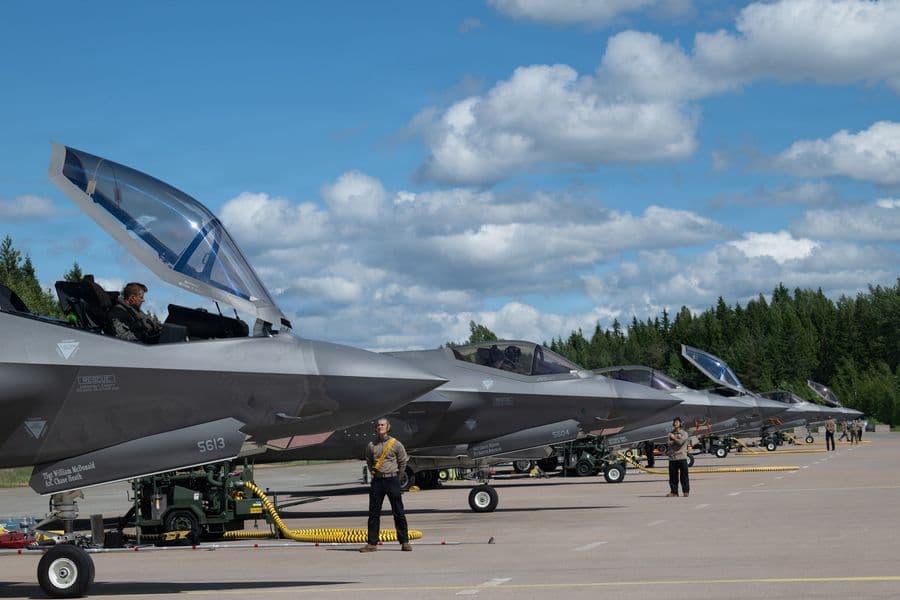
image: U.S. Air Force Airman 1st Class Luke LeGrand, 493rd Fighter Generation Squadron crew chief, prepares to launch Lt. Col. Dustin Merritt, 493rd Fighter Squadron commander, left, in a F-35A Lightning II aircraft during NATO Allied Air Command’s premier exercise Ramstein Flag 26, at Pirkkala Air Base, Finland, June 10, 2026. The 48th Fighter Wing exercises integrated air and missile defense, information, intelligence and data sharing, counter-anti-access/area denial and agile combat employment during RAFL 26. (U.S. Air Force photo by 2nd Lt. Sarah Hedgman)

In Pursuit of Nuclear Abolition
By Peter Huessy • RealClearDefense
Innovation Alone Won’t Prepare the U.S. for the Future Battlefield
By Joshua Segal • RealClearDefense
The sUAS Tactical Trifecta
By Bryan T. Woody • RealClearDefense
The Revolutionary War: When Strategic Options Share the Same Weakness
By Henry Yep • RealClearDefense
The Houthis Are Testing the Limits of Collective Defense
By Saima Afzal • RealClearDefense

Who Shoots Down the Drone Over the Shipyard?
By John Ferrari & Dillon Prochnicki • RealClearDefense
Northrop Grumman Breaks Out the Big Guns at AUSA
By Daniel Terrill, Defense News
Army Pursuing Diverse Array of New Anti-Air Interceptors
By Trevithick, The WarZoneWho Shoots Down the Drone Over the Shipyard?
By John Ferrari & Dillon Prochnicki, RCD
F-35C Lands for the First Time on a Ford-Class Aircraft Carrier
By The Aviationist