
Preventing Foreign Cultivation
Last updated 08:03 AM EDT • Read time: 12m
Nobody Had the Authority to Tell Him Who He Had Invited
The United States has no mechanism to protect a president's family from foreign cultivation. Adversary services know it — and on Tuesday, the country's chief law enforcement officer confirmed it, on camera.
In the service I came from, what happened in the Bahamas in May would not have been illegal. It would have been impossible.
I spent twelve years in Georgia's security services, most of them working against Russian intelligence operations, first in the state security apparatus and later in the Interior Ministry and the military police. Every service built on the Soviet template — Russia's included, and Georgia's were assembled from the same parts — treats the leader's immediate family as inside the security perimeter. Not as a courtesy. As doctrine. Contacts are checked. Foreign nationals in proximity are run against files. A man whose career traces directly to the officer now commanding the presidential protection service of a hostile state does not get within a hundred meters of the leader's son, because somebody whose job it was to prevent that would have prevented it — and would have answered for failing.
The United States does not work this way. Americans should understand that this is a deliberate choice their system made, not an oversight to be patched in a panic.
What actually exists
The Secret Service has protective-intelligence functions, and they are serious ones. What its protective mission is not, and has never claimed to be, is a licensing system for the personal relationships of a president's adult children. It has no authority to vet, approve, or veto their friendships, business partners, or wedding guests.
The FBI conducts counterintelligence. Its principal instrument in a case like this is the defensive briefing: an agent sits down with a private American and tells him that the person cultivating him is of interest to the Bureau. That is a warning. It is not a permission slip, and the citizen is free to disregard it.
The Treasury Department licenses transactions involving sanctioned persons. Umar Kremlev is not sanctioned under American law — ProPublica's own reporting confirms he does not appear on public U.S. lists. There was therefore no transaction requiring a license, and none was issued or withheld.
And Donald Trump Jr. holds no office, no clearance, and no reporting obligation. The continuous-evaluation machinery that governs cleared personnel — foreign contact reporting, financial disclosure, adjudication — touches him nowhere, despite a role, repeatedly noted by reporters covering this story, as one of his father's most trusted political advisers. The formal apparatus of vetting was built around titles. He has none, and matters enormously anyway.
Add these together and the finding is plain, if uncomfortable. The entire American defense of a president's family against foreign intelligence cultivation consists of the private judgment of private individuals, plus a warning the government may or may not have delivered and which the recipient may lawfully ignore.
That is the vulnerability. It is structural. It is not partisan, and pretending otherwise wastes it: the same architecture produced the Hunter Biden problem and will produce the next one under whichever party holds the White House.
One distinction has to be made carefully here, because almost everyone writing about this case has collapsed it. There is an enormous distance between claiming that the government approved a relationship and asking whether the relationship was of legitimate intelligence interest to the government. The first requires evidence that nobody outside a few compartments possesses, and anyone asserting it in public is guessing. The second is the ordinary daily business of counterintelligence, and the fact that it is rarely said out loud does not make it exotic. I am making the second claim, not the first.
The approach, read professionally
What the reporting describes fits a textbook cultivation profile — and I mean that descriptively, not as an accusation. The shared enthusiasm, boxing and the outdoors, supplied through a mutual acquaintance. A public joint appearance at an IBA panel in Istanbul in September 2025, after which the federation's own press release promised that "this alliance will not remain symbolic" — establishing the relationship as ordinary and expected well before the wedding made it interesting. Then the gift itself: large enough to matter, structured so that it stated no obligation, and impossible to reciprocate in kind.
What sharpens this considerably, and what the first wave of commentary undersold, is a detail ProPublica surfaced alongside the guest list: a month before the wedding, Vladimir Putin personally awarded Kremlev the Order of Friendship, and in the days immediately before he flew to the Bahamas, Kremlev was in China at the same time as Putin, traveling with a delegation accompanying him, according to Chinese state media. His press office says he was not part of the official delegation. Even granting that denial in full, this is not the profile of a freelance operator hoping to catch Moscow's eye. It is the profile of a man the Kremlin had just finished re-confirming as useful, walking from the Russian president's immediate vicinity into three unstructured days beside the American one's family.
Kremlev's own documented ask remains narrow — the IOC dispute, the 2028 Los Angeles Games, and, according to a person close to the federation's leadership, a real fear of being designated by the United States. A former IBA board member told ProPublica something considerably harsher: that Kremlev is guided by Putin, that the enterprise is geopolitics, and that boxing is incidental. Both accounts can be true at once, and in my experience they usually are. Services do not require their access agents to understand, or even to share, the strategic purpose their access eventually serves. A man can pursue his own small interest with complete sincerity and still be the vehicle through which someone else's larger interest travels. Holden Triplett, who ran counterintelligence for the National Security Council during President Trump's first term, put the general principle plainly: money remains one of the most reliable ways to buy access. He was not describing this case specifically. He did not need to.
This is also not the first time Donald Trump Jr.'s foreign contacts have produced this exact structure of concern. In June 2016 he met a Russian lawyer at Trump Tower who had offered damaging material on a political opponent; the special counsel's investigation later concluded there was insufficient evidence to bring criminal charges over that meeting. A decade apart, the two episodes share the same shape: not a broken law, but a vulnerability discovered by journalists, months or years after the fact, that nobody whose job it was had flagged in real time.
What he gave up in the Bahamas is also worth counting, and nobody has counted it. He skipped the eighteen-guest ceremony and arrived for the roughly fifty-person reception, with a delegation that included Alexander Lagutin, a businessman with senior roles at a Russian defense contractor and a state energy company, and Elena Sobol, his own deputy at the boxing federation. The other side of that room matters as much: Jared Kushner, Ivanka Trump, Eric Trump, Tiffany Trump and her husband were all present. What Kremlev bought was not proximity to one man. It was three unstructured days beside essentially the entire adult family of a sitting American president.
What he surrendered for it has gone uncounted. The payments moved through a Dubai entity the federation uses, and he appears in none of the family's published photographs — ProPublica located only the top of his head in a group shot posted by a friend of the bride. Every channel the family controlled was kept clean. None of the rest was. Fifty people saw him. His travel is documented, his delegation named, his associates identifiable, in a jurisdiction where American counterintelligence has both the authority and the appetite to keep such records. Whether Washington held that record before Monday, I do not know. That it holds it now is not in dispute.
Congress has asked one question. The Attorney General already answered a different one.
On September 14 and 15, Robert Garcia, the ranking Democrat on House Oversight, opened a formal investigation, with letters to Trump Jr. and to the White House chief of staff demanding the full guest list, the dates of Trump Jr.'s contact with Kremlev, and any communications with the White House or intelligence officials concerning him. His question was direct: what did Kremlev get in return. His letter also flags that Trump Jr. is a part-owner and major investor in companies holding substantial Defense Department contracts — the one element of this story that touches the government's own equities directly, and the reason it cannot be waved away as private life.
That question is unlikely to be answered by Congress in an election season, because congressional oversight of the opposing party is built to generate headlines about what an adversary's intermediary received, not to ask what he surrendered by showing up. That second question is what counterintelligence exists to do, and counterintelligence does not testify before House Oversight.
But a different branch has already answered a related question, on the record, in public. At Tuesday's White House briefing, a reporter asked Attorney General Todd Blanche whether the President had known about Kremlev's role. Blanche's answer was that the President does not know who Kremlev is, and that he does not believe other family members do either. Asked whether the Justice Department considered the matter worth investigating, Blanche responded: "Am I investigating what?"
Read that exchange the way a counterintelligence officer would rather than the way a press corps does. It is not evidence of a cover-up; there is no visible reason for one, since nothing illegal has been shown to have occurred. It is something more useful and more troubling: a real-time demonstration, by the one official positioned to activate any protective mechanism that might exist, that no such mechanism was engaged, considered, or apparently thought necessary. The Attorney General was not concealing an answer. He was accurately describing an absence.
The same gap, in a harder environment
The Bahamas is the easy version of this problem. Tbilisi is the live one.
This week the Trump Tower Tbilisi project held its launch gala. Eric Trump — the same son who, per ProPublica's own guest list, was present at the Kremlev-funded Bahamas reception in May — did not travel to Georgia for it. He appeared by video link. He told the room he would come very soon, when the foundation is laid, and that he hoped to visit often enough to become tiresome. He thanked the Prime Minister of Georgia by name for his warm words, thanked the economy minister, and praised the government's growth figures.
That last detail is the one worth holding onto. The Prime Minister he thanked appears on the same January 2025 letter to then-incoming Secretary of State Marco Rubio — reported by RFE/RL — that proposed sanctions on roughly two dozen figures in Bidzina Ivanishvili's network. So do two of the men in the project's own announcement photograph, Ilia Tsulaia and Soso (Samson) Pkhakadze. Tsulaia also appears by name in the European Parliament's February 2025 resolution, alongside Ivanishvili's son. No sanctions have been imposed on any of them. The tower itself is planned on land traced through the public registry to structures associated with Ivanishvili, the sanctioned oligarch who governs Georgia without holding office.
The environment around that gala is not the Bahamas. On July 3, a Georgian state delegation headed by President Mikheil Kavelashvili arrived in Tehran for Ayatollah Khamenei's funeral; Kavelashvili met President Pezeshkian the same day and thanked Iran for supporting Georgian sovereignty and territorial integrity. In August the Treasury designated a Georgian-registered exchange for moving Iranian Revolutionary Guard funds. As for Russian penetration, I do not need to offer my own estimate: in June the House passed H.R. 7668, directing the Secretary of State, the Director of National Intelligence and the Secretary of Defense to report within 180 days on the penetration of Russian and Chinese intelligence elements and their assets in Georgia. The House has already concluded the question is live; the bill now awaits Senate action, alongside the MEGOBARI Act, which has sat on the Senate calendar since April 2025.
The same son who spent three days beside a Kremlin-decorated oligarch's delegation in May spent Tuesday thanking, by video, the head of a government his own Congress has flagged for Russian and Chinese intelligence penetration — and promising to arrive in person once the foundation is poured. Nobody vetted the first appearance. Nobody will vet the second. Nobody has the authority to.
What would actually help
Not a statute policing the president's relatives. That road runs into the Constitution, and into the obvious abuse — the next administration using the instrument against the last one's family. Congress should not take it.
What is missing is far more modest, and procedural rather than legal: a standing, non-partisan counterintelligence briefing for the immediate family of every president, delivered on entry to office, refreshed at intervals, identical in form for both parties, and documented as given. Not a restriction. A disclosure. The government would be obliged to say the name out loud. The family member would remain entirely free to do as he likes with it.
Had that existed, somebody with a file open in front of him would have said the words "Alexei Rubezhnoi" — the officer who commands Putin's presidential security detail and to whom Kremlev owes his rise — to Donald Trump Jr. sometime before May. Instead the country read those words in September, and the Attorney General, asked about it on camera, could offer nothing better than a shrug dressed as a rhetorical question.
The scandal is not that a Russian paid for a party. It is that the most powerful government on earth has built no one whose job it is to tell the president's son who he has invited — and that when finally asked, on the record, its own Attorney General confirmed that nobody had.
Emzari Gelashvili is a former senior Georgian counterintelligence officer and a former member of the Parliament of Georgia. From 1996 to 2008 he served across Georgia's Ministry of State Security, Ministry of Internal Affairs and Ministry of Defense, with a counterintelligence career focused on Russian and Iranian operations. He is a veteran of the 2008 Russia-Georgia war.
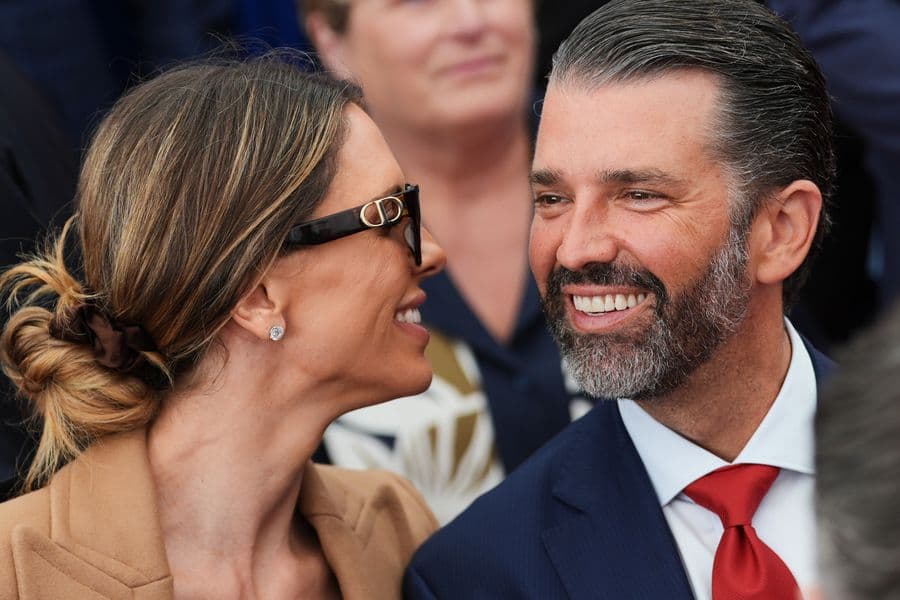
image: FILE - Donald Trump Jr., speaks with his wife Bettina, left, as they wait for President Donald Trump to deliver remarks to U.S. embassy staff at Deerfield Residence in Dublin, Sept. 12, 2026. (AP Photo/Julia Demaree Nikhinson, File)

In Pursuit of Nuclear Abolition
By Peter Huessy • RealClearDefense
Innovation Alone Won’t Prepare the U.S. for the Future Battlefield
By Joshua Segal • RealClearDefense
The sUAS Tactical Trifecta
By Bryan T. Woody • RealClearDefense
The Revolutionary War: When Strategic Options Share the Same Weakness
By Henry Yep • RealClearDefense
The Houthis Are Testing the Limits of Collective Defense
By Saima Afzal • RealClearDefense

Who Shoots Down the Drone Over the Shipyard?
By John Ferrari & Dillon Prochnicki • RealClearDefense
Northrop Grumman Breaks Out the Big Guns at AUSA
By Daniel Terrill, Defense News
Army Pursuing Diverse Array of New Anti-Air Interceptors
By Trevithick, The WarZoneWho Shoots Down the Drone Over the Shipyard?
By John Ferrari & Dillon Prochnicki, RCD
F-35C Lands for the First Time on a Ford-Class Aircraft Carrier
By The Aviationist