
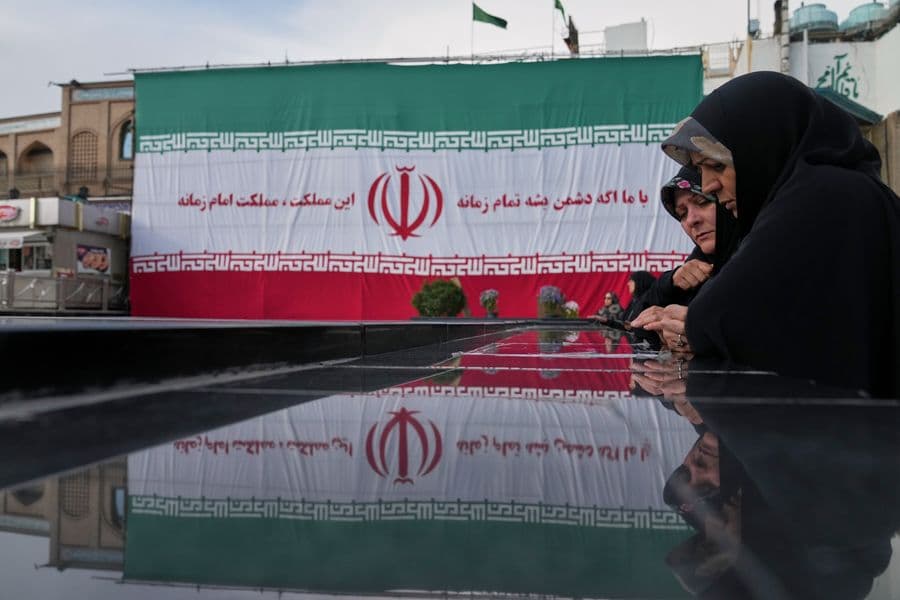
Iran's Security Dilemma in the Context of Great Power Rivalry in the Middle East
Last updated 05:18 AM EDT • Read time: 14m
Introduction
The Middle East area continues to be one of the most volatile regions of the world. Much of the volatility exists because of ongoing and evolving relationships and conflicts between international and regional players. The primary driver of these relationships is the competitive struggle for influence. At the heart of this competitive struggle for influence is Iran. As much as there is considerable disagreement over the nature of Iranian foreign policy and how it is executed, some see Iran as a threatening and expansive state while others believe Iran's actions are reactive in nature as they attempt to defend against perceived threats from Saudi Arabia, Israel and the United States.
Iran's perceptions of threats can also be evaluated using the "security dilemma" concept. When a country takes actions to improve their national security and another country perceives those actions as a threat to their national security, a "security dilemma" develops. Each country then views the other country's defensive measures as a threat to themselves. Therefore, each country will have a heightened sense of mistrust and tension with respect to the other country. The "security dilemma" is amplified in the Middle East due to historical animosity between regional players, religious differences and external involvement.
Iran's procurement of missiles, providing support to surrogate forces and attempting to acquire nuclear weapons capabilities could be seen as efforts by Iran to deter perceived threats from the United States, Saudi Arabia, and Israel. However, Iran's procurement of missiles, provision of surrogates and development of nuclear weapon capabilities may be viewed by the United States, Saudi Arabia, and Israel as a threat. This represents an escalating cycle of violence and distrust. Additionally, great power competition among the United States, Russia and China makes resolving disputes peacefully within the context of the security dilemma even less likely than if great power competition did not exist.
There are two distinct perspectives within the body of literature regarding Iran’s position in the Middle East. One perspective, supported by those who view Iran as a "revisionist" state, describes Iran as using both ideational and geographical tools to increase its influence over states in the region through supporting non-state actors and proxy wars. The revisionist perspective views Iran’s support for proxies in Syria, Iraq, and Yemen as examples of Iran’s desire to reorder the regional status quo to serve Iranian interests. Examples include Iran deploying IRGC commanders to Syria since 2011, providing Hezbollah with precision-guided missiles, and providing Houthi rebels in Yemen with ballistic missile technology. Critics note that these actions represent more than simply necessary defense.
On the other hand, defensive realists have argued that much of Iran’s behavior can be attributed to responses to threats posed by foreign actors. Specifically, they cite historical examples of foreign interference in Iran such as the 1953 CIA backed overthrow of Prime Minister Mohammad Mosaddegh, the Iran-Iraq war (1980 – 1988) and the ongoing United States military presence in the Middle East. Defensive realists view Iran’s strategic decision making as a rational response to the hostile nature of the international system and that it does not represent an effort by Iran to establish a sphere of influence. As an example, after the United States withdrew from the JCPOA in 2018, Iran resumed enriching uranium - an act that was described by Tehran as a defensive measure and viewed by Washington as an aggressive act.
Lastly, there is another school of thought which uses neoclassical realism to incorporate systemic and domestic factors to provide a more complete understanding of the drivers behind Iranian behavior including regime security concerns and leader perceptions. Research has also addressed how growing involvement by major world powers in the Middle East has created greater barriers to resolving conflict. This study seeks to address the remaining gap between identifying Iran’s security dilemma within the broader framework of increasing competition among major powers globally.
Security Dilemma, Proxy Warfare, and Great Power Rivalry within the context of Iran’s rationality
In Iran's use of force in the middle east, there is evidence to understand Iran's actions through the lens of the security dilemma. A security dilemma occurs when one nation builds its military capabilities or enters into alliance agreements to enhance national security. However, other nations may perceive such actions as a direct threat to their own national security. As a result, those nations will also build up their military capabilities and enter into new alliances. Ultimately, this increases the risk of conflict for all parties involved.
Iran’s Ballistic Missile Program
Iran has expended considerable financial and technical resources into development of ballistic missiles. Some examples include the Khorramshahr-4 with a range of 2,000 km: the Sejjil medium-range missile. While Iran claims it developed these missiles solely as defensive measures to prevent attacks by either Israel or the United States, both countries claim they are capable of delivering destructive payloads against them. Therefore, both have responded with increased military preparedness. Specifically, Israel has launched many airstrikes against Iranian missile manufacturing sites in Syria and reportedly inside Iran. Similarly, Saudi Arabia has purchased advanced missile defense systems from the United States. Thus, Iran and Israel and Saudi Arabia find themselves engaged in an increasing cycle of armament/counter-armament.
Proxy Wars
By engaging in proxy wars, Iran is able to expand its sphere of influence, while avoiding confrontation with militarily superior adversaries. For example, Iran provides funding and arms to Hezbollah in Lebanon; the Houthis in Yemen; Shia militia groups in Iraq; and Syrian government troops. To Iran, its proxies provide strategic depth and deterrence. For instance, Hezbollah possesses an estimated 150,000 rockets which can serve as a deterrent to potential Israeli attacks upon Iran’s nuclear facilities. Conversely, to Israel, Saudi Arabia and the United States, Iran’s proxies serve as offensive instruments used to further Iranian objectives in the region. When the Houthi rebels fired Iranian supplied drones and cruise missiles against two Saudi Arabian oil facilities in January 2019, most viewed this as an aggressive act of Iranian belligerence rather than a defensive measure.
Nuclear Program
Iran’s nuclear program represents perhaps the clearest case of disputed perceptions of intent. Iran insists that its nuclear program is solely for peaceful uses i.e., electricity generation, while relying upon a series of fatwas issued by Iran’s supreme leader prohibiting the acquisition of nuclear weapons. The IAEA reports that Iran conducted weapons related research before 2003, and that it is continuing to enrich uranium above civilian requirements. Israel and the United States believe that Iran’s advancements towards acquiring a nuclear capability constitutes an offensive pursuit of a weapon of mass destruction. The security dilemma could not be clearer: each additional step Iran takes towards achieving a nuclear capability is defined by Tehran as a defensive need to deter others from attacking it. Yet to its adversaries, each additional step creates the appearance of being an offensive preparation for war.
Evidence That Supports the Offensive Perception
Iran has created a network of proxy forces across four Arab capitals (Baghdad, Damascus, Beirut, and Sana’a); it has provided non-state actors with ballistic missiles and drone technology; Iranian naval vessels have harassed commercial shipping in the Strait of Hormuz; Iranian backed militia have attacked US bases in Iraq and Syria; the Quds Force, led by Qasem Soleimani, conducted operations across the region that clearly exceeded mere defensive necessities. Critics contend that such actions demonstrate clear examples of offensive expansionism based on virtually any definition of that term.
Evidence That Supports Defensive Perception
Iran is surrounded by US military personnel in nearly every neighboring state (Iraq, Kuwait, Bahrain, Qatar, UAE, Saudi Arabia and Turkey); The US has deployed F-35 and F-22 fighter squadrons in the region for specific purpose of countering Iran; Israel has carried out hundreds of strikes against Iranian targets in Syria; Saudi Arabia and the UAE have funded and armed anti-Iranian fighters; Iran has not invaded another country since the eighteenth century, whereas its neighbors have invaded Iran more recently (Iraq in 1980). Based on these historical trends, some would reasonably conclude that Iran's behavior appears defensive – although aggressively so - even though the objective survival is ultimately defensive.
A Reasonable Objective Observer
An objective observer who seeks a balanced assessment may determine that Iran's overall strategy is defensive in terms of its ultimate goal (the survival of the regime) but offensive in terms of its methods (projection of force, proxy warfare and entrenchment within the region). Such conclusions are consistent with neoclassical realist theory: Systemic threats to national security emanate from great powers. Domestic constraints and leaders' perspectives contribute to how states respond to systemic threats. The regime's ideological commitment to export the revolution and its belief that it is being encircled by hostile powers lead to a strategy that appears offensive to outsiders but was originally conceived as defensive by policymakers.
Great Power Rivalry Increases Pressure on Iran’s Security Dilemma
Great power rivalries between the US, Russia and China add pressure to Iran's security dilemma. The US maintains a web of military bases and alliances around Iran (Israel, Saudi Arabia, UAE, Bahrain, Kuwait, Qatar) to contain Iran. Russia has significantly strengthened its military relationship with Iran by supplying advanced Su-35 fighter aircrafts and S-400 air defenses in addition to coordinating strategies together in Syria. China has concluded a 25-year strategic partnership agreement with Iran which includes investments in Iranian energy and infrastructure as well as diplomatic backing for Iran internationally.
Therefore, because of the system level rivalry among major world powers surrounding Iran's geography and interests, it makes sense that the security dilemma is intensified for Iran and therefore drives its strategy.
JCPOA Reversal
The 2018 U.S. decision to withdraw from the JCPOA represents how great power acts exacerbate the security dilemma. The U.S. imposed new sanctions which caused Iran to accelerate its nuclear weapons development. Both Russia and China provided diplomatic backing and financial aid to Iran and allowed Iran to resist U.S. pressure but did not require Iran to give up. Ultimately, the outcome of this breakdown was not a stable or secure Middle East, but rather a region with increasing levels of nuclear weapons production and increasing tensions in the region. As both parties framed their actions as defensive measures, collectively, they created a more dangerous security environment.
Syria
In Syria, Iran, Russia and the United States all supported opposite sides in the civil war. Iran used IRGC troops and proxy fighters to protect the Assad regime. Russia contributed air support to Syria and Russian military advisers were stationed there. The U.S. sent money and military supplies to Kurdish-led fighters and had a small military contingent stationed in eastern Syria. Even though Iran framed its involvement in Syria as a defense of a fellow Shia Muslim state against Sunni extremist groups, the U.S. and Israel saw Iran's involvement as an example of expansionist policy by Iran. The fact that many different states are involved in Syria transformed the civil war into a proxy battle for global influence among major world powers.
Discussion and Consequences
Iran's use of unconventional tactics - proxy fighters and missile systems - suggests a strategy to compensate for lack of conventional military strength while simultaneously deterring potential rivals. Unconventional strategies allow Iran to demonstrate a capacity for action, create uncertainty, and increase instability in regions where they operate; however, these strategies may lead other countries - particularly Saudi Arabia and Israel to develop countermeasures against what they see as an aggressive Iranian foreign policy.
Yemen
The Houthi insurgency in Yemen provides another example of this dynamic. The Houthis have received ballistic missiles, drones, and anti-ship cruise missiles from Iran. Since then, the Houthis have fired missiles at Saudi oil installations (2019), fired missiles at ships in the Red Sea (2023-2024), and demonstrated the ability to fire long-range projectiles at targets beyond Yemen. For Iran, supplying the Houthis creates pressure on Saudi Arabia, draws away Saudi resources that could be used elsewhere, and supports an alternative government in Sana'a. For Saudi Arabia, providing material support to the Houthis is an act of aggression that directly impacts Saudi economic interests. This has led to a long-running conflict that has killed hundreds of thousands of people and destabilized the Arabian Peninsula.
Iraq
In Iraq, Iran-backed militias have emerged as one of the most powerful forces politically and militarily. These militias have targeted American military personnel (attacked American bases); murdered opponents (assassination campaign against opposition figures); intimidated those who oppose them (political intimidation). Iran claims it is acting to prevent a hostile Sunni regime from emerging in Baghdad and to defend its own border; however, the U.S. and Israel claim an Iranian "land bridge" exists that connects Tehran to Beirut. The U.S. drone attack that killed Qasem Soleimani was a direct reaction to what each country viewed as an offensive action by Iran, demonstrating how quickly escalations through the security dilemma can turn deadly.
Policy Recommendations
Multiple policy recommendations result from the Security Dilemma Framework. Traditional deterrence methods have shown to worsen the situation. For example, when the US deploys additional military assets to the Gulf region Iran increases its number of and capabilities of missiles and proxies. It appears to each side that the other's defenses are offensive. An alternative method of confidence building measures (CBMs) can be applied. Although the 2015 Joint Comprehensive Plan of Action (JCPOA), ultimately collapsed, it showed that negotiations can lead to constraints on Iran’s nuclear program and help reduce tensions. Diplomacy, possibly including Russia and China as guarantor states, could again stabilize the nuclear issue.
Second, major powers must understand that their competitive actions exacerbate regional security dilemmas. When major powers support different sides in local conflicts, these local conflicts become arenas of competition for those same major powers. If great powers were able to coordinate their diplomacy, this would lower the motivation for regional actors to increase levels of violence.
Finally, to address the Iranian security dilemma, one must consider Iranian internal politics. The primary goal of the government of the Islamic Republic of Iran is to survive. Any perceived threat or danger to the regime will cause aggressive reaction. On the other hand, if there was a way for Iran to believe that Western countries are interested in changing Iran's behavior rather than removing the current regime from power, then Iran's motivations for conducting offensive proxy warfare against its neighbors could decrease.
Summary
Iran’s security dilemma in the Middle East represents how regional rivalries intersect with great power competition, which creates significant complexities regarding stability in an anarchical international system. From the perspective of external observers, Iran's actions seem aggressive; however, most of these actions are reactive due to a hostile environment created by Iran’s past history of foreign intervention and the ongoing nature of threats to Iran from foreign entities. Regardless of intent – whether defensive or otherwise – all of Iran’s previous actions have produced offensive consequences. In addition, the increasing involvement of major powers (US, Russia, China etc.) in regional conflicts will continue to heighten inter-regional rivalries and elevate regional conflicts into global arenas of competition. Russia and Iran’s cooperation with respect to drone technology and missiles has increased since the beginning of the Russo - Ukrainian War. Additionally, China-US Rivalry has caused Beijing to take greater interest in relations with Tehran. This type of great power dynamic adds multiple levels of risk to potential escalations.
Conclusions
Several conclusions flow from the above discussion indicate various hypotheses. First, the security dilemma faced by Iran stems from regional interactions; however, it is also primarily driven by systemic structures within the international system. Second, any effort to reduce tensions and promote stability must address both the global and regional elements of the dilemma. Third, attempts at reducing tensions through traditional deterrence methods typically result in additional insecurity instead of deterring further escalation. Finally, domestic political considerations within Iran – specifically regime security concerns - must be addressed in any strategy aimed at decreasing conflict.
Unless genuine attempts are made to establish mutual trust and remove misperceptions regarding each side's intentions, it is probable that the cycle of insecurity will continue.
Chick Edmond is a Political Scientist and Graduate Researcher in the International Studies program at Old Dominion University. His research focuses on Nuclear Deterrence Strategies, Geopolitics in Europe/Africa and the balance of power between NATO and Russia.

Innovation Alone Won’t Prepare the U.S. for the Future Battlefield
By Joshua Segal • RealClearDefenseThe sUAS Tactical Trifecta
By Bryan T. Woody • RealClearDefense
The Revolutionary War: When Strategic Options Share the Same Weakness
By Henry Yep • RealClearDefense
The Houthis Are Testing the Limits of Collective Defense
By Saima Afzal • RealClearDefense
Radio Frequencies in the Intelligence Ecosystem
By Craig Brower • RealClearDefense

Who Shoots Down the Drone Over the Shipyard?
By John Ferrari & Dillon Prochnicki • RealClearDefense
Northrop Grumman Breaks Out the Big Guns at AUSA
By Daniel Terrill, Defense News
Army Pursuing Diverse Array of New Anti-Air Interceptors
By Trevithick, The WarZoneWho Shoots Down the Drone Over the Shipyard?
By John Ferrari & Dillon Prochnicki, RCD
F-35C Lands for the First Time on a Ford-Class Aircraft Carrier
By The Aviationist