
40 Years Later, Why Emulate Grenada?
Last updated 07:43 AM EDT • Read time: 5m
In 1974, the British granted independence within the Commonwealth to the tiny eastern Caribbean Island of Grenada, known as the Isle of Spice (especially for its nutmeg). Under Prime Minister Eric Gairy, an increasingly repressive police force and an extralegal private militia checked Grenadians’ civil unrest in the lush tropical “paradise” that it was for the tourists who provided revenues to Gairy’s coffers. To most islanders, however, Gairy ran “a hateful little dictatorship.”
In 1979, a small group of intellectuals pulled off a nearly bloodless coup, toppling a regime described as “a populist/black power revolutionary movement gone wrong.” Anthony P. Maingot wrote in Caribbean Review that the New Jewel (Joint Endeavor for Welfare, Education, and Liberation) Movement, “schooled in various revolutionary tracts and rhetoric, quickly shed their vague romantic . . . program of a people’s democracy and turned to an attitude of: we love the people and know what is best for them and so must guide their affairs” [emphasis added].
It was precisely the arrogant, self-congratulatory attitude of the “Anointed” described by brilliant and prodigious Professor Thomas Sowell – who once considered himself a Marxist.
Opinions varied on the nature and intentions of the People’s Revolutionary Government, whose leader, Maurice Bishop, became the new prime minister. One writer called Bishop’s brand of socialism, “documentary radicalism.” With good reason, others viewed the movement – self-described as Leninist and using the term “Politburo” – as more than rhetorical in nature. (Maurice named his son Vladimir Lenin Bishop; tragically, he died as a teenager in a Toronto nightclub.) In any case, the Bishop regime caught the attention of both the Carter (1977-1981) and Reagan administrations. The Cold War’s East-West rivalry guaranteed Washington’s concern, especially in view of Fidel Castro’s socialist Cuba and the similar threat to regional stability coming from Nicaragua.
Under Bishop’s regime, British military officer and historian Mark Adkin wrote, “Any sign of ‘imperialist’ characteristics in a person weighed heavily against him.” In some cases, the result was what Grenadians called “heavy manners,” a term that included imprisonment, torture, or even death. While, admittedly, Bishop managed to improve health care, housing, and literacy for many Grenadians, during the doctrinaire regime’s four-and-a-half-year rule roughly 1 percent of the populace was detained for political transgressions.
But in utopian movements that demand a Purity Test, no one can keep the standard for long. On October 19, 1983, fellow Marxists murdered Bishop. Some of them believed he sought a personality cult, others that he was not sufficiently leftist. Bishop’s miserable end was not unlike Robespierre’s two centuries earlier in France. The revolution devours its own. As the Book of Job asks, “. . . how can he be clean who is born of woman?” Unlike the gospel of Christ, Marx offers no forgiveness.
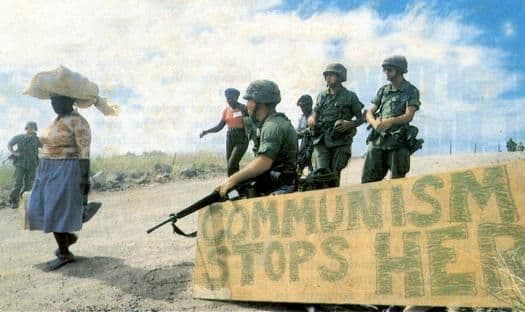
Days later, in a brief U.S.-led military operation purportedly launched to rescue several hundred medical students on the island, the Grenadian people’s revolution came to an end. The regime’s archives confirmed, as Washington suspected, that Bishop intended to grant both the Cubans and Soviets the use of the still-unfinished international airport at Port Salines.
Barely two weeks after the U.S. invasion of Grenada, no less a personage than Cuba’s Castro stated: “No crime can be committed in the name of revolution and liberty.” Castro quoted his own Cuban (Communist) Party from a few days before the U.S. operation. In short, if the cause is righteous, “no crime” is possible on the part of the revolutionaries. Frightening words, indeed.
As one commentator concluded recently, “While Marxism has failed spectacularly in politics, it has succeeded spectacularly in culture.” The senseless arrogance expressed by Bishop’s regime forty years ago is replicated today by the Pentagon’s CRT-DEI-touting leadership. Apparently, U.S. defense leaders believe no crushing of military members’ civil liberties can be committed in the name of liberating the so-called oppressed. Mandated diversity trainings, preferred pronouns and discouraged terms, and experimental drugs (formerly “vaccines”) are but three examples – lowering morale/cohesion and combat readiness and reducing the ranks in a military assessed by the respected Heritage Foundation as “weak.”
Theft of earned rank or duty position is now “equity.” No racism can be committed in the name of self-declared “Antiracism,” which includes the ridiculous claim of having “too many” white pilots in the United States Air Force. In the air, what besides skill matters?
Philosopher Sidney Hook wrote years ago, “As morally offensive as is the expression of racism . . . a false charge of racism is equally offensive.” While a variety of occasional misbehaviors will never cease in a fallen world, false charges of ongoing or “systemic” racism are particularly harmful to the military when junior or soon-to-be-accessioned personnel are the ones accused – by senior leadership – as occurred at the Air Force Academy in 2017 and the Virginia Military Institute in 2020.
Increasingly, veterans – whose multi-generational service families form the core of the “warrior ethos” – agree with one who addressed the military’s recruiting crisis bluntly: “Americans want to serve. They just don’t want to serve under tyranny.” One might add, Americans want to serve under meritocracy. The current madness precludes meritocracy.
Although the current brand of Marxism in America is not political, as it was in Grenada – rather, it is cultural – the remembrance of Marxism’s demise on the island forty years ago provides an echo of yet another failed Marxist experiment. Following several years of widespread woke-inspired devastation, recent developments including the disasters of woke capitalism, the decisions of courageous judges and Supreme Court justices, and Oliver Anthony’s phenomenal “North of Richmond” song offer encouragements that should put steel in the spine of Americans who want their country, their military, and their culture back.
Forrest L. Marion, Ph.D., is a retired U.S. Air Force officer and military historian. He is the author of Flight Risk: The Coalition's Air Advisory Mission in Afghanistan, 2005-2015 (Naval Institute Press, 2018), and (forthcoming), Standing Up Space Force: The Road to the Nation's Sixth Armed Service (Naval Institute Press).

Iranian Cyber Operations
By Michael Groen • RealClearDefense
Reflecting on an Epic Horse Campaign in the Mountains of Afghanistan
By Brian Glyn Williams • RealClearDefense
The Godfather of American Foreign Policy Realism Speaks to Today’s World
By Francis P. Sempa • RealClearDefense
In Pursuit of Nuclear Abolition
By Peter Huessy • RealClearDefense
Innovation Alone Won’t Prepare the U.S. for the Future Battlefield
By Joshua Segal • RealClearDefense

26th MEU – U.S. Needs Crisis Response MAGTF
By Marine Corps Compass Points
The Influence of History on a Sea Power
By CDR Salamander
Navy Civilianizes Six Former Flag Billets, Reduces Six to Captains
By Mongilio, USNI N.
Raytheon's $8B Contract for Strategic Comms Terminal Modernization
By M+A El
America’s Maritime Moment Will Not Wait
By CDR Salamander