
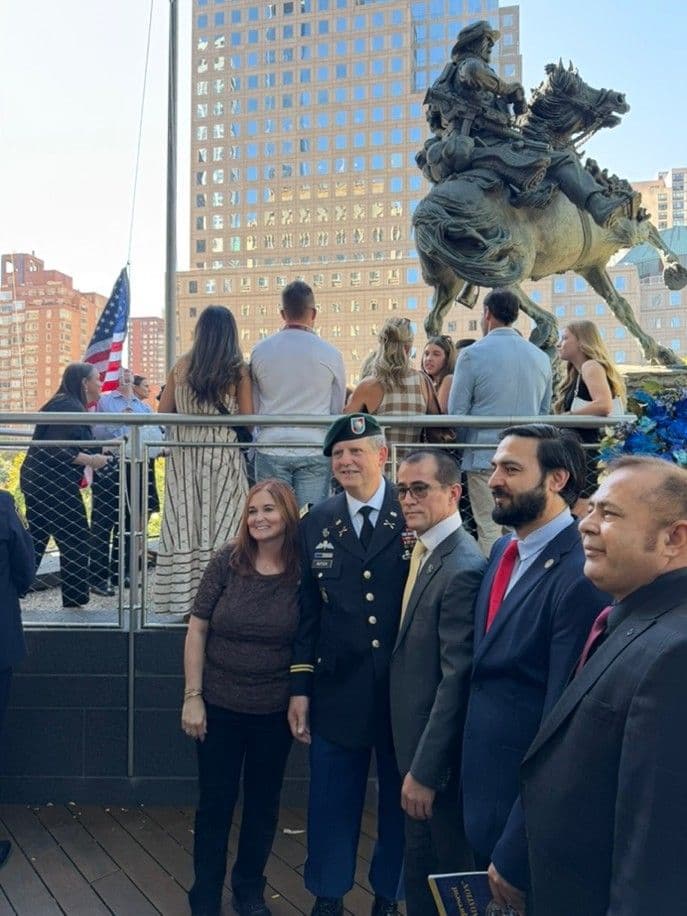
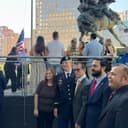
Green Beret families and Uzbeks at The America’s Response Statue NYC (photo Brian Glyn Williams
Reflecting on an Epic Horse Campaign in the Mountains of Afghanistan
Last updated 02:22 PM EDT • Read time: 53m
The CIA and Green Berets Commemorate 9/11 by Honoring Muslim Partners, Even as the Taliban and American Government Hunt our Loyal Afghan Allies
Amid all the partisan bickering between Republicans and Democrats over how each party presented the supposed gaffs of the other during the commemoration of the twenty fifth anniversary of 9/11, a historic memorial ceremony marked by a rare sense of unity was held in New York City on September 11th by an elite group of Green Beret Special Forces and CIA operatives. As in the past, when I have been invited by this remarkable brotherhood of warfighters who made history by leveraging local Afghan Uzbek horse warriors to provide America with a proxy force to overthrow the Taliban in 2001, I was invited to commemorate September 11th at what is one of the most powerful memorials to that tragedy; the America’s Response statue overlooking the Reflection Pools in Manhattan. Tourists who visit the nearby 9/11 Museum and Reflection Pools or go up the new World Trade Center often miss this 16-foot dramatic bronze statue of a horse mounted Special Forces soldier built on a promontory overlooking the hallowed grounds of the square. But on this crisp blue afternoon that was eerily reminiscent of that fine day shattered by planes flying into buildings a quarter of a century ago, the tourists could not fail to notice the activity on the knoll as scores of soldiers dressed in dress uniforms and the legendary Green Beret gathered for a historic event to honor their own.
In what I was told was the largest single gathering of U.S. Special Forces, CIA field operatives, and most remarkably, Afghan Uzbek cavalry commanders involved in the 2001 unconventional warfare campaign to overthrow the Taliban regime with just 300 American boots on the ground, all the legends who are played in the Hollywood movie about the campaign, “12 Strong. The True Declassified Story of the Horsesoldiers,” (based on the book Doug Stanton) were assembled. For this elite brotherhood of silent professionals more comfortable with being in the shadows, it was a rare moment to gather in the sunlight and recall not only the al Qaeda terror attack, but to look back upon the subsequent campaign their brotherhood spearheaded to destroy the terrorist group’s sanctuary in Afghanistan a quarter of a century ago. For those in attendance it was a chance to recall a desperate battle to avenge 9/11, a remove mountain valley, an ancient shrine, and a brotherhood forged in the heat of combat between Americans and timeless warriors in a land seemingly from another era.
Their story is that of small bands of Green Beret A-Teams, CIA shadow operators and Air Force combat controllers who were deployed into the remote mountains of Afghanistan to leverage local anti-Taliban proxy forces to wage guerilla warfare on October 19th, 2001. But the American force multipliers went far beyond their original remit and one 12-man team in particular, ODA 595 (Operation Detachment Alpha) code named “Tiger 02,” worked with a legendary local Uzbek horse commander to capture a pivotal Afghan shrine and break the fighting spirit of the superstitious Taliban. This enabled CENTCOM (Central Command) to unexpectedly overthrow the entrenched Taliban regime and shatter Al Qaeda’s sanctuary months ahead of schedule without having to deploy a larger conventional force from neighboring Uzbekistan in the following spring.
Among those in attendance at the event was the only colonel to conquer a country, the commanding officer of the October to December 2001 Task Force Dagger proxy leveraging campaign, Lieutenant General John F. Mullholland. While he was only a colonel when he famously strode down a row of tents on a windblown airfield known as K2 in Uzbekistan in October 2001 and selected an A-Team led by a Kansan rancher named Mark Nutsch to be the first team into the Uzbek rebel-controlled Hindu Kush Mountains, he has had a legendary career since then. He has gone on to become the Associate Director for Military Affairs at the CIA, Commanding General U.S. Special Operations Command, and Commander Combined Joint Special Forces Operation Task Force-West during Operation Iraqi Freedom.
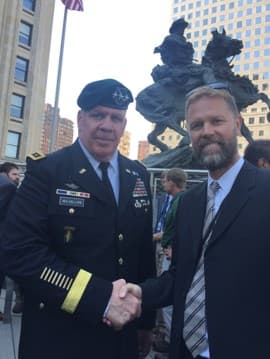
Williams with Lt. General John Mullholland at the De Oppresso Liber or America’s Response horse statute in New York.
Brian Glyn Williams
Among the Green Berets in attendance was also the number two on the 12 man A-Team that famously rode on horseback alongside the Uzbeks, Chief Warrant Officer Bob Pennington (masterfully played by Michael Shannon in the movie 12 Strong), as well as Sergeant First Class Vince Makela, and head of the famous horse riding Special Forces unit, Captain Mark Nutsch (played by A-List Avengers’ Thor actor Chris Hemsworth). The outlines of their mission portrayed in the movie are as follows. On October 19th, 2001, the Special Forces were flown by the legendary SOAR (Special Operations Air Regiment) Night Stalkers in helicopters from Uzbekistan over soaring peaks that reached 20,000 feet to the remote rebel-controlled landing zone for a night infil. The Green Berets record on their website “As the Green Berets stepped off the SOAR's highly modified MH-47 Chinook [helicopters], they stepped back in time, to a time of dirt roads and horses. They stepped into another world, one of arid deserts and towering peaks.”
After being successfully infiltrated and welcomed by CIA Uzbek-speaking liaison scouts and local Uzbek warriors, the Special Forces used their horses to spread out in sub-groups and ride over vast distances. As the Taliban hunted them, these three to four man cells hunted the Taliban moving along harrowing mountain trails overlooking yawning thousand-foot-deep canyons and calling-in precision guided airstrikes on enemy targets. While the over-the-top movie scenes in 12 Strong of actor Chris Hemsworth leading the charge and overrunning the Taliban while shooting from the hip on horseback are pure Hollywood fiction, the Special Forces did ride with ancient warriors from another era to remote and dangerous battlefields in the Darya Suf (Valley of the Caves) to direct bombs on the enemy with newly developed targeting technology.
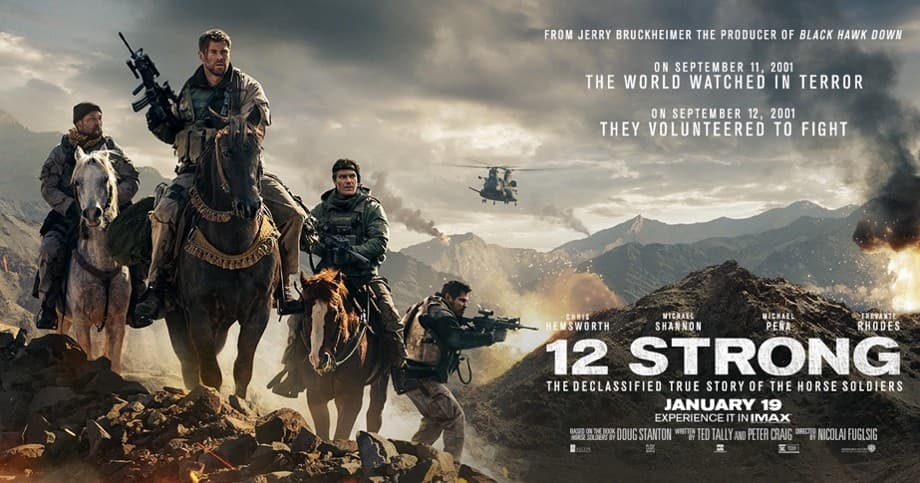
The 2017 blockbuster adaption of 12 Strong.
Brian Glyn Williams
In my interviews held with General Abdul Rashid Dostum, the legendary Uzbek cavalry commander who oversaw the joint operation, in his stronghold of Sheberghan, northern Afghanistan, he described the 12 Green Beret and eight CIA Special operators as “jasurs” (braves). He told me they moved around the battlefield like “grasshoppers” raining death and destruction upon the Taliban who were trying to prevent the Uzbek rebels from breaking out of the mountains to seize a Medieval holy shrine town on the plains. Their precision guided JDAM (Joint Direct Attack Munition) airstrikes delivered by venerable B 52s flying from the distant island of Diego Garcia in the Indian Ocean ultimately enabled the hard riding Uzbek horsemen to break through the Taliban positions blocking the Darya Suf valley. The strikes cleared the way for the Uzbek riders to boldly capture Afghanistan’s most holy mosque, the magnificent blue tiled Medieval tomb of Ali in Mazar i Sharif thus leading to the collapse of the Taliban house of cards after just a month of fighting. America could not have achieved this remarkable success unless it had allies willing to fight side by side with the Americans and protect their small footprint of com airstrike combat ground controllers from the Taliban.
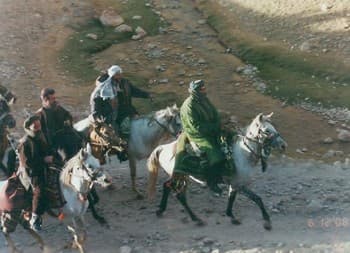
The Uzbek commander General Dostum in green with and turban Green Berets from Tiger O2.
Brian Glyn Williams
Over glasses of warm Afghan tea with his turbaned commanders looking on admiringly in his compound on the dry, windswept plains of the forgotten realm of Turkestan, Dostum who is a gregarious storyteller, recalled:
I told my men the Americans would be coming after we heard about the attack on your towers. We prayed for your slain people then we welcomed our American friends to our lands to fight the enemy. But we had never seen anything like the devices [special operations force laser acquisition markers] they used to coordinate bomb strikes for my men. It was almost magic.
I called the Taliban on our satcom to mock them, telling them the Americans had death lasers. I told them Azrail the Death Angel was hunting them. Many of them believed me because they had never been hunted from the air like that before. They lost their courage and thousands surrendered to my much smaller force. After the strikes, my riders rode through their bodies to assault the next position and take more prisoners.
As for the Americans, whom Dostum quickly befriended and came to trust, the scenes of him clashing with them in the movie were made up to infuse the story with high drama and tension. He would tell me of the Americans who rode with his men in bone chilling mountain cold on a barren, high-elevation battlefield while sleeping in caves and mud huts:
I pushed them hard. We rode vast distances and fought ceaselessly together. The pace was relentless, but the Americans did not mind. They wanted to kill the enemy as much as we did, and that made us brothers. I am proud we did not lose one of our American friends on the mountain campaign. I told my men to protect them with their lives. But sadly, when I was not there we later lost one of them [Johnny Mike Spann] in the Taliban prisoner uprising at Qala i Jengi [fortress].
While the Green Berets dominate the movie with their heroics, it was the CIA that led the operation in fulfillment of its Top Secret Blue Sky Memo proxy leveraging plan. Remarkably, we know the names of four of the Agency paramilitary scouts who were helo’ed into the mountains to pave the way for the subsequent Green Beret infil including the overall commander of the joint mission, J.R. Seeger, currently an author of riveting novels based on his extraordinary career, as well as Alex Rodriguez, the number two in command of the mission, Scott Spellmeyer, Dave Tyson, and Johnny Mike Spann. And even more remarkable was that Dave Tyson, the most famous of the operatives after being captured in action in the remarkable and at times terrifying CNN documentary House of War, emerged from the shadows to speak at the commemoration ceremony in New York.
Dave Tyson, who I attended a Central Asian Studies graduate program at Indiana University with in the late 1980s, appears in the powerful book First Casualty. The Untold Story of the CIA Mission to Avenge 9/11 by Toby Harnden. The book tells the story of the Agency-led mission that saw CIA overthrow the Taliban in the north in just 30 days of fighting but lose CIA ground controller Johnny Mike Spann, America’s first casualty in the 20-year war in Afghanistan. Dave Tyson stars in it as the legendary Agency commando who shot his way out of a bloody Taliban prisoner uprising in an Afghan fort known as Qala i Jengi (the Fortress of War) on November 25, 2001. He barely survived the Taliban revolt that led to death of his comrade Johnny “Mike” Spann, a former Marine and air combat controller from Alabama who became the first casualty of the war. After killing several Taliban attackers with an AK 47 and a pistol in seventeen minutes of terrifying close quarter combat, Tyson managed to clamber over a massive wall under Taliban fire, escape the Taliban prisoner-controlled fortress, and go on to call in a salvo of deadly airstrikes from AC 130 Specter gunships to obliterate the uprising prisoners and retrieve his slain comrade’s body.
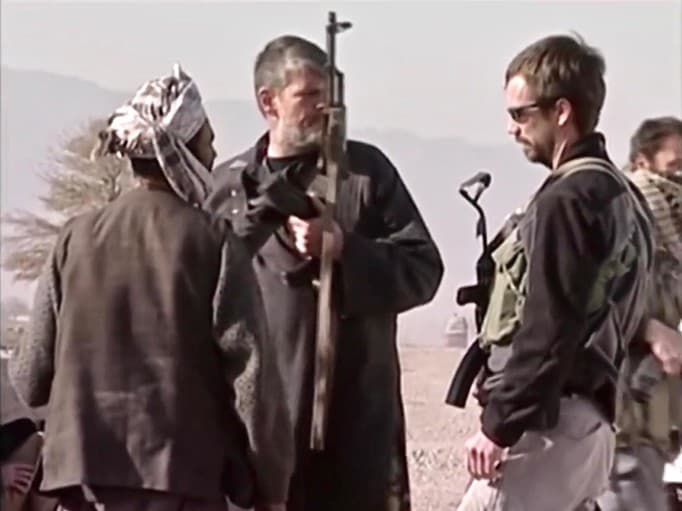
Agency legend Dave Tyson in the center with CIA paramilitary Scott Spellmeyer at Qala i Jengi.
Brian Glyn Williams
General Dostum showed me a forlorn monument he had erected in the bomb-blackened fortress commemorating Spann’s sacrifice for his nation and the Afghans who were liberated in the campaign. He grew silent as he solemnly prayed over his marker and told me “He came so far from his land to help free us from the terrorists. He was a hero for both our nations. We will always be grateful to him.”
Dave Tyson is one of the Agency’s most awarded officer and is not only a fluent speaker of Uzbek, Turkmen, Turkish, Russian and Farsi/Persian who served CIA’s Clandestine Service in Uzbekistan, Turkey, Afghanistan, and Azerbaijan, he is a recipient of CIA’s Distinguished Intelligence Cross, the Agency’s equivalent to the Medal of Honor, and the Agency’s Distinguished Career Intelligence Medal. He gave a moving speech at the New York ceremony honoring the heroism of his Uzbek friends who died in the hundreds in a fiercely fought campaign that took place on a barren mountain plateau few Americans could visualize. In his speech, Tyson recalled the bravery of the Uzbek cavalrymen who fought much as their ancestors had under Genghis Khan on horseback:
They were our fellow fighters, our shock troops, our security, our protectors, our vanguard, our reconnaissance force, our sources of intelligence. They were the first - the first to shed enemy blood at our behest, and - the first, again, the first - to shed their own blood. They were killed, wounded, and maimed in large numbers. They threw in their lot with us [the CIA] when we were just eight in number – at very great risk to themselves and their families - and they remained steadfast. They became our brothers.
Recalling the epic campaign that saw horsemen seemingly from the Middle Ages synergize their cavalry and foot charges with carrier-based aircraft flying hundreds of miles from the Indian Ocean, Tyson would further recall:
They conducted small and large scale combat operations as a cavalry force. They attacked enemy positions on horseback. They conducted cavalry charges on a routine basis. And when all this was done in conjunction with U.S. air power, it was awesome. It should go without saying that without these men, without these “partners,” without these brothers, we would not be here today. But it needs to be said. It needs to be remembered.
Captain Mark Nutsch and Bob Pennington were eyewitnesses to the Uzbeks’ historic charges and recorded them as follows in their remarkable book Swords of Lightning. Green Beret Horse Soldiers and America’s Response to 9/11:
Three or four hundred horsemen were arrayed into two separate lines. By early afternoon, they started maneuvering against the Taliban positions. One half of a line would charge to a ridge, dismount, and begin shooting. Their fire covered the advance of the other half, which would bound ahead on horseback to the next ridge. Then they would dismount and provide covering fire for the first line. The Taliban saw the horsemen maneuvering and attempted to cut them down with artillery and mortar fire.
On their website, one of the Green Berets who fought alongside the anti-Taliban rebels spoke in awe of the courage of the NA (Northern Alliance) allies noting:
It took a lot of heart, a lot of courage. "We heard a loud roar coming from the west," said Master Sgt. Keith Gamble, then a weapons sergeant on ODA 585, as he remembered one firefight. "We had no clue what it was until we saw about 500 to 1,000 NA soldiers charging up the ridge line. I called it a 'Brave Heart' charge.
Captain Mark Nutsch similarly noted the bravery of the local warriors in taking the battle to the enemy:
They weren't suicidal but they did have the courage to get up and quickly close that distance on those vehicles so they could eliminate that vehicle or that crew. We witnessed their bravery on several occasions where they charged down our flank to attack these armored vehicles or these air defense guns that are being used in a direct fire role and kill the crew and capture that gun for our own use.
As for the Uzbeks’ larger than life leader, General Dostum “the Taliban Killer,” who was described as an Afghan General Patton, Nutsch and Pennington were in awe of his fighting leadership. They were to write of the secular commander who previously fought against the CIA-backed mujahideen anti-Russian Muslim rebels in the 1980s Soviet invasion, “He had over twenty-five years of experience fighting in Afghanistan; there simply wasn’t anyone on either side of the conflict with the depth of his experience…he was an extremely effective warrior and leader.”
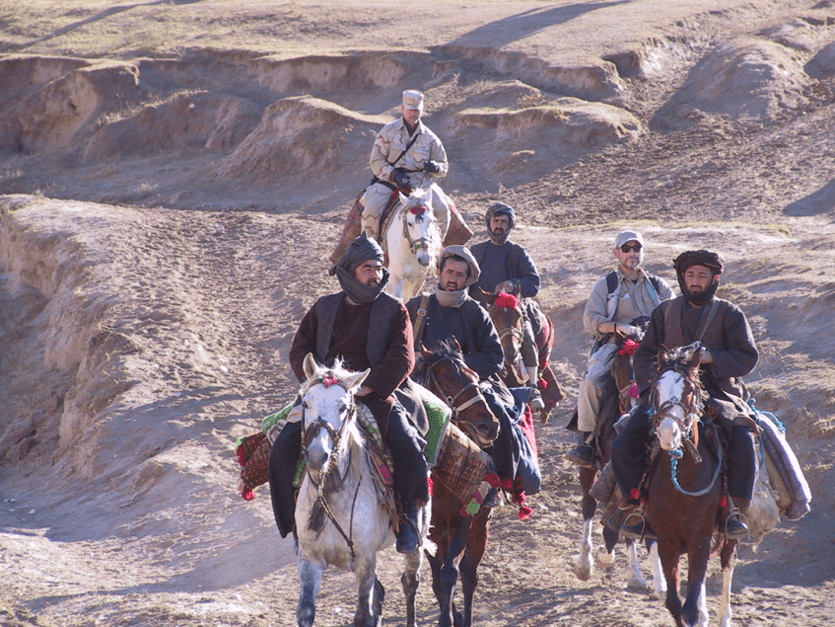
Dostum in turban on left leading U.S. Special Forces in tan fatigues (photo given by Dostum to Williams).
Brian Glyn Williams
The feared warlord was very protective of his cherished American guests whom he had symbolically broken bread with and offered the ancient rite of panagha (sanctuary protection). Nutsch and Pennington write in their book about his protectiveness of them, “Dostum assigned security to us, it came with a warning to the commanders: Nothing happens to the Americans. If they die, so will you…And he meant it. He told Mark later that he was willing to lose five hundred men before seeing one of us injured.” The trust that soon developed between the fighting men from different worlds was strengthened by their shared hatred for the common Taliban enemy. Mark and Bob would write of their shared enmity for the fanatic ethnic Pashtun Taliban that had conquered the Uzbeks’ homeland in 1998 and carried out horrific massacres against their people:
One thing was obvious as the militiamen talked: they hated the Taliban. They hated what they had done to the country. They were committed to the fight for the long haul. Almost to a man, the militiamen had stories of rapes of their wives, daughters, or both. Many had lost fathers, sons, or other relatives to the Taliban or al-Qaeda.
And honoring these Afghan partner forces was a key theme at the New York commemoration event. This effort by the Americans to honor their friendship with the Uzbeks was emblematic of the deep bonds they forged with the fighting men from a land steeped in ancient traditions of hospitality that are explored the Hollywood movie Lone Survivor. The movie tells the story of a Navy SEAL named Marcus Lutrell who was pursued into an Afghan village and given the Pashtun protection of nanawati or melmastiia by the simple villagers who defy the vengeful Taliban insurgents to protect him.
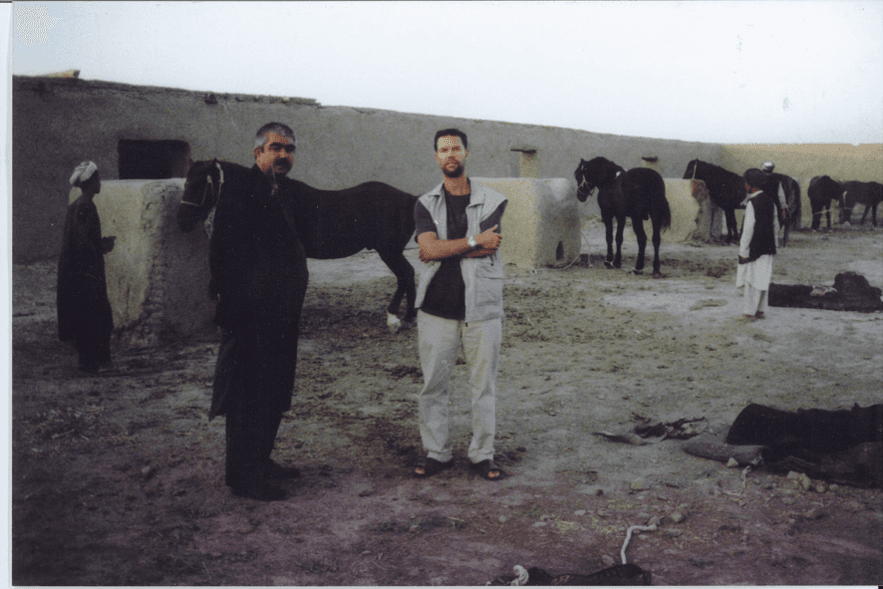
Williams with General Dostum in his compound’s stables in Sheberghan, northern Afghanistan.
Brian Glyn Williams
What was most heartening for me as a Central Asian historian who worked for the CIA in Afghanistan and wrote a book chronicling this historic Special Forces leveraging campaign from the untold Afghan Uzbek Mongol warriors’ perspective titled The Last Warlord. The Life and Legend of Dostum the Afghan Warrior who Led U.S. Special Forces to Topple the Taliban Regime, was the remarkable effort that Mark Nutsch and his team made to fly in most of the surviving Uzbek horse commanders for the event. He and Dave Tyson moved Central Asian mountains to get these unsung Afghan heroes to New York to honor them and their sacrifice of hundreds of their brothers, fathers, uncles, and friends in the desperate mountain campaign. Tyson and Nutsch have both been active in working with a group of CIA and Green Beret operators to get these allies who were abandoned in the desperate August 2001 “Operation Allies Refuge” air evacuation of friends and allies out of Taliban-controlled Afghanistan. The result of their efforts to save their Uzbek friends was that many of the pro-American Uzbeks who would have been hunted down and killed by the vengeful Taliban conquerors were safely evacuated to America and able to attend the event.
Having traveled extensively over the windswept mountains and deserts of the Uzbeks’ remote, war-torn homeland and been warmly welcomed in their simple clay-walled homes, I could see the awe in these Turkic-Mongol interpreter and warriors’ eyes as they gazed up at the gleaming towers of glass and metal surrounding them in the bustling modern American metropolis of New York. For most of them this was their first visit to Manhattan and they were enthralled. The Uzbeks spoke also with deep gratitude towards their American brothers who had not only worked assiduously to get them and their families evacuated as the Taliban swept over their lands in 2021, but had helped them find housing, schools for their children, clothes and food as they adjusted to a strange new world. The hand of friendship had been solemnly extended by the Uzbeks to the Americans in our hour of need after 9/11 and now it was being extended back to them by the grateful American soldiers and spies.
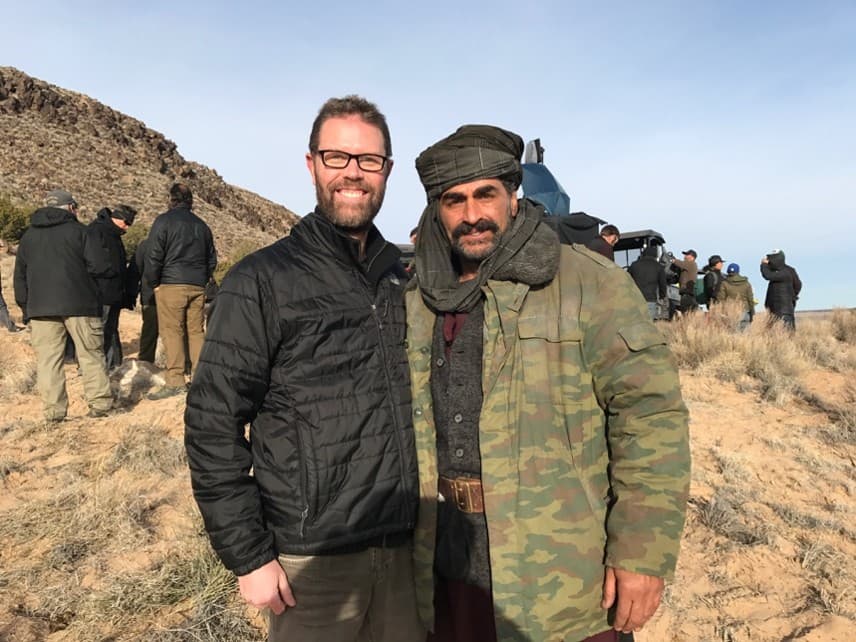
Williams with the actor Navid Negahban dressed in Marshall Dostum’s riding jacket while portraying Dostum on the New Mexico movie set for 12 Strong.
Brian Glyn Williams
And I was most heartened to see the Uzbeks accurately brought to life in three dimensions by Director Jerry Bruckheimer in his cinematic homage to the fighting men from both countries, 12 Strong, instead of just being relegated to being quaint native background for white man heroics as in the 1980s Afghanistan-based movie starring Sylvester Stallone Rambo III. The story of this friendship between Americans and Uzbek horsemen is accurately told in the Hollywood blockbuster that I advised on in the Afghanesque mountains of New Mexico. And the actor masterfully playing Dostum, the talented Navid Negaban, stole the show and even managed to find local Afghans in New Mexico to star as extras (see my review article for HNN here “12 Strong: The Inside Story of a (Refreshingly Accurate) Hollywood War Epic” on the making of the movie).
One figure was, however, notably absent from the commemoration event, General Abdul Rashid Dostum, the overall Uzbek commander of the joint American Uzbek campaign. The fierce Uzbek general could not make it due to poor health problems that included shrapnel wounds he received in his decades-long career that began when he fought as a secularist against Islamist jihadis like Osama bin Laden in the 1980s. It was Dostum who initially offered the plan to the CIA operatives Dave Tyson and JR Seegar for toppling the superstitious Taliban without falling into the footsteps of conventional occupation force like that of Alexander the Great, the 19th Brits, and the 20th Century Soviets. In his vision, the Americans would play the role of insurgents, not Soviet-style conquerors. General Mulholland similarly described this strategy to me as putting a Muslim ‘face’ on the campaign instead of acting as an invading infidel army to be resisted by defensive jihad.
In the joint American Uzbek campaign, Dostum played the role of an Afghan Omar Sharif to Captain Mark Nutsch’s Peter O Toole in the classic 1960s insurgent movie “Lawrence of Arabia”. Both men spoke with deep affection of the brotherhood forged in combat in their interviews with me. Dostum “the Taliban Killer,” a controversial and much mythologized figure who has been described in hyped terms as something between a Star Wars Klingon and an ogrish Attila the Hun, went on to become Marshall of the Afghan Army and Afghanistan’s vice president. As Vice President, the former Uzbek oil and gas worker-turned-anti mujahideen-Special Forces commander famously grew so frustrated with the faltering campaign to suppress the mounting Taliban insurgency in 2015 that he threw off his suit and tie, stormed out of his office, and went to fight in the cold trenches with his men on the frontlines.
Vice President Dostum was represented at the 9/11 memorial event by his daughter Rahila Dostum, a fierce fighter for women’s rights against Taliban misogyny whom he proudly introduced to me in his base at Sheberghan many years ago. She has been a fearless advocate of Afghan women who have been cast into thralldom by the cruel Taliban misogynists who are now once again stoning and flogging them for morality crimes and “sins.” The Uzbek warriors were fierce secularists under Dostum and his Jumbesh Party and now their women faced unimaginable horrors. The southern Taliban have swept into their northern villages enforcing Medieval shariah Islamic law and exacting revenge on all those who sided with the American “disbelievers.” The Taliban’s Supreme Leader Hibatullah Akhundzada has rejected American criticism of his regime’s acts of murderous misogyny against women and proudly proclaimed “You may call it a violation of women’s rights when we publicly stone or flog women for committing adultery because they conflict with your democratic principles. But I represent Allah, and you represent Satan.”
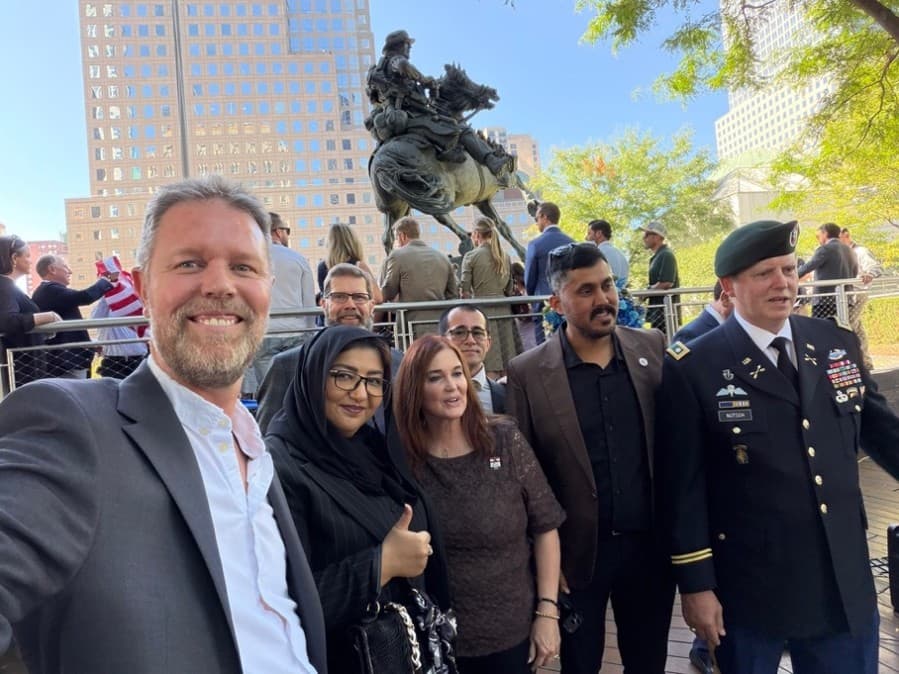
Williams (from left) with Rahila Dostum, Tiger 02 team member Vince Makela and behind him, Mark’s wife Amy Nutsch, two Uzbeks (whose names I am protecting) and Mark Nutsch at the “America’s Response” statue in NYC.
Brian Glyn Williams
A Bond of Friendship That Has Stood the Test of Time.
Seeing Mark Nutsch and the smiling Uzbeks renewing their friendship as I captured the Stars and Stripes being majestically raised behind General Mulholland above the horse soldier monument in the warm glow of the afternoon sun, I recalled his efforts to honor his Uzbek brothers-in-arms. Years earlier he had shown me a schematic of a statue of an Uzbek horse warrior that he wanted to erect in New York to commemorate their overlooked role in the war. He seemed to feel that the American public had made heroes out of him and his team but had overlooked the fact that it was the Uzbek ceriks (raiders) who charged through the bomb smoke from laser and satellite guided JDAMs into Taliban positions to overwhelm them. They were our “boots on the ground” fighting force and suffered terrible loses in the campaign. While the Americans had lost no men in the desperate mountain offensive, many of the Green Berets and CIA operatives involved in the campaign were clearly haunted by the death of his Uzbek comrades and felt gratitude to them.
I found a similar sense of deep loyalty by Green Berets for their Afghan comrades in another legendary member of this elite fighting brotherhood Lieutenant Colonel Scott Mann who has, like Mark Nutsch, Dave Tyson and J.R. Seeger, and Dostum’s oldest son Batur, been kind enough to share his experiences with my students in my Afghan War class at the University of Massachusetts-Dartmouth. Scott wrote an emotionally moving bestselling book titled Operation Pineapple Express. The Incredible Story of a Group of Americans Who Undertook One Last Mission and Honored a Promise in Afghanistan that begins with what I found to be one of the most inspirational openings I have ever read, “What is the meaning of a promise? And how far would you go to honor one?”
Scott Mann’s truly moving and inspirational book answers this opening question about the promise made to his Afghan friends by telling the story of his desperate effort to work with a group of retired Special Forces friends to save the lives of their Afghan Army commando comrades who were abandoned in the chaotic August 2021 American troop withdrawal. Mann captured a sentiment I and many others who came to see our partners as our greatest asset felt when Trump and Biden betrayed them writing;
I think that what we will look back on and really regret is the way we left there. I am not good with it. A lot of us are struggling with it. I believe we are abandoning our brothers and sisters in Afghanistan. We violated a pact that we made with them. We abandoned the people with whom we made an agreement to go the long haul.
As Scott’s betrayed Afghan Army comrades desperately called him from Afghanistan to tell him the Taliban’s dreaded Sara Khita (Blood Unit) vengeance death squads were sweeping the country hunting all suspected members of the hard fighting Green Beret-trained NDS (National Directorate of Security) and Army commandos in the late summer of 2021, he felt helpless. And the desperate calls from Afghanistan stirred up terrible memories of the war that had almost led him to commit suicide. That was until he decided to bravely overcome the darkness and create an “underground railroad”-style network to smuggle his dear Uzbek Afghan Army commando friend Nezam out of the country.
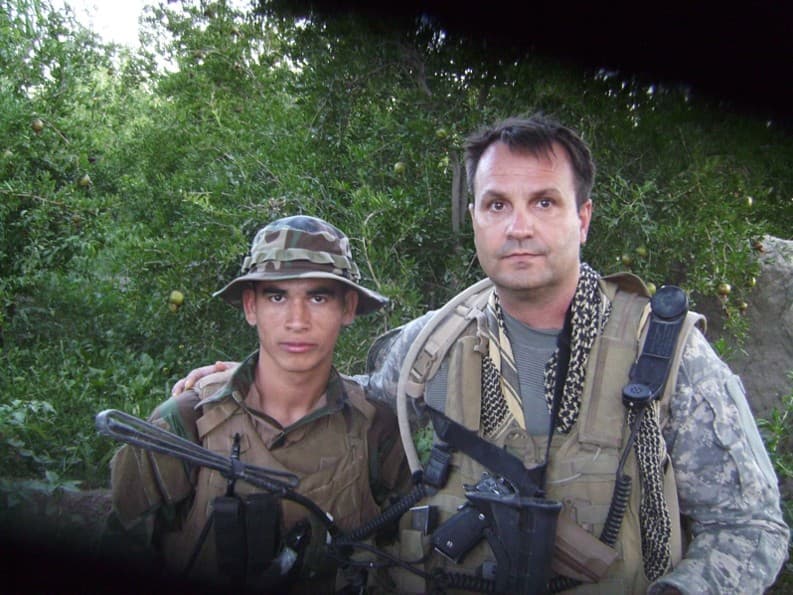
Lt Col. Scott Mann author of Pineapple Express and his Afghan commando friend Nezam.
Brian Glyn Williams
Nezam who completed the grueling Q Course Special Forces training in Fort Bragg, North Carolina was a small Afghan Uzbek with a big heart and went on to become a Green Beret to fight against the hated enemy of his people, the Taliban. And he saved his American Green Beret teammates on a raid when the Taliban launched an ambush on them. Scott writes of his Afghan friend’s remarkable bravery and grit:
On one such mission, Nezam took a round through the mouth, blowing out a cheek and shattering several teeth, but not before warning the American Green Berets behind him of the waiting ambush. While he was on a stretcher waiting to be evacuated, his face covered in blood, he pleaded with Mike, “Please don’t let the fucking Afghans fix my teeth.” Somehow, he was still able to talk. “Can you get me a U.S. dentist? If you do, I’ll be right back to the fight.
After getting his jaw, cheek and teeth fixed, Nezam lost no time in returning to join his beloved brotherhood and, like most of the commandos, he fought until the bitter end when their country collapsed in valley by valley surrenders by the regular army after it had been cut off for supplies, funding, ISR (intelligence, surveillance and reconnaissance) and air support by the departing Americans. As the vengeful Taliban swept over the land in August 2021, Nezam was hiding in his uncle’s home and time was running out. His uncle told him he would have to leave soon for he would bring the Taliban’s vengeance down upon the family. Scott frantically worked sleepless days and nights to save him and get him out of Afghanistan before the fast-closing Taliban dragnet closed in on him. He kept promising his desperate and increasingly skeptical Afghan friend that he would get him to his home in Riverview Florida where they would one day go fishing together.
Scott and his team---who were nicknamed Operation Pineapple Express for a movie-based code they gave their Afghan friends to get through the refugee swarmed checkpoints at the Kabul International Airport---literally saved hundreds of lives of dozens of Afghan commando brothers and their families by running a long-distance rescue operation stretching from their homes in America to Taliban-controlled Kabul. One of Scott’s Green Beret friends had had an Afghan soldier he was trying to save put torniquets on his legs and save him after he stood on a land mine and was obsessed with saving his battlefield comrade.
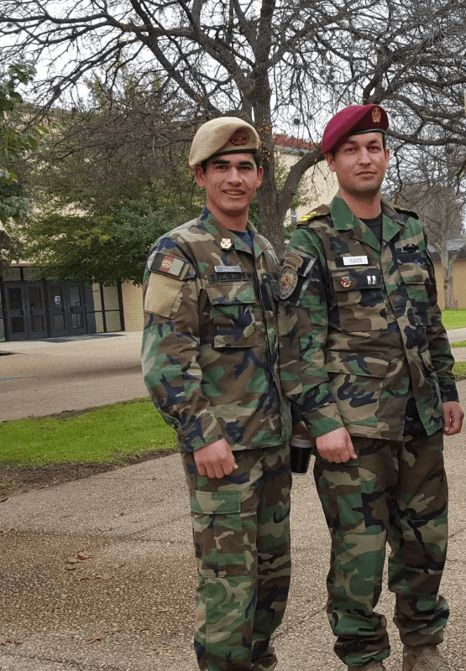
Nezam on left after proudly passing the grueling Q Course to become an elite Green Beret with his commanding officer Jamil.
Brian Glyn Williams
The Green Berets and their friends known as “shepherds” or “conductors” (named for the Underground Railroad slave rescuers) worked frantically day and night saving their Afghan friends in harrowing escapes that are the stuff of a Hollywood movie. These dramatic escapes included several in which Afghan soldiers and their family snuck through Taliban checkpoints, fought their way through desperate throngs swarming the Kabul airport, sloshed through a waist high open sewage canal, and squeezed through a four-by-four jagged hole cut in the airport fence by Scott’s Marine friends to be evacuated at the last minute on one of the final evacuation flights.
In the chaos of the airlift known as Operation Allied Refuge, the Afghan soldiers and their families said goodbye to the only world they had ever known. As their massive C-17 Globemaster planes soared over the brown Hindu Kush Mountains one last time, the traumatized, but thankfully alive pro-American Afghans made their way with great trepidation to the world of their American “big brother” to rebuild their shattered lives.
What stood out in these stories of friendships forged by men from places as far apart as Riverview, Florida, hometown for Scott Mann, and Sheberghan, Afghanistan, hometown of the Uzbeks Nezam and General Dostum, was how strong the bonds between them were, even though they came from vastly different worlds. In fact, I would describe them as coming from different times when you compare the modern society of America with the primordial land of Afghanistan that I found to be beyond Medieval, it was Old Testament Abrahamic. And the people who lived there had ancient codes of hospitality that meant if they welcomed you into the embrace of their home or qaum (clan) they were honor bound to die to protect you.
Dostum and Mark Nutsch warmly celebrating their friendship and victory as the campaign came to an end in a goodbye ceremony held by the Uzbek commander in his base at Khoda Barq.
Brian Glyn Williams
I received this protection from tribesmen while working undercover for the CIA tracking suicide bombers in Afghanistan’s Regional Command East and it literally kept me alive in that dangerous realm (see a declassified version of the findings of my work for the Agency on Taliban suicide bombing here). Earlier Dostum also had an Uzbek guard follow me everywhere I went and he even slept outside my door on a roll up carpet to protect me. Hollywood captured this sort of friendship in the haunting war movie The Covenant starring Jake Gyllenhall as an American soldier who is saved in an ambush by his “terp” (interpreter) Ahmed and then returns to Afghanistan to pay him back and save him after the Taliban launch a nationwide hunt to kill his Afghan friend. The movie ends on a somber note noting that more than 300 Afghan interpreters left behind in the American evacuations were captured and murdered as “infidel traitors” by the vengeful Taliban since their takeover in 2021.
Tens of thousands of Afghans like Ahmed helped America ensure that Afghanistan never again became a springboard for Al Qaeda mass casualty terror on the homeland. In my journeys I found these pro-American Afghan men and women everywhere. I encountered women schoolteachers, policewomen, female commandos, nurses, doctors, member of parliament, and even women pilots and a governor. I met men who served us as drivers, cooks, mechanics, base guards, interpreters, policemen, governors, Army troops, NDS (National Directorate of Security) operatives, transport drivers, and air force pilots. They all dreamed of a better future for their nation. One free of the black turbaned terrorists.
But their dreams ended in the fateful summer of 2021 when the small footprint of American Special Force enablers that had been the finger in the proverbial dike was yanked out by the politicians. Like many of my friends in the Agency and Army, I was horrified when the Trump administration under Secretary of State Mike Pompeo signed a cave-in troop evacuation treaty with the Taliban at Doha in 2020 that gave the country over to our terrorist enemy. The President Biden administration foolishly honored and implemented it in the summer of 2021. To my horror and that of my Afghan friends, our nation surrendered the pro-women’s rights, pro-minority rights democracy we had constructed with so much blood and treasure in the strategic country of Afghanistan to the pro-Al Qaeda Taliban fanatics without a fight. One dear Uzbek friend told me “It was shameful and dishonorable way to unilaterally end our joint war on the terrorists. We wanted to keep fighting. But the Americans snuck out of Bagram [Airbase] without even telling us. We were stabbed in the back.”
I had nightmares that terrible August as I received desperate calls from abandoned Uzbek friends who had offered me panagha (sanctuary), including one in Sheberghan who was captured by the notorious Taliban Sara Khita Blood Unit and his leg cut off as punishment for his friendship with the American “Great Satan.” In anguish and sorrow, I wrote a photograph homage for HNN for the Afghans who had befriended me. It was a requiem in photos to the lost world of smiling girls in schools now burnt, democracy now banned, protected pro-American minorities like the Uzbeks, Tajiks, Turkmen and Hazaras now terrorized, and free women now enchained by the fanatics in a dark religious prison camp. But at least I took solace from the fact that so many of the Afghans who had identified with our goals in Afghanistan and stood up to the terrorists had been evacuated in the chaotic August 2021 airlift aptly known as Operation Allied Refuge.
But many of our most stalwart Afghan friends, especially provincial Uzbeks and many commandos, were left behind. And since 2021 they have faced a terrifying nationwide hunt as the vengeful Taliban swept the country capturing their pro-American enemies and subjecting them to unimaginable torture including amputations, whipping and dismemberment, public executions, and a fate worse than death in their dark Medieval torture prisons.
The Taliban Hunt for pro-American Soldiers.
The heart-breaking thing about leaving so many of our allies behind is that many of them truly idealized America and everything it stood for. To the degree that they were willing to stand up to the terrorists and fight and die alongside their American friends. Especially the elite Afghan Army commando units like the APU Afghan Partnering Unit. This is a legendary fighting group I got to know and have written expert witness affidavits for as they now face the sudden terrifying prospect of deportation from America back to Taliban-controlled Afghanistan under the Trump administration. The elite APU Special Forces unit became known as Ktah Khas Afghanistan—roughly “Afghan Special Battalion”—and by the middle of the 2010s it was designated as Afghanistan’s highest ranked Tier 1 special-mission force. It was trusted by the Americans with Top Secret level missions in a time when there were defections among the less trained, normal rank-and-file Afghan National Army conscripts.
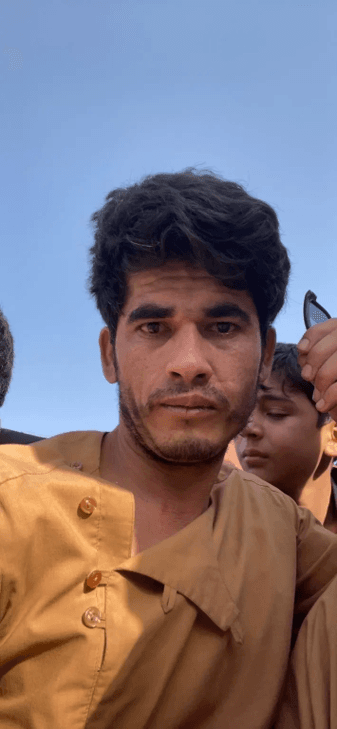
A selfie Nezam took of himself at the Karzai International Airport as he tried to get through the crowds and flash the Marines guarding a small hole in the fence a pineapple screen shot showing he was cleared for evacuation.
Brian Glyn Williams
The American CIA Special Activity Division and JSOC (Joint Special Operations Command) elite shadow warriors like the Navy SEALS, Army Rangers, and Delta Force considered the APU to be a de facto adopted Afghan wing of their famed fighting units. The hyper loyal APU was trusted and fought alongside their American partners in countless desperate battles along the Afghan Pakistan frontier. What is most extraordinary about the legendary APU is that the head of US CENTCOM Admiral William McRaven described them as the unit that “Went on target with JSOC forces to ensure that we had an Afghan that was going through the door first, that was making first contact with the locals.” In other words, when a U.S. commando team fast roped from Black Hawk helicopter onto a suspected Taliban compound and breached it with C 4 explosives, it was the Afghan commandos who were the first ones in the door with guns blazing. And all too often they were the first ones to pay the ultimate price for their bravery.
The elite, deeply loyal to America APU members often adopted, or were given, American nicknames from their much-admired American Special Forces “big brothers.” I knew of an Afghan Special Force operator named Faridun who became “Fred” and another nicknamed for the NASCAR driver Richard Petty. The APU Special Forces and other Afghan Army or NDS (National Directorate of Security) commando also adopted American soldier practices like dipping SKOAL tobacco, getting “sleeve” tattoos, and they typically wore Oakley wraparound sunglasses and baseball caps for American teams like the Boston Red Sox or Yankees that they adopted. These elite Afghan Special Forces troops, who deeply admired America and its soldiers, expertly picked up American accents and slang and were clearly American “wannabes.” One I met named “Sam” had a perfect New Jersey accent from watching episodes of Sopranos and partnering with an American from New Jersey.
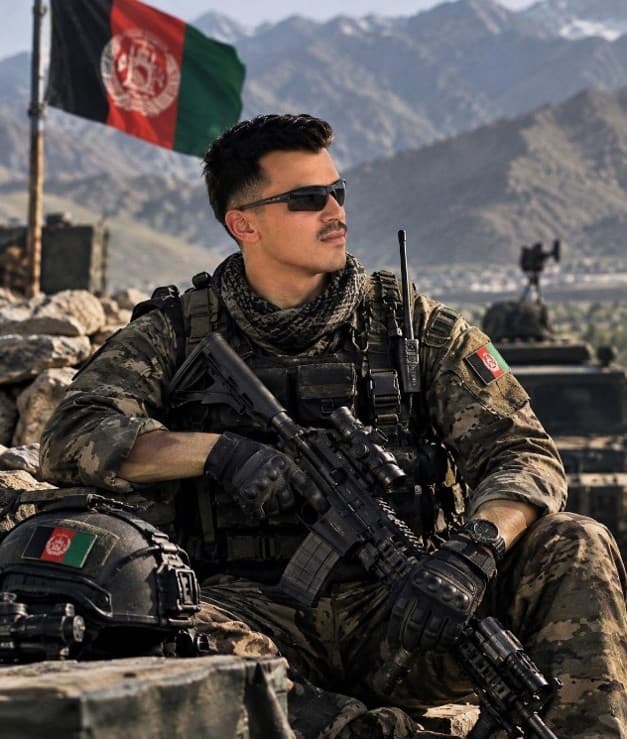
An Afghan National Army commando.
Brian Glyn Williams
And Afghan commandos like Nezami helped the Americans destroy the remnants of Al Qaeda and ensure the notorious terror group never again carried out a mass casualty terror attack on U.S. soil. The respected military journal Small Wars Journal has published an article that refutes the widespread but false notion that all Afghan fighting forces threw off their uniforms and defected or collapsed when the Americans abandoned them in the fateful summer of 2021. This article shows that the elite Afghan commando units like the elite NDS and APU fought ferociously to the bitter end against their hated Taliban foes as the enemy advanced.
As the regular Afghan National Army melted that summer in valley-by-valley defections, the elite commando fighting units refused to surrender. Many of them went down fighting with honor with guns in their hands as relayed in several riveting scenes in Scott Mann’s book. This Small Wars Journal article titled “The Afghans who Fought” relates the APU had a “solid reputation as determined fighters.” Its reputation for skill in combat and loyalty was un-matched by any unit other than the NDS. This source further describes the Afghan Special forces as a “dependable partner.” It notes of this battle-tested fighting force;
As the security situation in Afghanistan deteriorated and province after province fell, many Commando units continued fighting. Around Kandahar City, Commandos and other security forces battled that Taliban for more than a month…Even after the fall of Kabul, several Commando units refused to give in and began the slow march to the Panjshir (Valley of resistance), where a nascent resistance to the Taliban was building. Other units moved to the Hamid Karzai International Airport and helped secure the outer perimeter during the U.S. led evacuation.
When the Americans abruptly departed and left Karzai International Airport in Kabul as the only air exit for evacuations, many of these brave Afghan soldiers who so admired and emulated Americans were left trapped and isolated in remote bases, especially the provincial Uzbeks from the north who had less ties to Kabul than the ruling Pashtuns. Others in Kabul simply could not get through the desperate hordes trying to escape at the Kabul airport and they were left behind in a land controlled by the enemy they despised. As the Taliban tidal wave swept over the country these brave but abandoned Afghan soldiers tearfully burned their prized military uniforms, awards, commendations and service papers that had once meant so much to them and went into hiding. Their sense of betrayal was as powerful as their fear of being hunted down and killed in the Taliban’s vast nationwide hunt for “disbeliever traitors” who were all too often captured in night raids and publicly tortured to death in front of their families and friends.
Human Rights Watch was to report on the mass killing of thousands of Afghans who sided with the Americans “In many cities, the Taliban searched for, threatened, and sometimes detained or executed former members of the Afghan National Security Forces, officials of the former government, or their family members.” This source also stated:
Taliban forces in several provinces carried out retaliatory killings of at least dozens of former officials and security force personnel. After the Taliban took control of Malistan, Ghazni, in mid-July, they killed at least 19 security force personnel in their custody, along with a number of civilians. Advancing Taliban forces killed at least 44 former security force in Kandahar after the Taliban captured Spin Boldak in July. All had surrendered to the Taliban.
I am close to several former government employees who move furtively among friends’ houses trying to avoid the Taliban police and spies who regularly raid houses. There are many reports of former Afghan National Army troops or NDS members being hunted and executed by the Taliban. Below is a typical account of the desperate plight of former Afghan government soldier trying to hide from “door to door” Taliban raids:
When the Taliban took control of Afghanistan in a sweeping offensive last month, they promised a "general amnesty" to all Afghans, including those who had worked for the previous government or with foreign forces. Despite their promises, multiple sources told Insider that Taliban fighters have been going door-to-door hunting for former government officials to carry out revenge killings.
Many former Afghan National Army soldiers left behind have been arrested and “disappeared” or their mutilated bodies have been found after being tortured by the Taliban. In an article titled “Taliban Kill ‘Disappear’ Ex-Officials” Human Rights Watch records, “During searches, the Taliban often threaten and abuse family members to make them reveal the whereabouts of those in hiding. Some of those eventually apprehended have been executed or taken into custody without acknowledgment that they are being held, or information about their location.” Below is a typical account of a former Afghan Army commando who was captured, tortured and killed by the vengeful Taliban:
Ali Gul Haideri had been one of Afghanistan’s most elite soldiers. His work with American Special Forces put a target on his back when Kabul fell to the Taliban. Ali and his young family struggled to get on one of the planes departing Afghanistan as the Taliban took over. Soon after, he was captured and tortured for over a month. When he was released, Ali fled with his wife and child to a neighboring country. But mass deportations sent them back into the Taliban’s arms one year later. In early 2024, Ali was shot dead in Kabul.
Other former Afghan National Army soldiers who were not among the thousands suspected of being killed, imprisoned or tortured live in the shadows hiding dreading being turned in by informers to the Taliban. NPR reports one such case that exemplifies the terror America’s abandoned allies face from Afghanistan’s vengeful new Taliban rulers after they took over their bases and forced the former soldiers to flee the country or go into hiding:
Hayatullah says he left the base on foot. He walked for days, avoiding the main roads. Eventually he made it home to his village, where he kept a low profile, doing mostly farm work… When two police officers disappeared from a neighboring village this summer, Hayatullah says, he knew he was next. The village elders also warned him. “You are not safe here anymore,” he says they told him. He is hiding in Kabul, where he feels safer, because of the sheer number of residents.
The most terrifying aspect of the Taliban’s vast nationwide hunt for former Afghan Army troops is the fact that they used captured Afghan government digital identity and payroll systems containing former Afghan government employees’ personal and biometric data, including iris scans, fingerprints, photographs, occupation, home addresses, work records, phone number, and names of relatives. This gives them unique granularity of detail on where their Afghan Army enemies live so they can hunt them down and kill them. Below is a typical account of an NDS commando who was executed by the Taliban after they gained control of the previous government’s employee records:
The Taliban, through their intelligence operations and access to employment records that the former government left behind, have identified new targets for arrest and execution. Baz Muhammad had been employed in Kandahar by the National Directorate of Security (NDS), the former state intelligence agency. Around September 30, Taliban forces came to his house in Kandahar city and arrested him; relatives later found his body. These continuing executions have generated fear among former government officials.
But veterans of America’s war in Afghanistan who have established dozens of organizations where they step into the breach from the government’s negligence in protecting its allies take consolation in the fact that approximately 200,000 Afghan soldiers, interpreters etc. and their families were rescued from the vengeance of the Taliban and given sanctuary in America. Most were settled in California, Pennsylvania, Virginia and Washington DC where they have been successfully integrated often with assistance by veterans’ groups, local churches, and charities.
Afghan Special Forces soldier Salam.
Brian Glyn Williams
These groups have been active in not only getting their loyal Afghan partners rescued but in lobbying for their rights in Congress and helping them adjust to their new lives in America. They represent the loyalty of the armed forces to their battlefield allies that is a matter of honor for them. But unfortunately, there has been a growing tide of Afghanphobia from politicians who did not forge friendships with the Afghans and are now trying to get them sent back to very land where they are being hunted by the Taliban for allying with us. Opposed to them are veterans and members of Congress who served in the military who are fighting to save their brothers in arms from a terrible fate.
The Rise of Afghanphobia in America Threatens our Afghan Friends.
Those fighting men like Mark Nutsch and Scott Mann who have been ‘downrange’ in the war zone, know that America’s greatest asset in fighting the Islamist fanatics is men and women of good will like the stalwart pro-American, anti-ISIS Kurds in Syria who sacrificed 11,000 fighters lives destroying the ISIS Caliphate alongside the Green Berets, the famed Uzbek and Hazara horsemen in northern Afghanistan, the NATO member Turks who fought with us in Korea and Afghanistan, and the Jordanians currently hosting our troops in the Middle East. Tragically this awareness of our Muslim allies’ key role in the war is increasingly under assault in much of America today. Many of the Afghans who served faithfully alongside our troops and were evacuated here in 2021 are being arrested and sent back to near certain imprisonment, torture and death in Taliban-controlled Afghanistan. Headlines like an August 15, 2026, NPR report titled “They fought for the U.S. in Afghanistan. Now they worry about losing their green cards” capture the dread these Afghan fighting men who fought and bled alongside American troops face as their American allies move to remove the panagah protection they thought they had in a land they admired and fought for.
I have testified in over two dozen cases as an expert witness in which Afghan National Army troops or members of the Afghan NDS (National Directorate of Security) and Army commandos have been arrested in America and are facing deportation to a land ruled over by their merciless Taliban enemy. They are usually the hardworking bread earners of their families and are in despair as they languish in prison for the crime of having trusted their American allies. They face the real threat of being deported back to Afghanistan where their biometrics will be on the Taliban officials at the airport’s database and they will be immediately arrested upon arrival for having served alongside the Americans against the Taliban. It is no exaggeration to say that deportation to Afghanistan is a de facto death sentence for many of these allies who fought in the frontlines against the Taliban alongside their American friends.
The Taliban are a remorseless regime of black turbaned Medievalist terrorists with long memories that has vowed to kill the pro-American “disbelievers” like Dostum (who fled the country after a bitter battle that almost cost him his son) because they killed so many of their Taliban comrades while fighting alongside the Americans Understandably, these honor-bound Afghan warriors in America who often shared their simple homes, food and panagah protection with their American “brothers” do not understand this stunning and dishonorable betrayal of friendship that could literally cost them and their families their lives.
But the Trump administration has shown little gratitude to these Afghan battlefield allies or concern about their fate should they be deported back to the land they and their families fled in 2021. On the contrary, it has stoked fear and suspicion towards the Afghans. In 2025 and 2026, the Trump administration suspended or restricted several pathways used by Afghans to enter or remain in the United States. It also ended Temporary Protected Status for Afghans who were evacuated and many of them have been detained and imprisoned. It has also deported Afghan asylum seekers to dangerous third countries like South Sudan, the Central African Republic, or Congo.
In addition, in April 2025, the Trump administration announced the termination of Temporary Protected Status [TPS] for Afghans. Remarkably, the administration said its review concluded that Afghanistan no longer met the statutory requirements for TPS as there was no more risk of violence towards the Afghans who fought for America from the Taliban regime. As a result, thousands of Afghans in America were expected to lose the TPS protection. Completely ignoring the sort of horror stories that I have laid out above, the administration implausibly argued that conditions in Taliban-controlled Afghanistan had improved sufficiently for former Afghan soldiers to be repatriated back to Afghanistan! Scores of Afghan soldiers living in America have also received notices that their SIV (Special Immigrant Visa) status has been revoked and they now face deportation to Afghanistan or some other dangerous, war torn third country usually in Africa.
Some anti-Afghan Republican politicians have called for broad deportation measures affecting all Afghans in America with Republican Mary Miller of Illinois writing "Deport them all. Now.” The result has been a striking setback for Afghans who risked their lives helping American forces fight the Taliban but now live in fear of the immigration authorities. A typical example of this stunning reversal took place in 2025 when Sayed Naser, an Afghan soldier who had fought alongside U.S. troops against the Taliban, was detained and imprisoned by ICE (Immigration and Customs Enforcement) after appearing at a pre-scheduled immigration hearing in San Diego. CBS News reported that Naser had been legally paroled into the United States, had an active asylum case, and had a pending Special Immigrant Visa application based on his history of actively supporting the U.S. military efforts against the Taliban. In a heartbreaking statement reported by Military.com, Naser described the experience in deeply personal terms stating “I believed in you. I worked with you. I helped you for years, side by side.” He continued in despair, “Now, I sit in detention treated like a criminal for doing exactly what I was told to do.” And he had a personal message for President Trump
To President Trump, I love America, and I was building a life here. I had a car. I had a bank account. I had a job. Who will take care of all that now that I'm in detention? Instead of locking us away with no warning, why not offer us a shelter or some support?
Another former Afghan interpreter was detained and put in holding in Connecticut after appearing for a routine green-card appointment, according to the Washington Post. The newspaper reported that attorneys for him provided military contracts, certificates, recommendation letters and immigration documents describing his work for U.S. forces. But none of this mattered in the new anti-Afghan climate where the welcome mat to our allies was being removed. His lawyers were not successful as the administration was pushing to get Afghans like him deported no matter the cost.
The Afghan troops and interpreters living fearfully in America understandably feel a huge sense of betrayal mixed with dread at the prospect of being deported back to Afghanistan or to some third country in Africa like South Sudan which is threatened by Taliban-style militias like the notorious Janjaweed. One immigration advocate has reported the shock and despair many of the vulnerable Afghans who are integrated into schools, jobs and communities, feel when they face sudden detainment in prison and deportation to Taliban controlled Afghanistan, “These folks were on the frontlines of, our war. They were interpreting. They were enabling our mission. Now it feels like it's all coming crashing down and they get no explanation of what to do."
Many of these loyal pro American soldiers now live in fear of being detained by ICE. One Afghan Army immigrant worried "I've been here for more than four years, and then in the next year, I am eligible to apply for my citizenship. But when I go to the USCIS [United States Citizenship and Immigration Services], I'm stressed that they will detain me." Veterans have been horrified by what they saw as a betrayal of their Afghan friends like Nezam. The Washington Post was to report on the widespread concern among veterans who served in Afghanistan in an article titled “Veterans recoil at Trump plan to end Afghans’ deportation protection.”
In announcing an end to Afghans’ TPS, the administration said there have been “notable improvements” in Afghanistan under the Taliban’s authoritarian rule — a claim the Afghans’ advocates call fundamentally wrong. “To me as a veteran, that’s incredibly offensive,” said Andrew Sullivan, a former infantry company commander in Afghanistan.
Matt Zeller, a former CIA officer whose Afghan aid organization No One Left Behind maintains contacts with American veterans seeking to provide assistance to Afghan interpreters and troops, has summed up the predicament of abandoned Afghan allies who face the threat of deportation to Taliban controlled Afghanistan:
Simply put, they’re going to be murdered. [The Taliban] declared them to be something called apostates, which, in their perverted view of Islam, means they have to be killed. There’s a commandment from God that requires them to do it.
Shawn VanDiver, president and board chairman of #AfghanEvac, a coalition of groups that have worked to extricate and protect vulnerable Afghans, said of the murderous Taliban regime:
They kill people for being associated with us. These [Afghan immigrants in America] are people whose only ‘crime’ is having lived, learned or worked in the United States. And now, with TPS terminated and no viable pathway forward, they face an impossible choice: return to persecution or risk deportation from the very country they trusted.
Veterans have organized around the proposed Afghan Adjustment Act, which seeks to allow qualifying Afghan evacuees to seek permanent residency after additional screening. In 2022, Army veteran Matt Zeller and other veterans drove across the country to persuade Republican senators to support the legislation. Zeller fears that Afghans who fought alongside America against the Taliban who are deported back to the land of their hated enemies will be killed and has stated:
The Trump administration knows what’s going to happen to these folks. They’re not stupid. They understand that the Taliban is going to kill them when they get back to Afghanistan…They just don’t care.
For two decades, tens of thousands of Afghans served alongside the United States military, intelligence agencies and diplomatic missions. It is a little-known fact that as many as 69,000 of them died fighting the Taliban insurgents as allies (i.e., they lost 11,000 more troops than we lost in Vietnam). And as I saw for myself while working for the US Army on a Forward Operating Base in Regional Command East, Afghan “terps” or interpreters accompanied American troops into combat zones and were crucial to our mission success. Afghan commandos gradually became the lead element on night raids on Taliban hideouts as we ended our lead role in the war by 2014 and terminated Operation Enduring Freedom. And no unit, be it American or Afghan, suffered more higher percentage of deaths than the Afghan Partnering Unit Special Forces. No one knows that better than the Green Berets, Delta Force operators, Navy SEALs, Army Rangers, and CIA Special Activity Division operatives who worked with these brave Afghan commandos who were the tip of the spear in the war.
One of the biggest fear the veterans have is on the messaging the Trump administration’s policies of deporting Afghan partners have on future allies who we may call to stand up to our enemies in future wars if we betray our current battlefield allies. It is this feeling and a sense of gratitude that has driven many members of Congress from both parties to defend the Afghans. Republican Senator Roland Tillis best summed up this drive to honor our debts to the Afghan allies when he said:
I’ve heard from countless North Carolina veterans who are forever indebted to the brave Afghans who risked their own lives to protect them and advance our common mission in Afghanistan. We owe it to our Afghan allies to provide them with a fair and efficient refugee process that recognizes the sacrifices they made alongside America’s finest.
It remains to be seen whether Tillis’ calls for offering a fair refugee process will be enacted upon in this climate of rising Islamophobia. There is a fear that the Trump administration will get around the issue of deporting Afghan veterans to Taliban-controlled Afghanistan---where they face the almost certain fate of death, torture and imprisonment---by sending them instead to third countries of unimaginable violence, disease and poverty like Congo and South Sudan.
Thus, tens of thousands of Afghan soldiers living in precarious limbo in America face the sort of xenophobic hatred that drove racists in Louisiana to burn the fishing boats of pro-American Vietnamese immigrants who fled the conquest of their homeland by the Communist Viet Cong in the 1970s as the Trump administration taps into deep seated and hyped, alarmist fears of threats like a “Taliban-style shariah Islamic law” takeover of America. And it also remains to be seen whether the pro-Afghan immigrant voices in Congress and the powerful veteran’s community can save their Afghan friends from deportation to a land that has been consumed by the very darkness they fought so hard to defeat.
Afternote.
On September 29th after a long legal battle, the Supreme Court ruled that the Trump administration can legally deport immigrants from Afghanistan and other countries to third countries in violence-filled dangerous places like South Sudan and Congo. But even as the administration moves to arrest and deport Afghans who fought alongside us, Mark Nutsch and Dave Tyson continue to work to get their abandoned Uzbek allies out of Taliban-controlled Afghanistan via their organization Badger 6 (which was slain CIA operative Johnny Mike Spann’s call sign). To contribute to this worthy cause please see the link here.
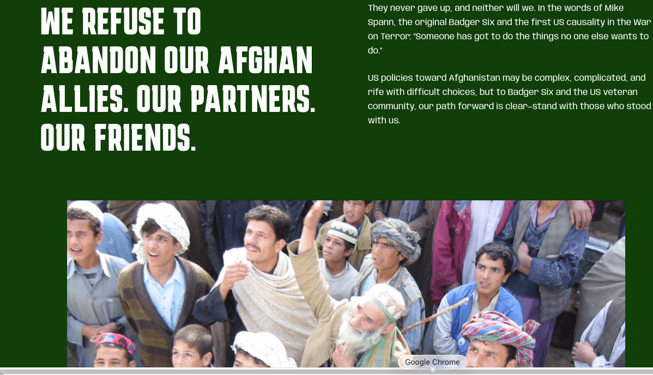
The Badger Six website run by Captain Mark Nutsch and Dave Tyson calling on Americans not to forget our abandoned Afghan allies.
Brian Glyn Williams
Scott Mann was able to evacuate his Afghan commando friend Nezam from Afghanistan at the last minute and ultimately ended up fulfilling his promise to get him to his home in Riverview, Florida and go fishing with him in the river running behind his house. In fulfillment of his honor bound promise, Scott worked with his local community to help Nezam and his family find housing, clothes, and schooling in his town. Scott is currently on tour doing a one man play about the frantic days where he and his team spent sleepless nights running their Operation Pineapple Express to save their friends from the chaos in Afghanistan as the Taliban swept to power. I had the pleasure of seeing his remarkable play titled “11 Days” in Connecticut with a veteran friend and like everyone else in the theater was awe struck and moved to tears by his powerful performance. Please see the link for his play here which was the most moving account of the war and the brotherhood it forged I have ever seen.
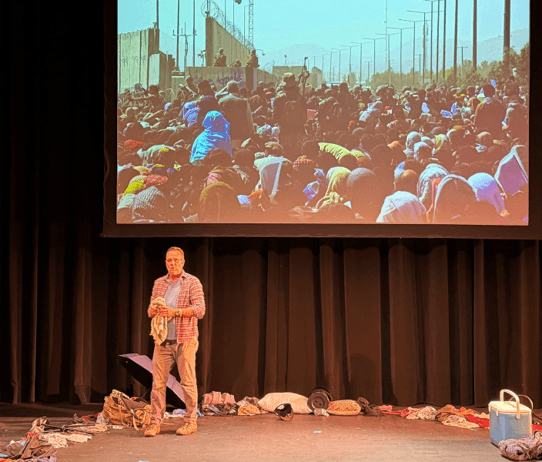
Scott Mann performing his riveting one man play about his efforts to save his abandoned Afghan friends “11 Days.”
Brian Glyn Williams
As for Nezam the brave soldier who was shot in the mouth during a Taliban ambush, he ultimately moved to Texas to build his life anew with his wife and three children…but when a hurricane devastated the west coast of Florida, he called Scott up and reported to duty proclaiming, “I have my pickup truck sir, where do you need me?”
Dedication. I would like to dedicate this article to all members of our military who fought in Afghanistan to protect the homeland and continue to wage an honor-driven battle to assist our Afghan allies and to all those Afghans who answered the call to duty to fight the terrorists and fought and bled alongside us in the war.
Brian Glyn Williams is Professor of Islamic History at the University of Massachusetts-Dartmouth and author of Afghanistan Declassified. A Guide to America’s Longest War which is a civilian version of a field manual he wrote for the US Army. In addition to working for the CIA in Afghanistan he worked on Forward Operating Base in Afghanistan doing Information Operations with the U.S. Army. His website can be found at www.brianglynwilliams.com
Reflecting on an Epic Horse Campaign in the Mountains of Afghanistan
By Brian Glyn Williams • RealClearDefense
The Godfather of American Foreign Policy Realism Speaks to Today’s World
By Francis P. Sempa • RealClearDefense
In Pursuit of Nuclear Abolition
By Peter Huessy • RealClearDefense
Innovation Alone Won’t Prepare the U.S. for the Future Battlefield
By Joshua Segal • RealClearDefense
The sUAS Tactical Trifecta
By Bryan T. Woody • RealClearDefense
Navy Civilianizes Six Former Flag Billets, Reduces Six to Captains
By Mongilio, USNI N.
Raytheon's $8B Contract for Strategic Comms Terminal Modernization
By M+A El
America’s Maritime Moment Will Not Wait
By CDR Salamander
Armor Up?
By Marine Corps Compass Points
Who Shoots Down the Drone Over the Shipyard?
By John Ferrari & Dillon Prochnicki • RealClearDefense