
Battleship Soldier
Last updated 09:07 PM EDT • Read time: 5m
What the U.S. Navy Could Learn From the Royal Navy
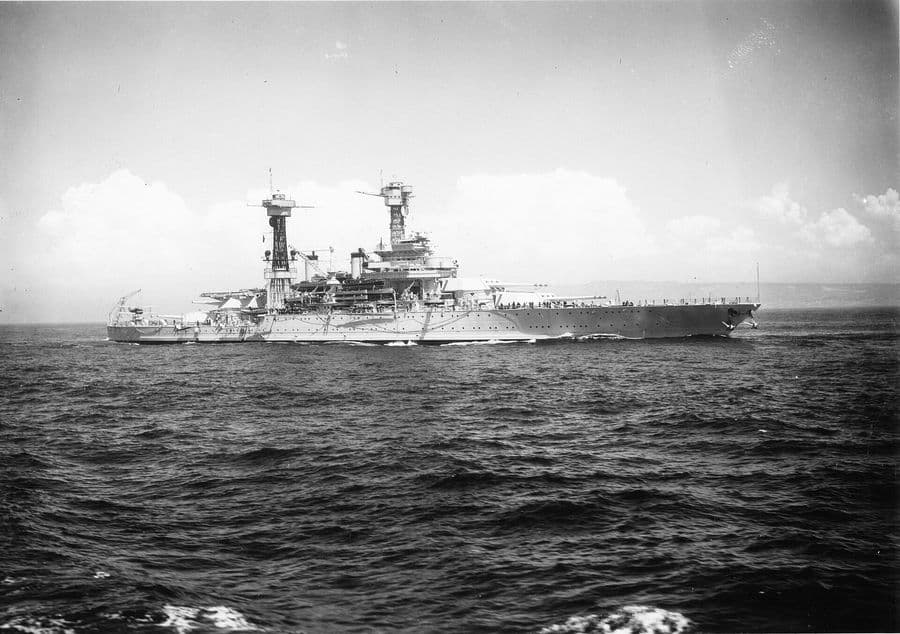
In his 1982 autobiography, Battleship Sailor, a U.S. Naval Reserve sailor named Theodore C. Mason talks about his days on the battleship USS California during World War II and learns an important lesson on the vital human element in naval combat. The book is extremely well-written, and at first, Mason, like many Americans who don’t know any better, has a low opinion of the Royal Navy, and in particular, a visiting ship, HMS Liverpool. He says: “She looked considerably smaller than her rated 9,400 tons and decidedly unshipshape; but then, we didn’t think much of the British Navy. In our minds we saw the Hood blowing up in a towering fireball, with a hanging column of black smoke as her funeral pyre. The Italians were the only ones the British seemed to have any success against, and the common attitude was that the cowardly Italian Navy was even more laughable than Nippon’s. Against one of our modern 10,000-ton light cruisers, we could easily see, the puny Liverpool wouldn’t have a chance. It seemed obvious why the Limeys were losing the war.” (p. 164)
No big surprises here, but Mason’s ethnocentric perspective begins to change once he gets a chance to go on a guided tour of a Royal Navy battleship and finds things that he really likes about the British way. Firstly, the battleship HMS Warspite has a great combat record, including the Battle of Jutland, where she distinguished herself: “Every schoolboy had read about Jutland, the epic naval engagement between the British Grand Fleet and the German High Seas Fleet on 31 May 1916. Accordingly, I knew about the Warspite. Then a nearly new dreadnought, turning in circles with a jammed rudder, she had shaken off salvo after salvo from [Admiral] Scheer’s main battle fleet while returning a murderous fire against the German battleships and [Admiral] Hipper’s force of battle cruisers. Now here she was at Pearl Harbor twenty-five years later, 30,000 tons of naval history.” (p. 165) Mason later concludes that “The Warspite’s past was indeed impressive.” (Ibid.)
Not only that, but once he comes aboard the Warspite, he notices that, despite all the things he may have heard, Royal Navy battleship officers were an improvement on their American cousins: “As I stepped from the after brow onto the quarterdeck of the Warspite, it seemed almost un-American to be saluting a foreign ensign and a foreign uniform, but I told myself I was actually saluting the ship’s glorious record. The officers did not seem as nattily uniformed or as taut as ours, but they more than made up for these deficiencies with their innate civility. Strange, I thought, that our officers, who had borrowed so much from the British, seemed to surpass them in hubris.” (p. 167) Furthermore, during his tour his Royal Navy escort is allowed to show Mason areas of the ship which he is not allowed to see on his own USN battleship, including officer’s country. (Ibid.) He also gets to see a Royal Navy cabin boy going about his duty on the Warspite, and although surprised that the British had children serving on their ships, he is forced to conclude that “… this pale, gawky adolescent, still too young to shave, already had more combat experience than anyone in the U.S. Navy.” (p. 168)
Additionally, he comes to realize that his earlier criticism of HMS Liverpool was probably unjustified and didn’t take full account of the importance of the human factor in war. As he puts it: “The other ‘experts’ and I hadn’t yet learned that combat-hardened crews in mediocre ships can often defeat untested and unblooded crews in superior ships.” (p. 164) Despite suffering from some embarrassment in the early stages of World War II, the Royal Navy has a tradition of excellence in its personnel, both officers and enlisted sailors. Its promotion system remains far superior to the U.S. Navy’s “Up-or-Out” nightmare, which came into effect in 1916. In this article from 2022, I argue that the American promotion system creates rampant careerism, and definitely undermines combat effectiveness. More to the point though, prejudice often disappears when one travels to other countries, or as it did in Mason’s case, to a Royal Navy battleship. For this reason, I would like to repeat some advice I have given to the U.S. Navy on previous occasions, and that is to make exchange tours with either the Royal Navy, the Royal Australian Navy or even the Royal Canadian Navy mandatory for future flag officers. By seeing how some of the most professional navies in the world operate, new U.S. Navy admirals might want to change the system and make their organization truly first-rate in all respects, including their people.
Roger Thompson is a Fellow of the Inter-University Seminar on Armed Forces & Society, a Research Fellow at Dalhousie University’s Centre for the Study of Security and Development, the author of "Lessons Not Learned: The U.S. Navy’s Status Quo Culture," and a former researcher at Canada’s National Defence Headquarters.
NOTES:
Theodore C. Mason. Battleship Sailor (Bluejacket Books). Naval Institute Press. Kindle Edition.
Roger Thompson. “Facing the hard facts about the ‘world class’ U.S. Navy”. Responsible Statecraft. September 8, 2022.

In Pursuit of Nuclear Abolition
By Peter Huessy • RealClearDefense
Innovation Alone Won’t Prepare the U.S. for the Future Battlefield
By Joshua Segal • RealClearDefense
The sUAS Tactical Trifecta
By Bryan T. Woody • RealClearDefense
The Revolutionary War: When Strategic Options Share the Same Weakness
By Henry Yep • RealClearDefense
The Houthis Are Testing the Limits of Collective Defense
By Saima Afzal • RealClearDefense

Who Shoots Down the Drone Over the Shipyard?
By John Ferrari & Dillon Prochnicki • RealClearDefense
Northrop Grumman Breaks Out the Big Guns at AUSA
By Daniel Terrill, Defense News
Army Pursuing Diverse Array of New Anti-Air Interceptors
By Trevithick, The WarZoneWho Shoots Down the Drone Over the Shipyard?
By John Ferrari & Dillon Prochnicki, RCD
F-35C Lands for the First Time on a Ford-Class Aircraft Carrier
By The Aviationist