
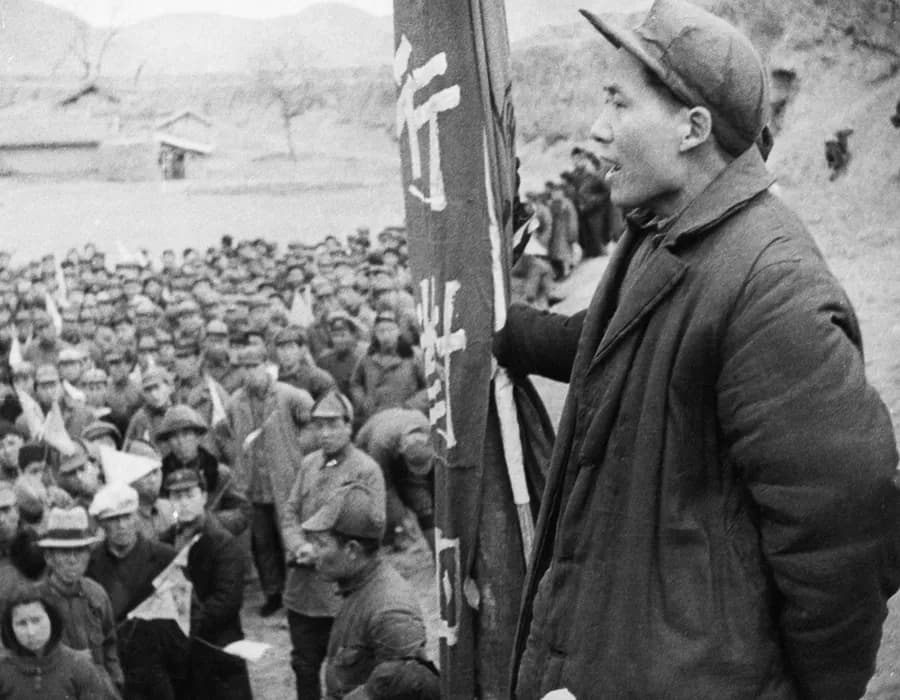
Mao's Triumph
Last updated 06:17 AM EST • Read time: 7m
The Strategic Alchemy Behind Victory in the Chinese Civil War
The Chinese Civil War was not merely a contest of armies, but a vessel in which the fate of modern China was forged. At its heart stood Mao Zedong, a leader whose success was neither inevitable nor singularly heroic, but the product of a dynamic interplay of confounding factors, others strategic blunders, and a mastery of narrative. This article argues that Mao’s victory was the result of exploiting external disruptions, capitalizing on his opponent’s missteps, and wielding a flexible, populist strategy that transformed the Communist Party from a marginal force into the victors of the Chinese Civil War.
The External Alchemy: America, Japan, North Korea, and the Soviet Union
American Policy: The Wrong Prescription
In the aftermath of World War II, China was a fractured nation. The United States, eager to stabilize the region, offered advice to Chiang Kai-shek, leader of the Nationalist government (GMD). But American solutions: coalition-building and military unification were ill-suited to China’s fragmented society. When Chiang attempted to eliminate warlord armies and unify command, thousands of disgruntled officers defected to the Communists, tipping the scales in favor of Mao, especially in Manchuria. The Nationalists not only lost troops but failed to leverage forces like the Manchukuo puppet army, whose 500,000 soldiers and equipment ultimately bolstered the Communist ranks.
Currency reform, another American import, sowed chaos in the Nationalist economy. Implemented during the height of conflict, these reforms accelerated military disintegration and eroded public trust.
Japanese Occupation: Recruitment by Brutality
The Japanese invasion left deep scars on China’s psyche and social fabric. Historians argue that Japanese brutality inadvertently fueled Communist recruitment. Mao’s cadres infiltrated Japanese-occupied areas, organizing resistance that provoked even harsher reprisals—the infamous Three-Alls Policy (“kill all, burn all, destroy all”).The GMD, as the ruling party during the Sino-Japanese War, bore the blame for failing to expel the invaders, while the Communists escaped criticism and positioned themselves as champions of national redemption
Soviet and North Korean Support: Rear Bases and Human Resources
The Soviet Union’s withdrawal from Northeast China was a calculated move to support North Korea’s militarization and indirectly aid the CCP. North Korea provided rear bases, enabling the Communists to shift troops and supplies beyond the reach of the GMD. around 500,000t-courted the GMD for the ethnic Korean population in Manchuria, integrating around 500,000 Korean minorities into the PLA . The GMD further alienated these potential allies through property seizures after Japan’s defeat.
The Counterproductive Factor: Chiang Kai-shek’s Strategic Missteps
Courting Institutions, Not People
While Mao built his power base among the peasantry, Chiang relied on military institutions and offered little to the rural masses except conscription and requisition. Communist land reform, though manipulative, temporarily won peasant loyalty. Yet, as some historians note, once peasants received land, they were less inclined to join the army, making recruitment a challenge. The CCP adapted by forming local militias and co-opting villagers to support the PLA.
Chiang’s attempt to unify command, ironically, drove more recruits to the Communists. By 1948,approximately half of the PLA’s soldiers had previously fought for the GMD. The Nationalists’ inability to enact meaningful land and tax reforms; increased the resistance from landowning elites and further alienated the population.
Economic Collapse and Loss of Legitimacy
Mismanagement, profiteering, and runaway inflation devastated the Nationalist economy Currency reform wiped out middle-class savings and eroded trust in Chiang’s rule. By 1948, only 21% of government expenditures were met through taxation; the rest came from printing money, fueling hyperinflation and undermining morale. The Nationalists lost the loyalty of the people, intellectuals, and agrarian communities, sealing their fate.
The Dynamic Factor: Mao’s Strategic Adaptability
Myth and Reality: Mao’s Leadership
Mao’s reputation as a military genius is enshrined in popular culture but contested by historians. Some historians argue that his tactical brilliance is a myth, amplified by victory and self-promotion. Mao was an intellectual, but his approach was often superficial. He synthesized material quickly and adopted interpretations dogmatically. Yet, his populist style and ability to command the narrative were critical to CCP unity during the war’s tumultuous final act.
Mao’s genius lay in his strategic flexibility. He recognized the need to adapt, shifting between guerrilla warfare and conventional operations as circumstances demanded. He was willing to regress to earlier stages of struggle if setbacks occurred, always framing reversals as part of a larger dialectical process. By defining progress as cyclical rather than linear, Mao could explain away failures and maintain momentum.
Propaganda and Control of the Narrative
Mao’s control of propaganda was essential. He transitioned from his famous seven steps to a three-phase approach in his writings on guerrilla and protracted warfare. By tying the pace of struggle to the will of the people and the strength of the enemy, Mao shifted responsibility for setbacks away from himself. In contrast, Chiang’s increasing tactical control made him personally accountable for defeats.
Western interpretations, like Henry Kissinger’s invocation of wei qi (Go) as a metaphor for Chinese strategy captures only a sliver of Mao’s political practice. The game emphasizes patient encirclement and positional advantage, but Mao thrived in volatility, bending chaos into opportunity rather than following a fixed board-game logic. While he maintained strict control of the revolutionary narrative, his campaigns often unleashed forces that rippled far beyond his inner circle, destabilizing the very structures he sought to command. Yet Mao remained adept at turning disorder into an instrument of survival. His strategic genius lay less in the orderly placement of stones on a board than in his chameleon-like ability to exploit shifting circumstances: warlord politics, foreign intervention, factional rivalries and weaponizing chaos itself. Kissinger’s analogy, while elegant and perhaps capturing aspects of Chinese Historical Strategy, ultimately oversimplifies a leader whose power rested not on static positional play but on the prudent management of turbulence.
The Cycle of War and Peace: Mao’s Enduring Contradiction
Mao’s philosophy was rooted in contradiction. He saw war as a monster to be eradicated by social progress yet believed that war itself could bring about peace. This paradox was embodied in his approach to revolution: a cycle of disequilibrium and equilibrium, each stage bringing China to a higher level of development. Mao’s ability to transform means and methods to meet changing strategic environments was critical to victory.
Yet, the cycle did not end with the civil war. Mao’s passion for perpetual revolution, and perhaps the confirmation bias that comes with success, led to his strategy consuming the social progress he had promised, leaving millions to bear the cost of his contrarian vision.
Conclusion: The Alchemy of Victory
Mao Zedong’s success in the Chinese Civil War was not the triumph of a lone genius, but the result of strategic alchemy. He exploited external disruptions, American missteps, Japanese brutality, Soviet and North Korean support—to weaken his enemies and strengthen his own position. He capitalized on Chiang Kai-shek’s strategic errors, economic mismanagement, and failure to win the loyalty of the people. Most importantly, Mao wielded a flexible, populist strategy, grasping the narrative and adapting to changing circumstances.
The blueprint of Mao’s victory was his ability to fashion external factors and then wield them against his enemies. It reminds us that revolutions are won not only on the battlefield, but in the hearts and minds of the people; and, that the cycle of war and peace is often more complex, and more costly, than its architects imagine.
S.L. Nelson has served from the tactical to strategic level. The opinions in this article are the author's own and not that of the U.S. Army or Department of War.

In Pursuit of Nuclear Abolition
By Peter Huessy • RealClearDefense
Innovation Alone Won’t Prepare the U.S. for the Future Battlefield
By Joshua Segal • RealClearDefense
The sUAS Tactical Trifecta
By Bryan T. Woody • RealClearDefense
The Revolutionary War: When Strategic Options Share the Same Weakness
By Henry Yep • RealClearDefense
The Houthis Are Testing the Limits of Collective Defense
By Saima Afzal • RealClearDefense

Who Shoots Down the Drone Over the Shipyard?
By John Ferrari & Dillon Prochnicki • RealClearDefense
Northrop Grumman Breaks Out the Big Guns at AUSA
By Daniel Terrill, Defense News
Army Pursuing Diverse Array of New Anti-Air Interceptors
By Trevithick, The WarZoneWho Shoots Down the Drone Over the Shipyard?
By John Ferrari & Dillon Prochnicki, RCD
F-35C Lands for the First Time on a Ford-Class Aircraft Carrier
By The Aviationist