
The St. Crispin's Day Speech—A Repudiation of Diversity and Inclusion
Last updated 06:39 AM EDT • Read time: 5m
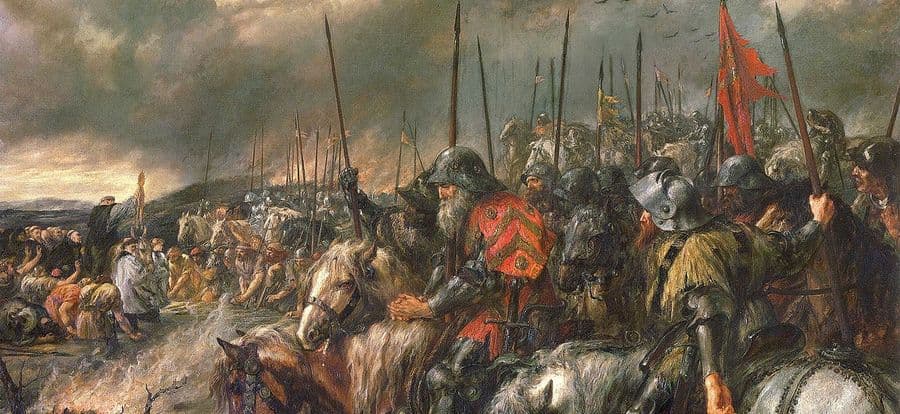
On St. Crispin’s Day, October 25, 1415, in the north of France, the Battle of Agincourt loomed. King Henry V’s army, beleaguered due to previous combat and disease, faced a French force six times its size. Confronted with discouraging odds, Henry positioned his troops brilliantly, took advantage of favorable terrain, and used his longbow archers to devastate a cumbersome foe. His victory set the stage for Shakespeare’s St. Crispin’s Day Speech in the play Henry V.
“From this day to the ending of the world,
But we in it shall be remember’d;
We few, we happy few, we band of brothers;
For he to-day that sheds his blood with me
Shall be my brother; be he ne’er so vile,
This day shall gentle his condition:
And gentlemen in England now a-bed
Shall think themselves accursed they were not here,
And hold their manhoods cheap whiles any speaks
That fought with us upon Saint Crispin’s day.”
Prior to battle, the situation appeared hopeless to the English army. Henry’s men kissed the ground on which they stood, for surely this was their final resting place before the day was done. Knowing his life and the destiny of England depended on his men’s courage and cohesiveness, Henry rallied their spirits by delivering the “St. Crispin’s Day Speech.” He reminded his cousin Westmoreland that the honor earned today will be remembered forever. Despite being outnumbered, Henry desired no reinforcements or cowards among his troops. Honor is a zero-sum game – a finite quantity that cannot be shared with those who are unworthy. The upcoming battle presented a cherished opportunity, and those absent would envy the participants and curse themselves for not being a part of history.
In Shakespeare’s time the word “vile” also meant someone of a low social class. Social barriers and petty prejudices abounded in fifteenth century England. To accentuate the differences among his soldiers or criticize their individual value, Henry would have undermined his army’s morale and exacerbated an already desperate predicament.
Since antiquity, successful military campaigns have depended on the morale, cohesion, courage, and trust of the soldiers and sailors waging war. General George Marshall noted that morale is the key to victory, and Napoleon stated it is the most important factor that determines an army’s effectiveness. Eisenhower remarked, "Morale is the greatest single factor in successful wars."
This week the Heritage Foundation released a scathing report and awarded the United States military its first ever "weak" score, noting "underfunding, poorly defined priorities, wildly shifting security policies, exceedingly poor discipline in program execution, and profound lack of seriousness across the national security establishment."
A prime culprit for this denouement is the inculcation of Critical Race Theory (CRT), masquerading as Diversity, Equity, and Inclusion (DEI), into the fabric of the armed forces. DEI neither improves morale or combat effectiveness but rather divides, excludes, and betrays the mutual trust of those who serve.
Richard Delgado, founder of Critical Race Theory, laid clear the objectives and philosophy of the movement in the book Critical Race Theory. America's institutions are irredeemable, steeped in racial oppression, and must be replaced. Equality, freedom, meritocracy, and justice are merely instruments of this oppression. A color blind society is not an acceptable solution, for as CRT co-founder and Marxist Derrick Bell stated, "CRT recognizes that revolutionizing a culture begins with a radical assessment of it."
Inherent in CRT's doctrine is co-opting language to control the narrative. One third of the book Critical Race Theory is devoted to a glossary that specifically defines words and phrases. The importance of this tactic cannot be underestimated since it shields its adherents from criticism. They alone determine what is true and what is false.
DEI is not an innocuous program that advances fairness, dignity, and goodwill. It is divisive by nature and serves as an instrument to introduce CRT into all segments of the military. Its aim is to transform, confuse, and destroy a foundational institution of American society that is tasked to protect and defend the Constitution.
In September 400 of the 575 surviving members of the United States Air Force Academy (USAFA) Class of 1972 met for our 50th year graduation reunion. The attendees were polled about the current direction of USAFA, and only 13% supported the goals and vision of the Academy’s leaders. Of particular concern was a mandatory Diversity and Inclusion lecture warning cadets not to use the words “dad” and "mom,” and challenging the propriety of Dr. Martin Luther King’s statement prioritizing character rather than skin color. The use of preferred language and the emphasis on identity politics echo the teachings promoted by Delgado and demonstrates that CRT is being actively promoted in United States military academies.
As St. Crispin's Day and the anniversary of the Battle of Agincourt approaches, it is time to reassess the destructive nature of CRT and its offspring DEI that have laid waste to morale and the ability of the armed services to fulfill its most basic mission.
Scott Sturman is the President of the USAFA Class of 1972

Iranian Cyber Operations
By Michael Groen • RealClearDefense
Reflecting on an Epic Horse Campaign in the Mountains of Afghanistan
By Brian Glyn Williams • RealClearDefense
The Godfather of American Foreign Policy Realism Speaks to Today’s World
By Francis P. Sempa • RealClearDefense
In Pursuit of Nuclear Abolition
By Peter Huessy • RealClearDefense
Innovation Alone Won’t Prepare the U.S. for the Future Battlefield
By Joshua Segal • RealClearDefense

26th MEU – U.S. Needs Crisis Response MAGTF
By Marine Corps Compass Points
The Influence of History on a Sea Power
By CDR Salamander
Navy Civilianizes Six Former Flag Billets, Reduces Six to Captains
By Mongilio, USNI N.
Raytheon's $8B Contract for Strategic Comms Terminal Modernization
By M+A El
America’s Maritime Moment Will Not Wait
By CDR Salamander