
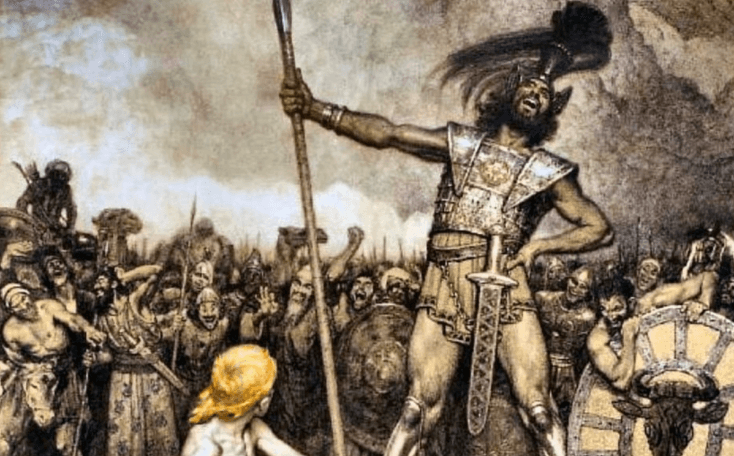
When Goliath Triumphed
Last updated 05:19 AM EST • Read time: 7m
The End of Everything: How Wars Descend into Annihilation by Victor Davis Hanson
Defeat is the feared conclusion of war but rarely is annihilation the outcome. Whether belligerents are nearly equal or frightfully mismatched, the defeated are typically relegated or dominated but not eradicated.
Victor Davis Hanson's latest examination of history, The End of Everything: How Wars Descend into Annihilation, immerses the reader in the rare episodes when the weak fatally misjudged the intentions and motivations of the strong.
Recounting the fate of extinguished civilizations, Hanson reminds the reader that victory in war is not always governed by norms or laws, or mercy and this reality tests the modern warfighter.
Four Case Studies in Annihilation
Hanson is an American academic with a focus on classical Greece and military history. Over the course of twenty-four books, Hanson has elaborated on the Greek approach to warfare and its centrality to the Western way of war. Hanson's scholarly intimacy with original Greek distinguishes his research while his elegant writing style transports the reader effortlessly between blood-soaked battlefields and scholastic reflection.
Hanson’s specialty is assembling battles spanning centuries and identifying underappreciated linkages and themes and The End of Everything represents his latest success.
In four vividly written chapters, Hanson catalogues each episode's prologue: Thebes dared to resist Macedonian domination; Carthage moved against a Roman ally; Constantinople stood as the final holdout to Ottoman manifest destiny; Tenochtitlan defied Spanish imperialism.
The pivotal moments: Thebes's allies abandoned it; Carthage savagely executed Roman prisoners of war; Byzantium's commanding officer fell victim to an Ottoman arrow; Tenochtitlan suffered a devastating smallpox epidemic.
And the particulars of their grisly epilogue: Macedonians invited Theban enemies to join in the slaughter; Romans destroyed every trace of Carthage; Ottomans reanimated Constantinople as Istanbul; Spaniards founded its New World capital upon the ruins of Tenochtitlan.
Nevertheless, not all of history's conquerors exterminate the conquered.
Then why these civilizations?
The March Toward Oblivion
In Hanson's estimation, the story lines begin with imperiled civilizations choosing between permanent subservience or annihilation and risking the latter on the basis of grievous miscalculations.
The defenders misjudged the durability of their defenses and had little to no insight as to their attacker's capabilities.
The besieged suffered from disunity and vainly waited for help from faithless allies.
The leadership failed to understand the degree to which the enemy's intentions had changed.
Lastly, and most consequentially, the temporal dimension prevailed -- "the longer the siege lasts, the more violence escalates, and the more savage the combatants become to end it."
As the cycle of escalation and brutality nears climax, the strictures of right and wrong recede and those poised for victory face a choice between cruelty and compassion.
In these case studies, the victors chose cruelty.
The victors substantiated the apocryphal Athenian boast made during the Peloponnesian War -- "the strong do what they can, and the weak suffer what they must."
Never Again – Right?
In quoting the Melian Dialogue, Hanson challenges modern warfighters to remember the present day is not immune to such sentiments.
For the reader, the episodes denote the barbarity of ancient history, the unruliness of medieval warfare.
With the separation of centuries, the reader can be confident that modernity, born of historical experience and technological advances, has made such war unthinkable, that it has ensured the obliteration of a civilization cannot happen again.
Until the reader peruses the news feed.
The twenty-four news cycle attests to the fragility of modernity.
Historical experience does not quell age-old animosities, and technological advances only tempt the vengeful.
The world's youngest nuclear powers, Pakistan and North Korea, were prepared to eat grass and endure famine to acquire weapons of mass destruction, respectively. Russia just increased its doctrinal reliance on nuclear weapons. Iran's reference to Israel as a conveniently "one-bomb country" is a brutish and grotesque hypothetical, but also a potential fait accompli that could not be reversed or punished commensurately.
Even the robustness of the nuclear taboo in the West may be overstated. A scholar recently found that majorities of sampled members of the U.S. public would support the use of nuclear weapons, depending on the circumstances (e.g. war, terrorism), and would deem the use ethical.
According to Hanson, "modern civilization faces a toxic paradox. The more that technologically advanced mankind develops the ability to wipe out wartime enemies, the more it develops a postmodern conceit that total war is an obsolete exercise… that war itself is an anachronism and no longer an existential concern."
The postmodern conceit is no more evident than in the latest war in the Gaza Strip.
Goliath Returns?
Multiple elements of Hanson's historical survey (written before the terrorist attacks of October 7, 2023) reverberate in this fifth war between Hamas and Israel.
Hamas overestimated the deterrent value of concealing its fighters and weapons among the civilian population.
Hamas underestimated the sophistication with which Israel integrated artificial intelligence into its military operations.
Hamas misjudged the depth of its support within Gaza.
Hamas's fellow Arabs never undertook commensurate strikes against Israel and Hamas never received substantial aid from its neighbors.
And, as above, lastly and most consequentially, Hamas misunderstood how the barbarism of the October 7 terrorist attacks would harden Israelis' hearts.
Seemingly routine years of anti-colonial resistance convinced Hamas that the latest escalation would only be met by counter-escalation constrained by respect for international opinion.
Instead, October 7 only convinced Israel to punish Hamas severely, to ensure that this latest act would be The Last.
Such determination characterized Macedonian, Roman, Ottoman, and Spanish decision-making; whether Israel has emulated their example has sparked considerable debate and agitation.
The Israeli Defense Forces (IDF) have decimated Hamas's political and military leadership as well as its governing capacity, killing 17,000 of its estimated force of 25,000 to 30,000 fighters. The IDF has also dismantled most of Hamas’ twenty-four battalions and has killed dozens of commanders and key leaders.
The number of dead is approximately 45,000, including more than 17,000 children and the number of missing totals more than 100,000. Israeli attacks have damaged or destroyed more than half of Gaza's homes and hospitals, more than two-thirds of its roads and farmland, and almost ninety percent of its schools. Almost two million inhabitants, ninety percent of the population, have been displaced.
In response, the International Criminal Court has issued arrest warrants for Israeli leaders for crimes against humanity.
Whether Israeli military operations constituted war or wanton violence will polarize observers and historians for years to come.
Goliath's Choice
Ultimately, The End of Everything is about war termination and the choice between retribution or magnanimity.
In Hanson's accounting, the aggressors ensured no future wars by annihilating their opponent -- the strong did what they could and the weak suffered what they must.
In the modern day, annihilation having been made unthinkable, the weak can suffer retribution or the strong can choose magnanimity.
A comparison of the two World Wars is instructive.
After World War I, the Allies imposed the harsh peace of Versailles on Germany. The terms only embittered Germany, prompting it to immediately began seeking the means to overturn the status quo.
After World War II, the cumulative destruction of both wars, as well as the cataclysm of the Holocaust, led the Allies to occupy and divide Germany and disestablish the foundational state of Prussia, the closest parallel to Hanson's case studies.
The Allies briefly considered the Carthaginian peace of the Morgenthau Plan, a proposal for a deindustrialized Germany, but instead recognized the need to rehabilitate it, especially in the face of the new Soviet threat. Indeed, the United States bolstered Germany (and Europe's) recovery by later enacting its inverse, the Marshall Plan.
Retribution ensured a second world war; magnanimity foreclosed a third world war.
To terminate the war in Ukraine, has the opportunity passed for magnanimity on either side? To end the conflict in Gaza, has Israel ensured there is no Sixth Gaza War or only another round of retribution?
Despite the centuries since Thebes, Carthage, Constantinople, and Tenochtitlan, modernity is no salve for the antagonisms that predate and postdate war and prevailing norms and laws will not ensure magnanimity. It is incumbent on practitioners and students of war to ensure war termination is not the end of everything.
R. Jordan Prescott is a private contractor working in defense and national security since 2002. He has been published in The National Interest, Small Wars Journal, Modern War Institute, 19fortyfive, and RealClearDefense.

Innovation Alone Won’t Prepare the U.S. for the Future Battlefield
By Joshua Segal • RealClearDefense
The sUAS Tactical Trifecta
By Bryan T. Woody • RealClearDefense
The Revolutionary War: When Strategic Options Share the Same Weakness
By Henry Yep • RealClearDefense
The Houthis Are Testing the Limits of Collective Defense
By Saima Afzal • RealClearDefense
Radio Frequencies in the Intelligence Ecosystem
By Craig Brower • RealClearDefense

Who Shoots Down the Drone Over the Shipyard?
By John Ferrari & Dillon Prochnicki • RealClearDefense
Northrop Grumman Breaks Out the Big Guns at AUSA
By Daniel Terrill, Defense News
Army Pursuing Diverse Array of New Anti-Air Interceptors
By Trevithick, The WarZoneWho Shoots Down the Drone Over the Shipyard?
By John Ferrari & Dillon Prochnicki, RCD
F-35C Lands for the First Time on a Ford-Class Aircraft Carrier
By The Aviationist