
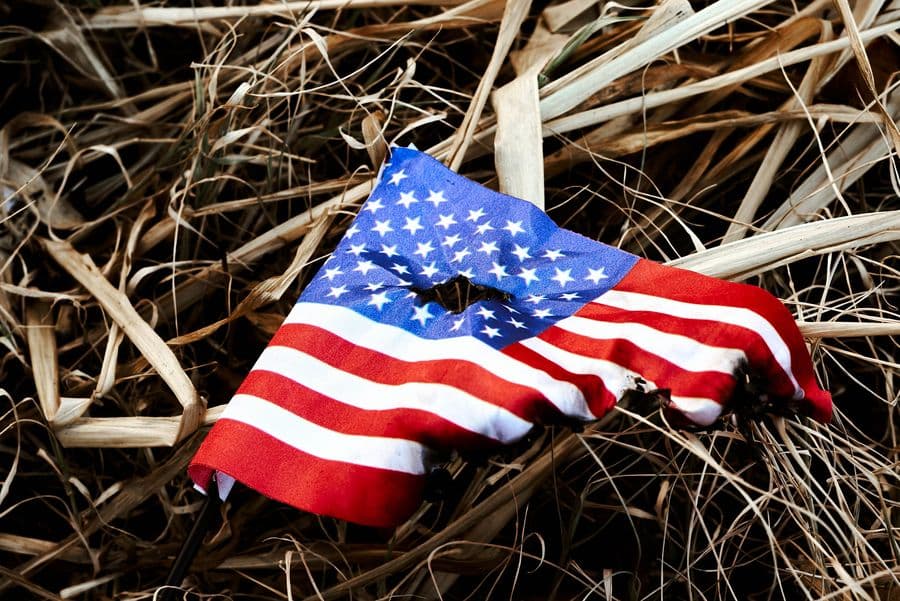
The Military's Extremist Stand-Down: Is the Cure Worse Than the Problem?
Last updated 10:55 PM EDT • Read time: 6m
The Jan 6 Capitol riots were a shock to the nation. How could a violent group of insurrectionists defile America’s sacred seat of government ‒ an unforeseen pernicious group that devolved into a violent mob of seditious actors. Who were these desecrators? Politicians and the media were quick to conclude they were far-right domestic extremists. But as details emerged that current and former military members were involved, the focus of guilt took a disturbing turn.
And in the crosshairs was the United States military.
Within a month of the riots, the newly appointed Secretary of Defense issued a rare department-wide “stand-down” to “address extremism in the ranks.” As far as the defense department was concerned, the Capitol riots were a testament to a military infiltrated by domestic extremists, and it was determined to root them out.
However, as Proverbs 19:2 reminds us, “he who hurries his footsteps errs.”
According to a new study by the Chicago Project on Security and Threats, which looked at the demographics of those arrested in the Capitol riots, investigators found something unexpected ‒ a demographic group, described as “common people,” predominantly unaffiliated with the military or aligned with extremist organizations.
Of those involved with the Capitol breach, 65% were 35 or over, 9% were unemployed, 13% were business owners, and 27% were white-collar – an atypical demographic for extremist organizations. Additionally, the study found only 10% of those arrested were affiliated with known right-wing extremist organizations.
Adding to this surprising discovery, according to a CBS report, of the 400 people charged in the Capitol riots (a total of 800 had entered the Capitol building), only 37 were military members or veterans. A disappointing number indeed but a fraction of those who breached the Capitol and a statistically insignificant number when weighed against the 2.2 million current service members and 18 million veterans.
In fact, according to a Pentagon press conference, in 2020, the FBI opened 68 investigations into current service members and veterans for “domestic extremism” ‒ or .000003% of the total military and veteran population. You are just as likely to be struck by lightning (1:500,000) as
finding an extremist in the ranks.
But the twists and turns didn’t stop here.
Shortly after the Capitol riots, politicians and the media abruptly concluded that it was not just far-right insurrectionists at fault but racially-inspired supremacist groups. On cue and with little evidence, the military marched in lockstep, making race the stand-down’s primary emphasis. As the secretary’s guidance underlined, “Service members…deserve an environment free of discrimination, hate, and harassment.”
Yet, according to the Chicago study, 87% of the Capitol rioters were not associated with far-right extremist organizations or hate groups. Somehow the riots went from being the work of a violent group of disenfranchised “common people” to a gang of far-right racial supremacists who had infiltrated the military – a troubling leap of faith.
Imagine a commander evaluating a combat operation with little intelligence about the enemy, its numbers, plans, or intentions. In short, to walk blindly into a battlespace looking for a non-existent enemy but never the less, convinced of its presence and motive. It would be a waste of precious resources and time ‒ and worse, create a suspicious and volatile environment for the innocent.
A direction that is creating more confusion than consent.
In a recent article, Some US troops view Capitol riots, racial protests equally, worrying Pentagon leaders, the author interviewed the Senior Enlisted Advisor (SEA) to the Chairman of the Joint Chiefs of Staff about the military’s concerns over dissenting opinions expressed during the stand-down training. He described the extent of objection from the troops as “coming from every echelon.”
Young service members were understandably contrasting the Capitol riots with last summer’s violence. Many are questioning the so-called “extremist” difference between the two events. However, instead of listening to their concerns and acknowledging that any violent associations are unacceptable in the military, the SEA attempted to answer ‒ that is, correct ‒ the troops by making sure “that military members understand the difference between Seattle and Washington.”
As if Seattle’s seditious autonomous zone has no place in this discussion.
But the SEA’s troubles didn’t stop there. He made matters worse by ominously commenting, “We have to educate them … No, that’s not what that meant,” referring to TV commentators who pointed out similarities between last summer’s protests and the Capitol attacks.
According to the SEA, the troops are wrong to compare the Capitol riots with last summer’s violence and to question it requires correction ‒ that is, to possible follow-up training. A disquieting Orwellian undertone.
So, where does this take us?
The Capitol riots were an egregious attack on the seat of government and the rule of law. But the questionable conclusion, hastily concocted by politicians and pushed by mainstream media, was a dishonest assessment of the problem and irresponsible association to the military.
The secretary’s stand-down is unwarranted, misinformed, and fueled by a suspicion of collective guilt. Reaffirming a service member's oath or, as the Navy requires, forcing them to repeat an incongruous “intersectional identities” pledge is a slap in the face to the military.
The last thirty years of spent blood and treasure deserve more than an unjustified conjecture of traitorous affiliations or hate-mongering. The deeds and sacrifices of the military deserve our respect and gratitude, not expedient politicized indictments.
The military is the last apolitical bastion of integrity and excellence, a group that stands between America’s foes and its people. Now is not the time to try to fix something that’s not broken ‒ otherwise, the cure will be worse than the problem.
Donald McGregor, Major General, U.S. Air Force, Retired, is an accomplished national security leader, fighter pilot, and career Air Force Officer with a diverse career, and expertise in Homeland Defense and National Guard issues. He was a former lead advisor to the Chief of the National Guard Bureau, who is a member of the Joint Chiefs of Staff. In this lead advisor role, he was the National Guard’s Director of Strategy, Policy, Plans, and International Affairs, developing overall strategy, Secretary of Defense (SECDEF) policy, and civil support planning for the National Guard’s warfighting, homeland, and international partnership missions.

Iranian Cyber Operations
By Michael Groen • RealClearDefense
Reflecting on an Epic Horse Campaign in the Mountains of Afghanistan
By Brian Glyn Williams • RealClearDefense
The Godfather of American Foreign Policy Realism Speaks to Today’s World
By Francis P. Sempa • RealClearDefense
In Pursuit of Nuclear Abolition
By Peter Huessy • RealClearDefense
Innovation Alone Won’t Prepare the U.S. for the Future Battlefield
By Joshua Segal • RealClearDefense

Navy Civilianizes Six Former Flag Billets, Reduces Six to Captains
By Mongilio, USNI N.
Raytheon's $8B Contract for Strategic Comms Terminal Modernization
By M+A El
America’s Maritime Moment Will Not Wait
By CDR Salamander
Armor Up?
By Marine Corps Compass Points
Who Shoots Down the Drone Over the Shipyard?
By John Ferrari & Dillon Prochnicki • RealClearDefense