
Bogged Down
How Rewilding Wetlands Could Shape NATO's Eastern Defense
Last updated 06:33 AM EDT • Read time: 7m
In the first century AD, two Roman centurions searching for sources of the Nile were halted by enormous marshes where the water was difficult to traverse even by small boat. The Sudd of present day South Sudan is a maze of channels, floating vegetation, mud and seasonally changing water, creating a formidable barrier even to this day. The account captures a durable strategic truth: sometimes the most effective obstacle is not a wall, but the ground itself.
Nearly two millennia later, NATO members are revisiting the same principle. Finland, Lithuania, Latvia and Poland are exploring ways to use environments as part of national defense. Their terrain-shaping measures include restoring selected landscapes, strengthening natural obstacles, narrowing an attacker’s choices and making geography work are becoming part of a larger defense-in-depth system.
The Strategic Value of Bad Ground
Land forces remain constrained by the terrain on which they travel and fight. Their heavy formations need routes that can carry their weight. A bog does not have to be literally impassable to make a difference in conflict. It only has to make cross-country movement slower, less reliable or more dependent on engineering support. If difficult ground restricts an invading formation to certain approaches, attacking forces are funneled into more manageable corridors.
A restored wetland is not an impenetrable barrier. Its objective is to constrain an adversary’s freedom of movement and increase the time, equipment and planning required to advance. Difficult terrain is most valuable when it is integrated into a doctrine designed to exploit the delay it creates.
For centuries, the Dutch turned water management into defense. Low-lying areas could be deliberately flooded to make them difficult to cross while increasing the importance of the remaining passages. Their system showed that a state can deliberately shape the mobility characteristics of its own landscape before an enemy arrives.
Restoring Obstacles
Finland now offers a modern expression of that logic. Researchers Jan Kunnas, Juha Mäkinen and Risto Sulkava have advanced a broader proposal for using natural barriers along Finland’s eastern border. In their 2026 article, “Restoring Natural Obstacles on the Eastern Border,” they argue that natural conditions can be deliberately restored and incorporated into defense rather than treated merely as background geography.
Kunnas cautioned against focusing too much on peatlands, stating they are “too easy to circumvent using solid ground and even existing roads.” The larger objective is landscape-level counter-mobility where natural features reinforce each other: forests, wet mires, lakes, waterways and even the removal of unnecessary forest roads can all make difficult terrain harder to penetrate.
Large areas of Finnish mire were drained in the past, increasing industry and access. Restoration can return water to degraded peatlands and rebuild wetland ecosystems, aiding biodiversity and water management while simultaneously restoring terrain that is more difficult for heavy ground movement.
In October 2025, Finland’s Ministry of the Environment established a working group to examine shared objectives between habitat restoration and national defense. Its final report found that at least 180,000 hectares of mires could be restored in ways that would also benefit national defense. Sulkava noted that the working group examined roughly the first 10 kilometers from the border, while military defensive “depth” can extend “up to 100 kilometers,” suggesting substantially more terrain may have defensive value.
Professor Pasi Tuunainen of the University of Eastern Finland explained to Victarra Strategic that Finland’s territorial defense model combined conventional defense with elements of guerrilla warfare and depended heavily on familiarity with local terrain. “The idea was to slow down the attacker from the border and, during delaying action, inflict casualties on it,” Tuunainen wrote.
Difficult ground can't stop an army by itself, but it can reduce the number of practical routes an enemy can use, increasing reliance on more predictable and therefore vulnerable movements. The obstacle creates delay and defensive forces exploit the delay.
Sulkava later drew attention to infiltration by small groups of attacking personnel through drone-dominated battlefields. In Finland, decades of peatland drainage may have created exactly the kind of narrow routes such groups could exploit. “Finland’s drained peatlands have created a vast number of ready-made routes suitable for infiltration: the drainage ditches themselves,” he wrote. His proposed remedy is restoration: reflood the peatland, fill the ditches with water and remove them as dry movement corridors.
This is not a new Salpa or Maginot Line made of water. Wetlands are just one layer in a territorial defense system that accepts depth, seeks to impose cumulative friction and raises the prospective cost of aggression. A restored wetland can perform a defensive function without ceasing to perform an ecological one. Not every wetland has military significance, but where restoration is ecologically justified, it can strengthen the terrain on which national defense depends.
A Broadening Landscape
Finland is not alone. Lithuania has approved counter-mobility measures including wetland restoration. Latvia has backed restoration of former peat-extraction sites where natural barriers can contribute to the Baltic Defence Line. Poland’s Green East Shield similarly calls for restoring water-dependent ecosystems along its eastern frontier to reduce the mobility of potentially hostile ground forces.
These projects should not be mistaken for stand-alone defenses though. They sit alongside conventional counter-mobility infrastructure and other military measures. Hydrology also changes with season and weather, while modern militaries possess bridging, engineering, reconnaissance and unmanned systems that can overcome even difficult terrain. None of these limitations invalidate the concept, but they define how it should be used.
Buying Time
The Sudd obstructed ancient travelers because they encountered a landscape they could not readily master. The Dutch went a step further and deliberately manipulated water to create defensive terrain. NATO’s eastern members are now exploring a third model: restoring terrain in peacetime so that ecological recovery and military counter-mobility reinforce each other.
NATO’s northeast frontier shows that terrain becomes strategically important when a prepared defender has organized forces, plans, doctrinal readiness and local knowledge to exploit the difficulty. An attacker slowed by difficult ground must spend more time and resources advancing through a smaller number of usable and well defended corridors. Reflooded ditches and restored microterrain can also reduce infiltration routes available to dismounted forces. As a result, the defender gains time to mobilize, reposition, sustain delaying actions and integrate allied reinforcement.
That time serves as a form of deterrence as an aggressor considers the cumulative cost of facing difficult terrain, restricted routes, prepared obstacles, local forces, conventional formations and allied reinforcement. If restoration can make that calculation less favorable while simultaneously repairing damaged ecosystems, it represents an efficient form of peacetime preparation.
Europeans spent centuries draining wetlands to make land more productive and movement easier. Along NATO’s eastern frontier, some governments are now recognizing that ease of movement is not always an advantage.
Sometimes the ground is more useful when an army gets bogged down.
Ben Poulin is the founder of Victarra Strategic, an independent publication focused on defense, geopolitics and strategic concepts. He previously served in the U.S. Army and is also the author of several novels. His nonfiction work focuses on European security, military innovation and national resilience.
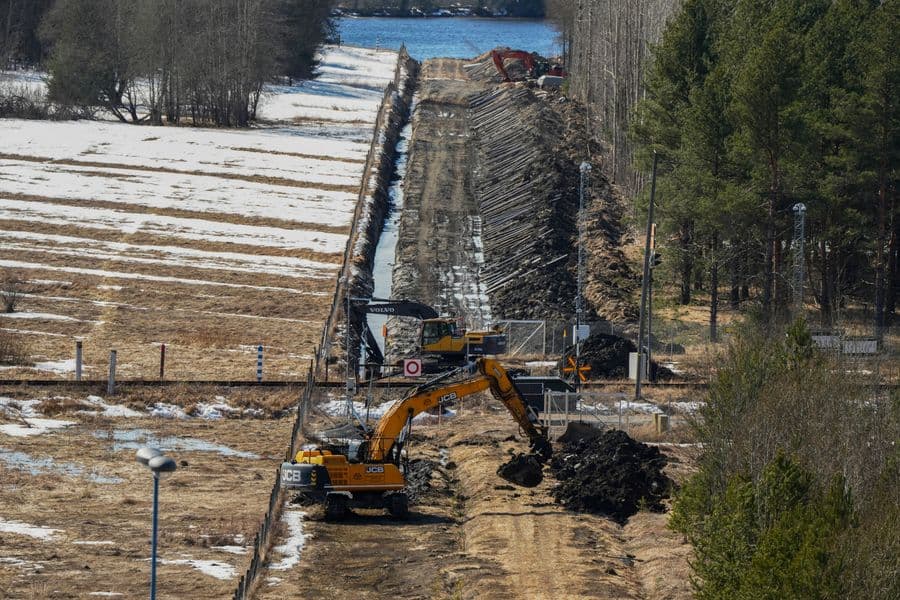
image: Excavators work at a construction site of the border barrier fence between Finland, right, and Russia near Pelkola border crossing point in Imatra, south-eastern Finland, Friday, April 14, 2023. (AP Photo/Sergei Grits)
Sources:
Finnish Government, Final report of the working group on defining shared objectives for nature restoration and national defence, 31 August 2026.
Finnish Ministry of the Environment and Ministry of Defence, “Working group: Major synergies between restoration and national defence,” 15 June 2026.
Jan Kunnas, Juha Mäkinen, and Risto Sulkava, “Ennallistamalla luonnollisia esteitä itärajalle,” Alue ja Ympäristö 55(1), 2026, pp. 150–157. DOI: 10.30663/ay.179476.
University of Eastern Finland, Forest Policy Day program, 12 November 2025; Jan Kunnas, “Restoring the Eastern Border as a Way to Combine the EU Restoration Regulation and National Defense Needs.”
Lithuanian Ministry of National Defence, government counter-mobility measures including wetland restoration, 12 August 2026.
Latvian Ministry of Defence, restoration of degraded historical peat extraction sites as natural barriers along the eastern border, 29 January 2026.
Polish Ministry of Climate and Environment, Green East Shield (Zielona Tarcza Wschód).
UNESCO World Heritage Centre, “Dutch Water Defence Lines.”
Seneca, Natural Questions, Book VI, section 8.
Correspondence with Professor Pasi Tuunainen, University of Eastern Finland, September 2026.
Correspondence with Jan Kunnas, University of Eastern Finland, September 2026.
Correspondence with Risto Sulkava, September 2026.