
President Trump's European Realities
Last updated 06:30 AM EDT • Read time: 10m
President Trump’s European Realities and Why the United States Must Commence Peace Through Strength
A Strategic Framework for Restoring Deterrence on NATO’s Eastern Flank, Strengthening Alliance Readiness, and Preventing a Limited Russian Challenge from Becoming a Wider European War
The eastern approaches of the North Atlantic Alliance have entered a period of acute operational stress. What was once framed as a distant contingency-planning problem has become a continuous, multidomain contest of will, force posture, and escalation management. Russia’s ongoing campaign in Ukraine has not exhausted its capacity for mischief; instead, it has refined a doctrine of calibrated pressure against NATO’s most exposed members while Moscow reconstitutes and repositions forces for the next phase of confrontation.
In late August 2026, the indicators converged with unusual clarity. Baltic, Polish, and Finnish commissioners delivered an urgent written appeal to European Commission leadership, describing a deteriorating security environment marked by repeated airspace violations and drone incursions. Finland’s army commander publicly assessed that Russia could ultimately field approximately 80,000 troops along the shared border once Ukrainian commitments ease—an expansion enabled by new barracks, logistics nodes, and equipment concentrations visible in satellite imagery from the Pechenga region through Karelia. Poland simultaneously began integrating the first tranche of South Korean K2 tanks into the 16th Mechanized Division oriented toward Kaliningrad, while German engineers assisted in the emplacement of antitank obstacles under the Eastern Shield program. Concurrently, Russian Foreign Ministry spokeswoman Maria Zakharova asserted that British military facilities and equipment, both inside Ukraine and beyond its borders, constituted legitimate targets in response to the employment of Storm Shadow systems. CIA Director John Ratcliffe’s unannounced presence in Moscow underscored the seriousness with which Washington now views the risk of a limited probe against alliance territory.
These events are not isolated. They form a coherent pattern of Russian strategic behavior: attritional warfare to degrade Ukrainian resistance, hybrid operations to erode NATO cohesion and public confidence, nuclear signaling to raise the perceived cost of Western support, and deliberate force-posture adjustments designed to confront the alliance with a rapidly executable limited-option threat.
The Geography of Vulnerability: Suwałki and the Northern Flank
The Suwałki Gap remains the decisive terrain feature of the eastern theater. A narrow corridor of Polish and Lithuanian territory, roughly 65 kilometers wide at its most constricted point, separates the Russian exclave of Kaliningrad from Belarus. Control or interdiction of this corridor would isolate the three Baltic republics from rapid land reinforcement. Russian doctrine has long recognized this reality. Any limited operation aimed at testing Article 5 would almost certainly incorporate rapid seizure or neutralization of key nodes within the Gap, supported by fires from Kaliningrad, electronic warfare, and special-purpose forces operating from Belarusian territory.
Finland’s border presents a different but equally demanding challenge. The vast, forested, lake-studded terrain favors the defender in prolonged conflict, yet the projected Russian force density of up to 80,000 troops—supported by improved infrastructure—creates the capacity for rapid, multiaxis limited offensives or for pinning Finnish and NATO forces while operations occur farther south. The Arctic approaches add a further dimension: control of High North Sea lines and airspace would complicate reinforcement and sustainment of the entire northern flank.
Nuclear Threshold and Flexible Response
The Pentagon’s current review of nuclear-employment guidance, led by Undersecretary of Defense for Policy Elbridge Colby in coordination with U.S. Strategic Command, addresses a critical deficiency. Russia and China maintain substantially larger inventories of low-yield and theater-range nuclear systems than the United States. An adversary that believes Washington faces only a binary choice—strategic response or inaction—may calculate that limited nuclear employment on the battlefield remains a usable option. The review seeks to restore a spectrum of credible, limited options that an opponent must treat as realistic. Existing systems such as the W76-2 low-yield warhead and the B61-12 gravity bomb, together with emerging air- and sea-launched cruise missiles, form the technical foundation. The strategic objective is escalation management through strength rather than reliance on massive retaliation alone.
This is not nuclear adventurism. It is the restoration of the classical logic of flexible response that underwrote successful deterrence throughout the later Cold War. An adversary must never be permitted to believe that the only American answer is either disproportionate or nonexistent.
European Realities Under American Leadership
Frontline states are responding with seriousness. Defense spending in the Baltics and Poland has reached or exceeded 5 percent of GDP. Fortifications, armor modernization, and counter-drone investments are underway. Yet the structural reality remains: the ultimate guarantee of these states’ independence rests on American extended deterrence, intelligence dominance, and the capacity for rapid reinforcement. Western European allies continue to lag in readiness and stockpiles. The alliance’s political cohesion is tested daily by Russian information operations and by the lingering temptation among some capitals to seek accommodation at the expense of the frontline.
President Trump confronts these realities without illusion. The prior administration’s approach of open-ended support without clear escalation dominance produced prolonged attrition without decisive strategic result. The present requirement is different: restore credible deterrence across the conventional-nuclear spectrum, compel greater European burden-sharing, and create conditions under which a negotiated end to the Ukraine conflict does not merely free Russian forces for the next theater.
The Eagle’s Shield: A Five-Point Strategy for the Eastern Flank
Drawing upon hard-edged naval realism, special-operations insight, integrated high-technology operational concepts, and the classic Reagan emphasis on peace through strength, the following five-point program—termed the Eagle’s Shield—offers a coherent framework for restoring deterrence and denying Russia any viable limited-option strategy.
Point One: Preemptive Multidomain Denial of the Suwałki Corridor.
Establish permanent, heavily fortified multidomain defensive complexes astride the Gap. Pre-position armor, artillery, air-defense batteries, and long-range precision fires in hardened sites. Integrate continuous unmanned aerial and ground surveillance with rapid-reaction special operations forces capable of interdicting infiltration routes from Belarus and Kaliningrad. Construct layered antitank obstacles, electronic-warfare nodes, and mobile counter-drone systems so that any Russian attempt to seize or close the corridor becomes prohibitively costly within hours rather than days.
Point Two: Theater Nuclear Credibility and Flexible Response.
Accelerate deployment and operationalization of low-yield and theater-range nuclear systems—air-launched cruise missiles, sea-launched options, and dual-capable aircraft—under updated employment guidance. Ensure that Russian planners understand that limited nuclear use on the eastern flank will be met with precise, proportionate nuclear responses designed to restore deterrence without automatic escalation to strategic exchange. Pair these capabilities with robust conventional long-range strike to complicate any Russian nuclear decision calculus.
Point Three: Maritime and Aerospace Dominance of the Baltic and Arctic Approaches.
Surge carrier strike-group presence, submarine operations, and land-based aviation into the Baltic and High North on a rotational but high-tempo basis. Deploy advanced maritime patrol, antisubmarine, and integrated air-and-missile-defense architectures that deny Russian surface and subsurface forces freedom of action. Incorporate directed-energy and advanced electronic-warfare systems—capabilities long envisioned in forward-leaning operational concepts—to neutralize massed drone and cruise-missile salvos before they reach critical infrastructure.
Point Four: Clandestine and Special Operations Edge.
Expand the authority and resourcing of special operations and intelligence elements to conduct persistent, low-visibility reconnaissance, sabotage of forward logistics nodes, and support to indigenous resistance networks inside threatened territories. Maintain the capacity for rapid insertion of specialized teams capable of disrupting Russian command-and-control, electronic-warfare, and air-defense nodes in the opening hours of any crisis. This clandestine layer multiplies the effectiveness of conventional forces and raises the uncertainty cost of any Russian limited operation.
Point Five: Integrated Alliance Reinforcement and Industrial Surge.
Require and resource a standing NATO eastern-flank corps with American leadership, pre-positioned equipment sets, and continuous live-fire training. Simultaneously drive a U.S. and allied industrial surge in precision munitions, air-defense interceptors, and counter-drone systems so that stockpiles are measured in months of high-intensity combat rather than days. Tie continued American security guarantees to measurable European increases in readiness and production capacity.
The Eagle’s Shield is not a plan for aggressive war. It is a plan to ensure that war never becomes the rational choice for Moscow. Strength, properly configured and visibly deployed, remains the surest path to peace.
The Reckoning That Cannot Be Deferred
There comes a moment in the life of a free people when the fog of comfortable illusion burns away and only the hard edges of reality remain. That moment is upon us now.
History is not a gentle slope of inevitable progress. It is a series of sharp cliffs, and nations that refuse to climb them with purpose and power simply fall. Courage is not the absence of fear; it is the decision that something else matters more. The United States of America does not outsource its destiny, and it does not bargain away the freedom of those who stand on the frontier of liberty.
Russia is testing the metal of the West. It is measuring whether the American guarantee is still written in steel or only in paper. It is calculating whether limited aggression can succeed because the free world has grown soft, divided, and afraid of its own strength. Every airspace violation, every new barracks rising near the Finnish border, every threat against British facilities, every tank moved toward Kaliningrad is part of that measurement.
We answer not with speeches alone, but with the Eagle’s Shield raised high and unmistakable. We answer with forces positioned to deny the Suwałki Gap in hours, not weeks. We answer with nuclear options that make any limited nuclear gamble suicidal for the aggressor. We answer with special operations that operate in the shadows where adversaries prefer darkness. We answer with industrial might that turns production lines into instruments of deterrence. And we answer with the unbreakable American will that has, time and again, broken the ambitions of those who believed free peoples would choose comfort over courage.
This is not the hour for half-measures or carefully worded ambiguities. This is the hour when the United States must look Vladimir Putin in the eye—through the instruments of power we still possess—and make certain he understands a simple truth: the cost of testing this alliance will be higher than any prize he seeks. The cost of limited war will be decisive defeat. The cost of nuclear blackmail will be the end of the regime that attempts it.
Raise the Shield. Deploy the forces. Arm the frontier. Speak with the clarity of those who still believe that freedom is worth the price of strength. History is watching. The frontier is watching. And the men and women who stand on that frontier deserve nothing less than an America that once again knows who it is and what it is willing to defend.
Peace through strength is not a mere slogan from a bygone era. It is the only doctrine that has ever kept the peace when tyrants measured the resolve of free nations. The time for that doctrine is now. The place for that doctrine is the eastern flank of Europe. And the nation that must lead it remains the United States of America.
Travis A. Karnes is a strategic analyst who was the former lead editor of the Peace Through Strength Institute.
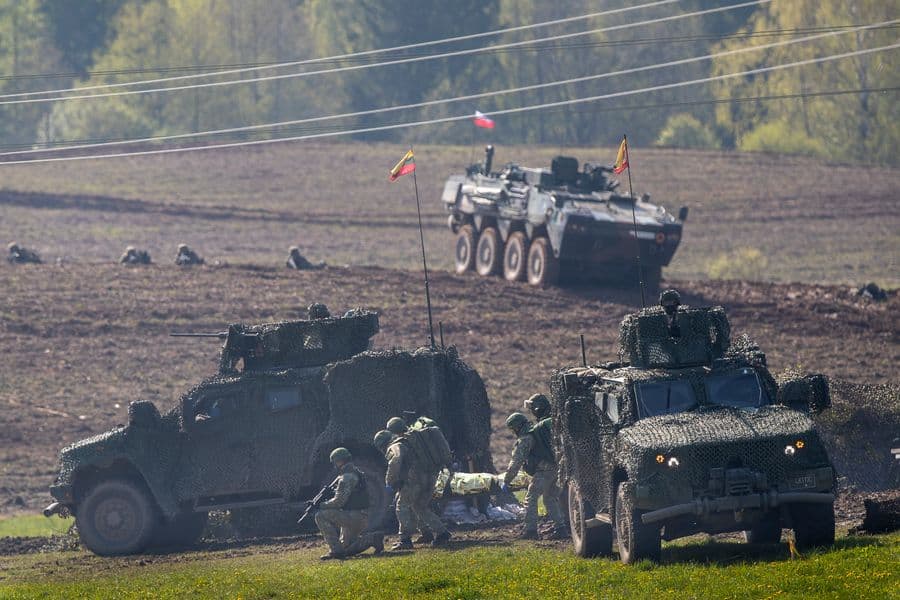
image: Lithuanian Army soldiers take part in a Lithuanian-Polish Brave Griffin 24/II military exercise near the Suwalki Gap near the Polish border at the Dirmiskes village, in Lithuania on Friday, April 26, 2024. Over 1500 troops and 200 pieces of tactical equipment are rehearsing defence scenarios under the bilateral Lithuanian-Polish Orsha Plan near the Suwalki Gap. (AP Photo/Mindaugas Kulbis)

Innovation Alone Won’t Prepare the U.S. for the Future Battlefield
By Joshua Segal • RealClearDefense
The sUAS Tactical Trifecta
By Bryan T. Woody • RealClearDefense
The Revolutionary War: When Strategic Options Share the Same Weakness
By Henry Yep • RealClearDefense
The Houthis Are Testing the Limits of Collective Defense
By Saima Afzal • RealClearDefense
Radio Frequencies in the Intelligence Ecosystem
By Craig Brower • RealClearDefense

Who Shoots Down the Drone Over the Shipyard?
By John Ferrari & Dillon Prochnicki • RealClearDefense
Northrop Grumman Breaks Out the Big Guns at AUSA
By Daniel Terrill, Defense News
Army Pursuing Diverse Array of New Anti-Air Interceptors
By Trevithick, The WarZoneWho Shoots Down the Drone Over the Shipyard?
By John Ferrari & Dillon Prochnicki, RCD
F-35C Lands for the First Time on a Ford-Class Aircraft Carrier
By The Aviationist