
Building Durable Demand for American Ships
Last updated 07:07 AM EDT • Read time: 7m
Can Washington Build a Maritime Industrial Base Without a Market for American Ships?
For years, assessments of America’s shipbuilding have been largely the same: not enough shipyards, not enough skilled workers, aging infrastructure, unreliable suppliers, and ships delivered years late and billions over budget if the program succeeds at all. What is different now is that Washington is reconsidering not merely how much it spends on ships, but how the industrial system that produces them should operate.
The Navy’s May 2026 Shipbuilding Plan calls for a “buildable and sustainable” high-low mix of platforms and a dramatic expansion of construction distributed among multiple sites. According to the plan, around 10 percent of shipbuilding work currently takes place at distributed sites. The Navy now wants that share of distributed production to reach 50 percent by using modular and digital designs to spread work among more yards, factories, and suppliers. The Navy argues that increasing the share of distributed production can expand capacity, reduce bottlenecks, and increase competition in the market.
The Navy and White House have also been taking substantive steps consistent with the shipbuilding plan in the months since its publication. In July, the Navy awarded its first ever Vessel Construction Manager contract to the TOTE services company in a $2.2 billion dollar deal to oversee the construction of the new Medium Landing Ships. This structure will place TOTE in charge of overseeing production across several different sites, better leveraging commercial best practices during the program. Later in August, President Trump directed the government to apply the ‘Finland Model’ to as many as three ship classes as part of a broader effort to revitalize American shipbuilding. In addition to restricting the Navy from imposing the kinds of iterative design changes and instability that caused serious disruptions in the Constellation program, the Finland Model aims to bring investment from foreign shipbuilders into American shipyards. Participating foreign shipbuilders would establish or take a controlling stake in a U.S. shipyard, train an American workforce, license their shipbuilding techniques and technology, develop an American supply chain, and build all vessels after the first two in American yards.
Washington is fundamentally reconceptualizing America’s maritime industrial base. Considering commercial shipbuilding, naval construction, suppliers, repair facilities, ports, and workforce inside a single conceptual framework reframes the shipbuilding crisis as a larger maritime economy issue rather than a defense-production issue or a contracting system issue.
The administration’s efforts to better integrate America’s maritime industrial base and economy makes Italy a useful case study for comparison as an already integrated maritime industrial base.
Italy’s shipbuilding sector is largely organized around Fincantieri, a majority state-owned company that builds some of the world’s largest cruise ships as well as frigates, submarines, and other naval vessels. Although commercial and military construction are not interchangeable, Fincantieri has managed to integrate both under a wider industrial base where demand spikes in one sector can smooth drops in the other and sustain production capacity. This structure has made the industry more resilient to market fluctuations like cancellations and protected its profitability and revenue growth.
Fincantieri’s structure allows its naval construction to draw upon an industrial ecosystem sustained partly by commercial demand. Capital investment, engineering expertise, workforce training, suppliers, digital tools, and production techniques developed across Fincantieri’s civilian businesses can also benefit and support its defense business. Fincantieri is explicitly planning to improve production at its Riva Trigoso–Muggiano naval complex, by leveraging practices from the civilian sector, as part of an effort to double defense-production volume in its Italian yards and reduce FREMM frigate construction time by 18 months.
Fincantieri’s success highlights a central flaw in the American model: the weakness of the underlying industry supporting naval-yard capacity. Throughout the second half of the 20th century, U.S. shipyards closed en masse, leading the industry to consolidate behind a small handful of overspecialized shipyards struggling to retain talent and meet the Navy’s demands.
The U.S. commercial shipbuilding industry that could provide a broader source of maritime demand, industrial scale, and shipbuilding talent has become smaller and less competitive than ever before. American shipyards cannot compete effectively for international commercial orders because of high costs and a lack of economies of scale. The result is that the broader U.S. maritime economy provides relatively little commercial scale and talent for naval construction to draw upon.
The administration's shipbuilding reforms address real supply side constraints in naval shipbuilding. Greater use of distributed production will allow more suppliers and facilities to enter the naval construction market. Mature allied designs can reduce development risk for these shipyards. Commercial acquisition practices can create efficiencies and widen the pool of companies capable of participating. More predictable demand from the Navy and the strategic commercial fleet can make investments in facilities and workers easier to justify for American shipbuilders.
While these supply-side measures can improve shipyard capacity in the near term, that capacity must ultimately be sustained by continuous work. Without a robust commercial sector to anchor the workforce and supplier networks, infrastructure will decay the moment Navy and Coast Guard procurement cycles dip.
The government recognizes the lack of demand for American built commercial vessels, and its attempts to revitalize American shipbuilding will depend upon how effectively it can create demand for American vessels. The Maritime Action Plan proposes financing incentives, restructured operating subsidies, guaranteed cargo or procurement commitments, and a Strategic Commercial Fleet intended to create reliable revenue to restore the American shipbuilding industry. It also calls for government-wide shipbuilding plans that provide predictable multiyear demand signals. The strategy therefore is striking at the heart of the shipbuilding industry’s problem in addressing the demand side of the equation, but the unanswered question is how to create demand at sufficient scale.
The proposed Strategic Commercial Fleet would involve growing the current U.S. flag fleet from 188 vessels to 250 according to the proposed SHIPS for America Act of 2025, but a one-time initiative to build 62 new commercial ships is not going to save American shipbuilding in the long term. American shipyards and maritime suppliers need continuous work over the coming decades to the attract skilled workforce and capital investments they need. But if the government alone cannot create sufficient demand for American built vessels, then who can?
There is very little durable demand for American ships, with only 5 commercial ships currently being built per year primarily targeted at domestic Jones Act transport. The administration therefore must not only stimulate additional ship construction on its own, but also find a way to make the cargo vessels we already produce significantly cheaper to compete with international providers and drive up demand enough to support the workforce, suppliers, infrastructure, and capital investment required by the much larger maritime industrial base it envisions.
This is where the Italian comparison is most useful. What distinguishes Fincantieri's naval business is not only the manufacturing techniques it can borrow from commercial shipbuilding, but the existence of a large commercial business that helps sustain the broader industrial ecosystem in which naval construction operates. The central test of America's maritime revival will therefore not simply be whether Washington can enable more yards to build ships, but whether it can create a market where American ships are internationally competitive and those yards attract enough work to stay in business long after the Strategic Commercial Fleet is finished.
Michael Roberts is Yorktown Institute’s senior research assistant.
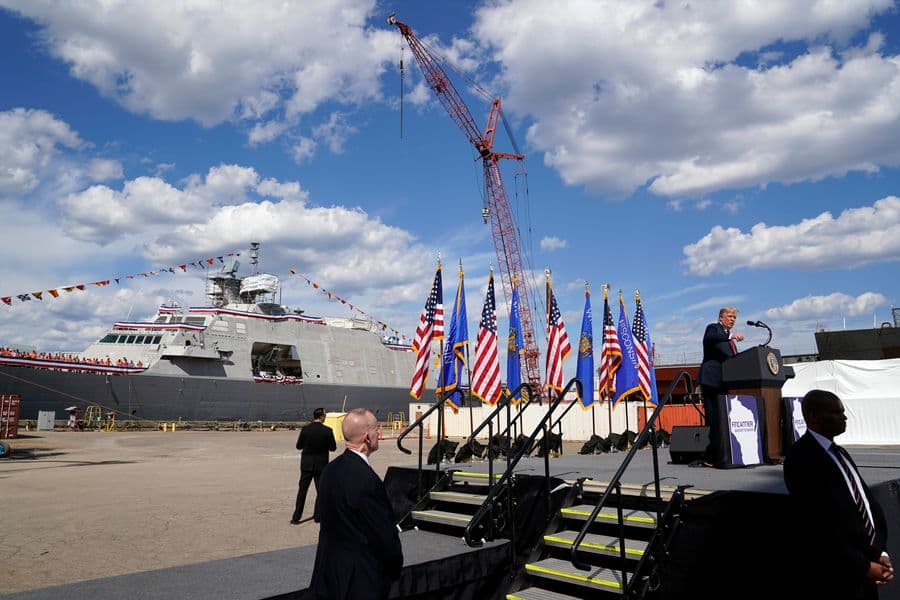
image: President Donald Trump speaks during a visit to Fincantieri Marinette Marine, Thursday, June 25, 2020, in Marinette, Wis. (AP Photo/Evan Vucci)