
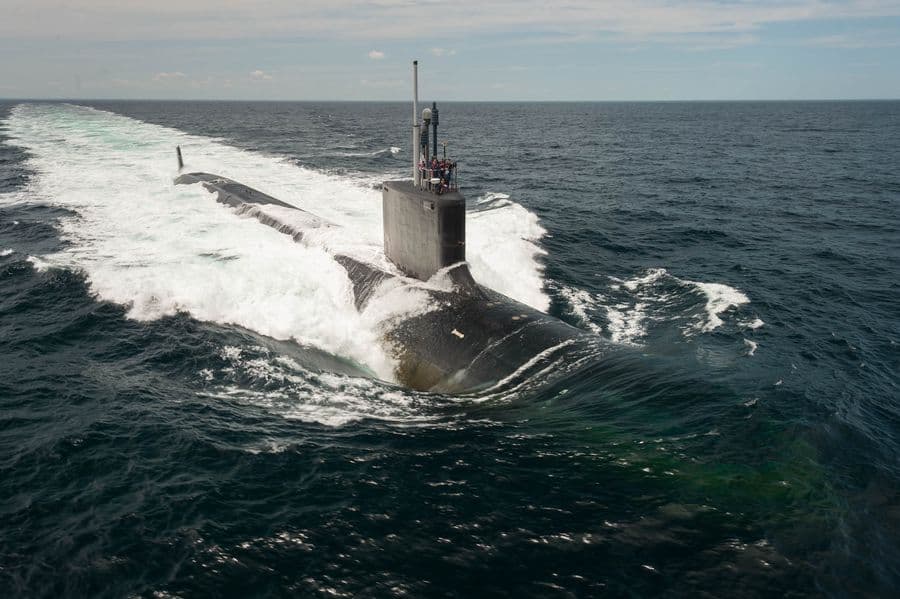
The Silent Deficit: The Navy's Looming Submarine Cruise Missile Gap
Last updated 01:58 AM EDT • Read time: 8m
Deep within the Silent Service, a subtle but monumental shift is occurring beneath the waves, reshaping the future of American maritime strike capability. As the United States Navy quietly prepares to inactivate the Ohio-class guided-missile submarines, the era of the undisputed undersea leviathans is ending. For over two decades, these four vessels—the USS Ohio, USS Michigan, USS Florida, and USS Georgia—have served as the most heavily armed conventional strike platforms ever to patrol the oceans.
Originally designed as strategic nuclear deterrents, they found a second, highly lethal life following the 1994 Nuclear Posture Review, which determined the Navy only required fourteen ballistic missile submarines. Rather than scrap the four oldest hulls, the Navy transformed them in the early 2000s into unparalleled arsenals of conventional firepower. Now, as these aging behemoths face mandatory retirement driven by inevitable metallurgical fatigue, a fierce debate has emerged in defense circles regarding a perceived critical shortfall in cruise missile capacity.
On August 3, 2026, the Department of the Navy formally reclassified 19 planned Virginia-class submarines equipped with the Virginia Payload Module (VPM) as guided-missile submarines (SSGNs). This move, announced just weeks after USS Georgia (the first of the Ohio-class SSGNs) began inactivation, marks the transition in real time.
The Mathematical Illusion
The underlying math has generated alarm, pointing to a sudden deficit of 400 to 600 vertical launch cruise missiles as the Ohio-class retires. With the Navy transitioning its strike capacity to the upcoming Block V and Block VI Virginia-class submarines (SSGNs), critics point to a massive drop in dedicated payload volume.
However, a meticulous examination of force-mix strategies, historical deployment realities, and modern tactical doctrine reveals that this terrifying mathematical gap is largely an artificial construct. The true threat facing the Navy is not a lack of ultimate capability, but a perilous timeline.
To grasp the perceived shortfall, one must first understand the staggering scale of the Ohio-class SSGN. Measuring 560 feet from bow to stern, these ships were engineered to accommodate 24 massive Trident ballistic missile silos. During their extensive conversions, 22 of these silos were reconfigured to house Multiple-All-Up-Round Canisters (MACs). Since each canister was precisely engineered to hold exactly seven Tomahawk land-attack cruise missiles, a single Ohio-class submarine boasted the theoretical capability to launch 154 precision-guided munitions. Multiplied across the four hulls in the SSGN fleet, the Navy possessed a concentrated, combined launch capacity of 616 Tomahawks. As these ships reach the absolute limits of their 42-year service lives, their immense arsenals are being removed from the fleet without a one-for-one replacement of identical scale.
The anxiety surrounding this transition centers entirely on the comparative arithmetic of the replacement program: the Virginia Payload Module (VPM). Traditional Block I through IV Virginia-class fast-attack submarines carry twelve vertical launch tubes located in the bow. The Block V and VI redesign alters this geometry by inserting an 84-foot midsection into the submarine’s hull to house four large-diameter payload tubes. Much like the converted silos on the older Ohio boats, each of these four new VPM tubes can hold seven Tomahawks. This engineering addition provides an extra 28 missiles per boat, which, when combined with the 12 forward-mounted tubes, gives the new Virginia-class SSGNs a total capacity of 40 missiles each.
This is where the mathematical discrepancy takes root. If the Navy is losing four submarines capable of carrying 154 missiles each (616 total) and replacing them with 19 submarines capable of carrying 40 missiles each (760 total), the fleet-wide capacity actually increases in theory.
Operational Reality vs. Theoretical Maximums
Yet, relying solely on theoretical maximums ignores the pragmatic, operational history of how the United States Navy utilized the Ohio-class vessels.
The stark reality is that the heavily touted 154-missile figure was a maximum-capacity myth that rarely, if ever, materialized on combat patrols. The Ohio-class submarines were inherently designed as multi-mission platforms, expected to perform covert tasks far beyond acting as submerged cruise missile trucks. Among their most critical and highly classified missions was the clandestine insertion and extraction of elite Special Operations Forces (SOF). To facilitate these covert deployments, the Ohio-class SSGNs were outfitted with specialized lockout chambers. In operational scenarios, at least two of the 22 available missile tubes were permanently converted to support Dry Deck Shelters (DDS), which accommodated up to 66 special operators, their gear, and SEAL Delivery Vehicles (SDVs). Furthermore, other tubes were frequently reserved for deploying Unmanned Underwater Vehicles (UUVs) or advanced sensor arrays.
Consequently, a fully loaded 154-missile boat was an operational anomaly. Deployment histories indicate that the standard multi-mission deployment was closer to 100 Tomahawk missiles per hull, although the exact number remains classified. Therefore, the 760 total missile slots provided by the 19 new Virginia-class SSGNs represent a genuine and significant increase in practical, deployable firepower.
Distributed Maritime Operations
Furthermore, assessing the transition merely by counting missile tubes fundamentally misunderstands modern American naval doctrine and the realities of peer-state competition. The Navy has explicitly pivoted away from concentrating overwhelming firepower in a small handful of centralized platforms. This strategic shift is formalized under the doctrine of Distributed Maritime Operations (DMO).
In an era defined by advanced anti-access/area-denial (A2/AD) systems, hypersonic anti-ship missiles, and persistent satellite surveillance, relying on four massive submarines presents a profound tactical vulnerability. An Ohio-class SSGN represented a terrifying concentration of lethality, but it also constituted a massive single point of failure. The loss of just one hull would instantly degrade the Ohio fleet’s undersea strike capacity by 25 percent.
The decision to redesignate 19 Virginia-class submarines as SSGNs is the ultimate manifestation of DMO in the undersea domain. By spreading hundreds of cruise missiles across 19 individual, highly stealthy, and technologically superior hulls, the Navy exponentially complicates adversary targeting. Instead of tracking four massive submarines globally, an enemy fleet must now contend with nineteen distinct threats capable of projecting power simultaneously across multiple theaters, from the Indo-Pacific to the North Atlantic.
This transition from concentrated mass to distributed lethality yields unparalleled operational flexibility, allowing combatant commanders to tailor their undersea presence dynamically without committing a massive strategic asset to a localized conflict.
The True Threat: A Perilous Timeline
However, dismissing the entire shortfall narrative as a mathematical illusion would be intellectually dishonest. While the raw capacity gap is largely artificial when factoring in operational loadouts and distributed tactics, a very real, temporal capability gap looms ominously on the horizon. The true deficit the Navy faces is not in total capacity, but in time and manufacturing throughput.
The decommissioning schedule for the Ohio class is rigid. These submarines have been subjected to decades of immense pressurization cycles, and their pressure hulls cannot be safely extended further. As the USS Georgia initiates its inactivation, the remaining three Ohio-class SSGNs will rapidly age out of service before the end of the decade. By 2030, the era of the large-hull SSGN will be definitively closed.
In stark contrast, the industrial base is struggling to meet the Navy's ambitious procurement schedules. The first Virginia-class submarine equipped with the VPM (the USS Arizona, SSGN-803) is not scheduled for delivery until late in the decade, and current shipbuilding backlogs suggest further delays are possible. The full planned fleet of 19 Virginia-class SSGNs is not expected to be completely built, commissioned, and operational until the late 2030s.
This staggered timeline creates a deeply perilous trough throughout the early to mid-2030s. During this critical decade, the United States Navy's aggregate undersea strike capacity will be undeniably diminished. For a period of roughly five to eight years, the Navy will simply have fewer vertical launch tubes submerged beneath the waves than it did at the height of the Ohio-class era. To mitigate this risk, the Pentagon will be forced to rely on the advanced capabilities of the remaining fast-attack fleet, surface combatants, and strategic bomber forces to bridge the gap. This interim “trough” will require careful cross-decking of munitions and sustained production of Tomahawk missiles to sustain readiness.
It is also vital to note that the new Virginia Payload Module tubes are not designed exclusively to carry the aging subsonic Tomahawk. Their wide diameter is specifically engineered to eventually accommodate next-generation weaponry, including Intermediate-Range Conventional Prompt Strike (IRCPS) hypersonic missiles, advanced seabed warfare systems, and large-displacement UUVs.
Ultimately, the transition from the legacy Ohio-class to the new generation of Virginia-class SSGNs represents a necessary evolution in naval warfare. The true challenge for the coming decade is not a lack of ultimate capability, but the perilous race against the calendar to construct the next generation of silent, distributed firepower before the strategic window closes.
Supporting Assets: Bridging the Undersea Strike Gap
In the interim, the remaining Virginia-class fast-attack submarines (Blocks I–IV) continue to perform distributed strike missions, while the new Columbia-class ballistic missile submarines will soon field their own conventional strike packages.
Additionally, Arleigh Burke-class guided-missile destroyers are equipped with Vertical Launch Systems (VLS) which carry Tomahawks already provide a robust layer of conventional precision strike that can be surged into theater.
Strategic bomber forces, including the B-52H, B-2A, and incoming B-21, deliver long-range cruise missile and hypersonic options from standoff distances.
Supported by steady Tomahawk production and a robust inventory across submarines, surface, and air platforms, ensures reliable munitions availability. Together, these complementary systems create a layered maritime strike posture that, while differing from the concentrated capacity of legacy Ohio-class submarines, disperses offensive power and significantly reduces vulnerability to individual timeline delays.
Bruce Allen Lubbering held several management positions with aerospace manufacturing companies in a career that lasted over 30 years.