
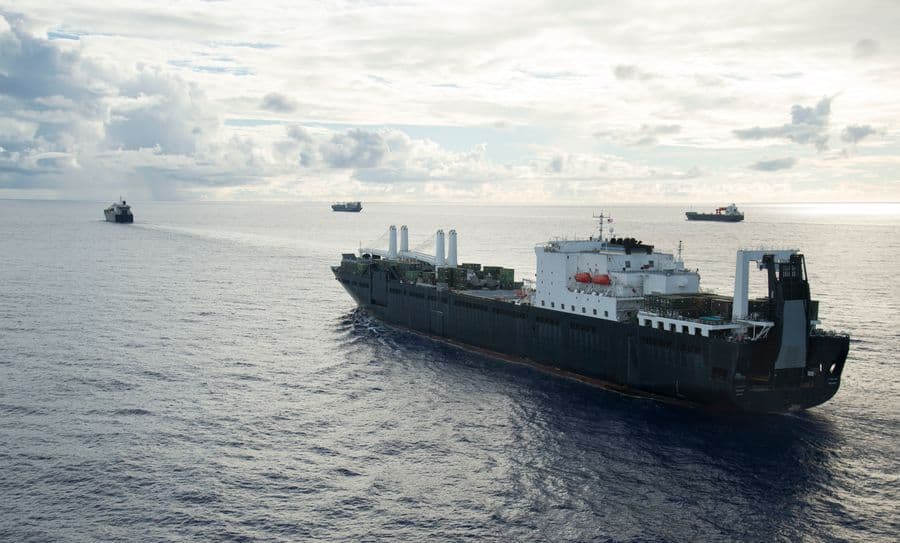
Rebuilding the Maritime Prepositioning Force
Last updated 07:08 AM EDT • Read time: 7m
Rebuilding the Backbone: Why America Must Urgently Revitalize Its Maritime Prepositioning Force
For decades, the United States has relied on a unique logistical system that enables it to project power quickly and decisively worldwide. Key to this system is the Maritime Prepositioning Force (MPF), a fleet of strategically positioned ships loaded with equipment, vehicles, ammunition, and supplies for Marine Air-Ground Task Forces. These ships, along with forward prepositioned materiel in Norway and the Indo-Pacific, and the Navy’s ability to extend power over the horizon, form a triad of logistical capabilities unmatched by any other country.
However, this system is under strain. The MPF fleet is aging, the number of available sealift ships is decreasing, and the logistical assumptions that supported U.S. global operations for decades are being challenged by peer competitors capable of contesting the maritime domain. The Marine Corps, Navy, and Department of Defense have all recognized these vulnerabilities, but the pace of modernization remains dangerously slow. If the United States is serious about maintaining global reach, deterring adversaries, and keeping forward-deployed forces in contested environments, then the maritime prepositioning enterprise must be elevated to the highest levels of military and political strategy. The MPF is not just a niche capability—it is the backbone of American expeditionary power. And today, that backbone is showing signs of stress.
The MPF was established during the Cold War to rapidly reinforce NATO’s northern flank and enable Marine forces to quickly deploy to global hotspots. The concept was straightforward yet innovative: instead of transporting heavy equipment from the United States, it was prepositioned on ships near likely conflict areas. Marines could fly in, connect with their gear, and be combat-ready in days rather than weeks. This concept remains just as relevant today as it was in the 1980s. In fact, in an era of contested logistics, anti-access/area-denial threats, and the need for dispersed operations, the MPF is likely more important than ever.
A 2022 Proceedings article clearly captures this reality, arguing that the Marine Corps “needs the Maritime Prepositioning Force more than ever.”[1] The article emphasizes that the MPF offers a level of strategic agility that cannot be matched by airlift or by relying solely on sealift from the continental United States. In a crisis, time is the most valuable resource, and the MPF saves time—time to deploy, time to deter, and time to act before an adversary can consolidate gains. The Marine Corps Association’s analysis of the MPF similarly highlights that prepositioned equipment afloat remains vital for enabling distributed maritime operations, expeditionary advanced base operations, and the emerging Marine Littoral Regiments.[2] These new formations are designed to operate within contested maritime spaces, but they cannot do so without reliable, survivable, and responsive logistical support. The MPF is the only system capable of providing that support at scale. It is not a legacy capability; it is a strategic necessity.
America’s ability to project power globally depends on three interconnected pillars: maritime prepositioning ships, forward-deployed materiel in Norway and Diego Garcia, and the Navy’s capacity to project power beyond the horizon. Each pillar is essential, and each supports the others. The Marine Corps Prepositioning Program–Norway (MCPP-N) stores equipment in hardened caves and facilities designed for rapid reinforcement of NATO’s northern flank. A 2015 GAO report found that the program remains crucial to U.S. and NATO readiness but also identified challenges in equipment maintenance, accountability, and modernization.[3] Despite these issues, the program has repeatedly proven its value. It supports exercises like Cold Response, enables quick deployment into the High North, and acts as a hedge against Russian aggression. In a world where Arctic competition is increasing, the Norway prepositioning program is not a relic—it is a strategic asset.
In the Indo-Pacific, the prepositioning ships at Diego Garcia give the United States a forward logistics hub in a region where distances are large and infrastructure is limited. These ships enable Marine forces to respond swiftly to crises from the Middle East to Southeast Asia, and they serve as a crucial link in the sustainment chain for distributed operations. The Navy’s capacity to project power over the horizon—using amphibious ships, carrier strike groups, and logistics vessels—connects the entire system. Without naval reach, prepositioned equipment cannot be delivered to contested littorals. Without prepositioned equipment, naval forces cannot maintain operations ashore. Without advanced bases, naval forces lack the forward support necessary for persistent operations. This triad forms the foundation of American expeditionary power, but each part of the triad faces growing pressures.
The most critical vulnerability in the maritime prepositioning enterprise is the shortage of ships—both in the MPF and the broader sealift fleet. Many MPF ships are decades old and maintaining them is becoming increasingly costly. The Marine Corps Association’s analysis warns that the fleet is “aging out” and that replacement ships are not arriving quickly enough.[4] The Navy and Marine Corps have investigated options for modernizing the fleet, but progress has been slow and funding has been inconsistent. A 2023 Defense News report revealed that the Marine Corps has started developing a new class of smaller prepositioning ships designed to operate inside contested maritime environments.[5] These ships would be more agile, more survivable, and better suited for distributed operations than the large, vulnerable MPF ships of the past. This is a promising development, but it is only a first step. The United States needs not just new ship designs, but more ships overall.
The MPF does not operate alone. It relies on the larger U.S. sealift fleet, which is also in crisis. The Ready Reserve Force and Military Sealift Command fleets are aging, understaffed, and too small to support large-scale operations. The U.S. Merchant Marine, responsible for providing the mariners needed to crew these vessels, is also shrinking. This is not just a theoretical issue. It is a tangible and increasing threat to U.S. military readiness.
Logistics determines victory, and the United States faces the risk of losing its logistical advantage. China and Russia have heavily invested in capabilities meant to disrupt U.S. logistics—such as long-range missiles, submarines, cyberattacks, and electronic warfare. In a conflict, the U.S. cannot assume that its logistics ships will sail without challenge or that supply lines will stay secure. The Marine Corps’ Force Design 2030 recognizes this reality and advocates for a more distributed, resilient, and survivable logistics network. However, the MPF must be an integral part of that network—not an afterthought.
Prepositioned equipment must be modern, maintained, and ready. The 2015 GAO report on the Norway program highlighted issues with equipment maintenance and accountability.[6] These issues are not unique to Norway—they reflect broader challenges in managing prepositioned stocks across the force. If prepositioned equipment is not modern, maintained, or ready, then the entire concept collapses. The United States must also be capable of delivering that equipment into contested theaters quickly and reliably. This requires more prepositioning ships, additional connectors, more logistics vessels, distributed stockpiles, resilient supply chains, and increased investment in sealift and the Merchant Marine. Without these investments, the United States risks having equipment it cannot deliver, forces it cannot sustain, and commitments it cannot uphold.
The Maritime Prepositioning Force is essential, not a luxury or a Cold War relic. It is a primary element of American expeditionary power. However, that backbone is aging, overstretched, and underfunded. The United States cannot take the MPF for granted—especially in an era of great-power competition, contested logistics, and swiftly changing threats. To maintain global reach, deter enemies, and keep forward-deployed forces strong, maritime prepositioning must be raised to top military and political priority. Congress, the Department of Defense, and the services need to treat the MPF as a strategic asset, not just a budget line item. Revitalizing the MPF will require substantial investment, but the consequences of neglecting it will be far worse.
James M. Deitch served as the Motor Transport Operations Chief for 6th Motor Transport Battalion, 1st Fleet Service Combat Support Group during Operation Desert Storm from 1990 to 1991. He served in the Marine Corps from 1984 to 1996.
Notes:
[1] “Marines Need the Maritime Prepositioning Force More Than Ever, Proceedings”, U.S. Naval Institute, 2022.
[2] “Transforming the Maritime Prepositioning Force”, Marine Corps Association.
[3] U.S. Government Accountability Office, Marine Corps Prepositioning Program–Norway, GAO‑15‑651, 2015.
[4] “Transforming the Maritime Prepositioning Force”, Marine Corps Association.
[5] Megan Eckstein, “U.S. Marine Corps Begins Developing Smaller Pre‑Positioning Ship,” Defense News, June 28, 2023.
[6] GAO‑15‑651.