
Space: The Next Frontier for Maneuver Warfare
Last updated 06:15 AM EDT • Read time: 5m
The U.S. Space Force Space Warfighting framework formally declares a shift in U.S. policy toward treating space as a complex and contested warfighting domain. The change in defensive posture comes as adversaries increase space-based threats, including proximity “stalking” maneuvers in Low Earth Orbit, escalated satellite jamming and cyberattacks, and growing arsenals of counter-space weapons. Consequently, military maneuver strategy, which has always evolved with technological development, must now extend into space.
Two space defense experts are providing guidance on what a U.S. strategy needs to include. Retired Lt. Gen. John Shaw, former Deputy Commander, U.S. Space Command and a highly respected strategist, frequently writes and speaks on the direction of military space strategy. In a recent Forbes article, he explained that the age of space maneuver warfare is not a distant prospect but is imminent.
Gen. Stephen Whiting, commander of U.S. Space Command, is making the same argument from the inside. During the 2026 Space Symposium in Colorado Springs, he directly stated that a satellite locked into a predictable orbit is not a strategic asset; it is a target. His call for a formal maneuver warfare strategy, which Space Command is developing under a wargaming program known as the Apollo Maneuvers, is a generational shift in how the Department of War (DoW) intends to operate in space.
The doctrine and recommendations expressed by both of these experts expose an uncomfortable fact: static, positional space operations, in which satellites are launched into fixed orbits and conserve fuel to extend their operational lifespan, creates predictable signatures that adversaries can exploit. Already, China and Russia are accelerating development of maneuverable counterspace capabilities. To respond to emerging threats, both generals note that the U.S response must adopt the same strategy as used in every other warfighting domain: maneuver, repositioning, and unpredictable operations.
The Missing Maneuver Warfare Link
Their cogent argument is supported by accelerating advances in technology and logistics that will make orbital maneuver possible. However, the current discussion tends to underemphasize what is arguably the most operationally consequential challenge: space-generated data is simply not useful without a sound communications infrastructure connecting maneuvering spacecraft to each other and the military commanders tasked with consequential decision-making.
Operationally, maneuver warfare requires real-time situational awareness, low-latency command and control and near-real time redirection of information flows as conditions change. It demands that data move faster than adversaries can react, and that communication pathways remain available even when specific links are jammed, spoofed or physically threatened. It also necessitates maneuvering networks that are non-static, dynamically flexible and architecturally resilient.
As military spacecraft change orbital altitudes and theaters of operation, communications infrastructure must be flexible enough to support those maneuverability requirements. Just as when a Navy ship changes its region and pre-provisions connectivity for the next phase, the logic of maneuver dictates that space-based infrastructure needs to become more flexible and adaptive.
Communications also cannot be left dependent on highly vulnerable terrestrial gateways or fiber. Required ground-based resiliency can be achieved by geographic diversity across landing stations, redundant equipment and multiple fiber and Points of Presence routes that protect changing conditions.
Strengthening Communications Infrastructure
New advanced commercial satellites can provide an assured communications backbone using space relay services that connect military or 3rd party satellites to modern space-based networks, so that data securely reaches commanders on the ground.
This capability is included in the DoW’s proliferated LEO strategy, which centers on using a mix of government-owned and multiple commercial constellations operating in parallel. Routing traffic across several independent networks will make it much harder for an adversary to map or target any specific data. Optically linked inter-satellite architectures support this by enabling a space-based intelligent mesh architecture that presents multiple data routing options, skipping any compromised or suspect satellite.
Once data is uplinked from a maneuverable satellite, it can bypass public terrestrial networks to avoid adversary accessibility. While no space path is invulnerable, the proliferated, multi-provider approach and a rapid-recovery posture matter as much as the routing technology itself. The military can also retain full control over encryption and decryption, landing data at government-owned gateways or wherever deemed necessary.
The proposed Golden Dome missile defense program is expected to require this model of a global command-and-control system that can fuse information from multiple sources and feed it to weapons in real time.
Ensuring space-based situational awareness
Fundamentally, maneuverability in space is not only about propellant and on-orbit servicing. It is about the sustained, assured information flow across vast battlespace that spans every orbit and geographic theater simultaneously.
The networks transferring such critical data must be engineered from the ground up to enable the doctrine Generals Shaw and Whiting describe as essential to securing U.S. space superiority. Critical networks must accelerate the Observe, Orient, Decide and Act (OODA) loop that is the foundation of modern military decision-making. They must be capable of operating in a congested, contested and competitive space environment without degradation.
This is the standard against which defense organizations will increasingly measure commercial satellite networks. By leveraging next-generation constellations, our adversaries will not know exactly how, when or where critical government data traverses the network.
Col Chuck Cynamon (U.S. Air Force, ret.) is the President of Telesat Government Solution.
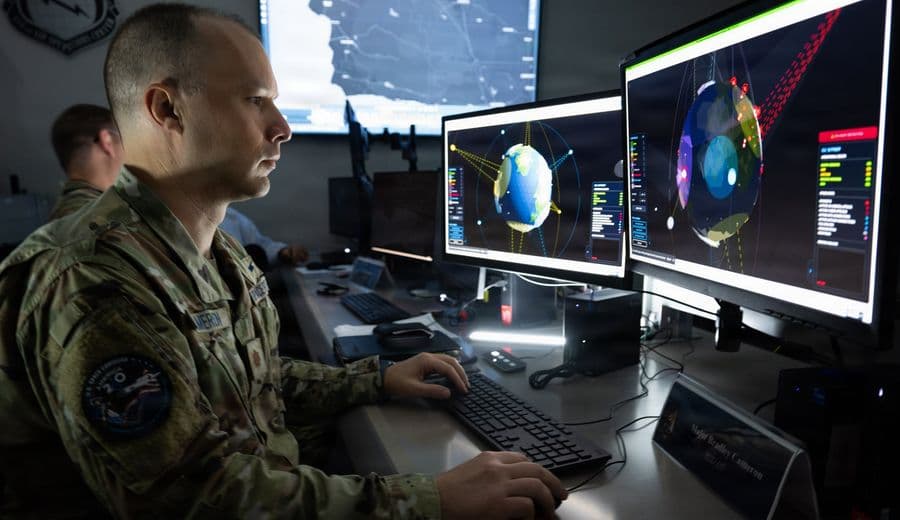
image: A U.S. Space Force Guardian, foreground, monitors data on computer screens at a multi-screen operations center workstation at the Combined Space Operations Center (CSpOC), Vandenberg Space Force Base, Calif., May 28, 2026, during the APOLLO NEXUS 26 Live Fire Exercise. U.S. Space Forces – Space (S4S) and CSpOC personnel supported the U.S. Space Command exercise, which is a dynamic, real-world demonstration of the precise timing and operational synchronization required to execute complex, multi-Combatant Command (CCMD) strategic options. The event highlighted the future of joint campaigning, showcasing a strategic mix of U.S. military, commercial industry, and Five Eyes partner assets to demonstrate advanced interoperability and integrated deterrence in action. (U.S. Space Force photo by David Dozoretz)

In Pursuit of Nuclear Abolition
By Peter Huessy • RealClearDefense
Innovation Alone Won’t Prepare the U.S. for the Future Battlefield
By Joshua Segal • RealClearDefense
The sUAS Tactical Trifecta
By Bryan T. Woody • RealClearDefense
The Revolutionary War: When Strategic Options Share the Same Weakness
By Henry Yep • RealClearDefense
The Houthis Are Testing the Limits of Collective Defense
By Saima Afzal • RealClearDefense

Navy Civilianizes Six Former Flag Billets, Reduces Six to Captains
By Mongilio, USNI N.
Raytheon's $8B Contract for Strategic Comms Terminal Modernization
By M+A El
America’s Maritime Moment Will Not Wait
By CDR Salamander
Armor Up?
By Marine Corps Compass Points
Who Shoots Down the Drone Over the Shipyard?
By John Ferrari & Dillon Prochnicki • RealClearDefense