
Islamic State Poses a Growing Threat in Turkey
Last updated 05:52 PM EDT • Read time: 3m
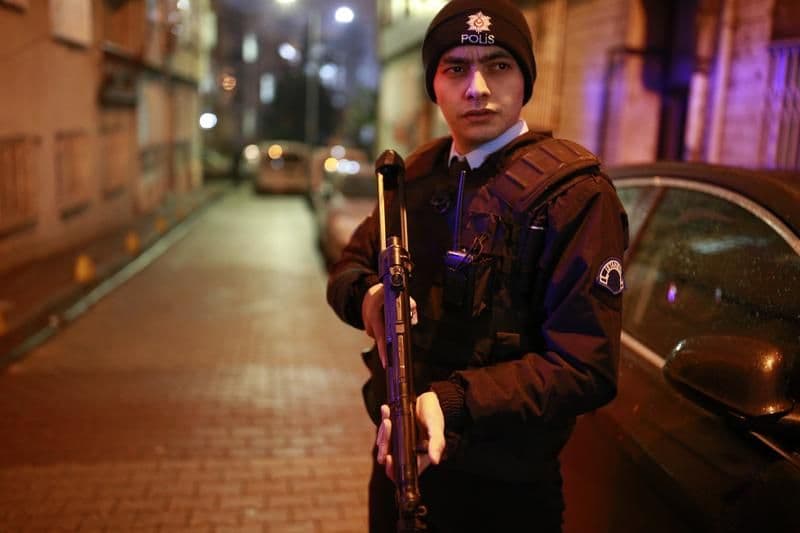
(Washington, D.C., March 29, 2017) – As Secretary of State Rex Tillerson prepares to travel to Ankara on Thursday, a new report from the Foundation for Defense of Democracies (FDD) finds that the Islamic State (IS) has become a significant domestic threat to Turkey, with IS footholds in as many as 70 of Turkey’s 81 provinces.
The report, “Islamic State Networks in Turkey,” finds that Turkish authorities conducted anti-IS operations in at least 54 of Turkey’s 81 provinces in 2016. The jihadist group is now expanding its reach by recruiting Turkish speakers on Twitter and other social media platforms.
Jonathan Schanzer, FDD’s senior vice president, and research associate Merve Tahiroglu write that Ankara’s failed attempts to topple the Assad regime by allowing jihadists to cross the Turkish border into Syria, and the ruling elite’s lackluster approach to tracking jihadists inside the country, have significantly contributed to the spate of IS attacks that Turkey has recently suffered.
“This is a classic case of blow-back,” Schanzer said. “In its attempts to bring down Assad, the Erdogan government believed that it could turn on and off the jihadi spigot. The recent Islamic State attacks against Turkey demonstrate just how wrong they were.”
Schanzer and Tahiroglu also note that Turkey’s fight against Kurdish militants is steadily undermining its struggle against IS. Moreover, clashes between Turkey’s Kurdistan Workers’ Party (PKK) and Syria’s Democratic Union Party (PYD) with IS in Syria and Iraq are spilling over Turkey’s borders, radicalizing Turkish citizens and serving to recruit both groups.
“The de-escalation of the Kurdish conflict could allow Ankara to return to its pragmatic approach to the PYD, and help Turkey focus its counterterrorism efforts on the fight against IS,” Tahiroglu said.
The authors offer several recommendations to the Trump Administration, including:
- Provide support to Turkey in its fight against IS in Syria, but only so long as that mission is confined to fighting IS.
- Support Turkey’s anti-IS operations at home by offering Ankara more intelligence on IS suspects, recruiters, financiers and support networks inside Turkey.
- Issue targeted sanctions against all actors in Turkey already identified as IS operatives, recruiters, financers, advocates, or facilitators, and urge Turkish officials to identify additional financial targets.
- Increase funding for programs focused on combatting jihadist ideology and de-radicalization in Turkey, and expand U.S. efforts to counter IS’s messaging on social media in Turkish.
- Take steps to downgrade the U.S.-Turkish relationship if Turkey does not cooperate more fully with the United States on this crucial issue.

In Pursuit of Nuclear Abolition
By Peter Huessy • RealClearDefense
Innovation Alone Won’t Prepare the U.S. for the Future Battlefield
By Joshua Segal • RealClearDefense
The sUAS Tactical Trifecta
By Bryan T. Woody • RealClearDefense
The Revolutionary War: When Strategic Options Share the Same Weakness
By Henry Yep • RealClearDefense
The Houthis Are Testing the Limits of Collective Defense
By Saima Afzal • RealClearDefense

Who Shoots Down the Drone Over the Shipyard?
By John Ferrari & Dillon Prochnicki • RealClearDefense
Northrop Grumman Breaks Out the Big Guns at AUSA
By Daniel Terrill, Defense News
Army Pursuing Diverse Array of New Anti-Air Interceptors
By Trevithick, The WarZoneWho Shoots Down the Drone Over the Shipyard?
By John Ferrari & Dillon Prochnicki, RCD
F-35C Lands for the First Time on a Ford-Class Aircraft Carrier
By The Aviationist