
Taliban Say Latest Talks End on U.S.'s Afghanistan Withdrawal
Last updated 04:59 PM EDT • Read time: 3m
KABUL, Afghanistan (AP) — The latest round of talks between the Taliban and the United States on a deal to withdraw thousands of U.S. troops from Afghanistan has ended and now both sides will consult with their leadership on the next steps, a Taliban spokesman said Monday.
The eighth round of talks in the Gulf Arab nation of Qatar concluded after midnight and was “long and useful,” Zabihullah Mujahid said in a statement.
He made no statements on the outcome of the talks.
Last week, another Taliban spokesman had said a deal was expected to follow this round as both sides seek an end to the nearly 18-year war, America’s longest conflict.
An agreement — if reached — is expected to include Taliban guarantees that Afghanistan would not be a base for other extremist groups in the future. However, both the Islamic State group’s affiliate and al-Qaida remain active in the country. The Taliban stage near-daily attacks across Afghanistan, mainly targeting Afghan forces and government officials but also killing many civilians.
The deal also could include a cease-fire and stipulate that the Taliban would negotiate with Afghan representatives, though the insurgent group has so far refused to negotiate with Kabul representatives, dismissing the Afghan government as a U.S. puppet.
There was no immediate comment on Monday from U.S. envoy Zalmay Khalilzad, who on Sunday tweeted that “I hope this is the last Eid where #Afghanistan is at war.”
Sunday was the first day of the Muslim holiday of Eid-al-Adha, which unfolded without any major violence reported in Afghanistan.
Khalilzad later added that “Many scholars believe that the deeper meaning of Eid al-Hadha is to sacrifice one’s ego. Leaders on all sides of the war in Afghanistan must take this to heart as we strive for peace.”
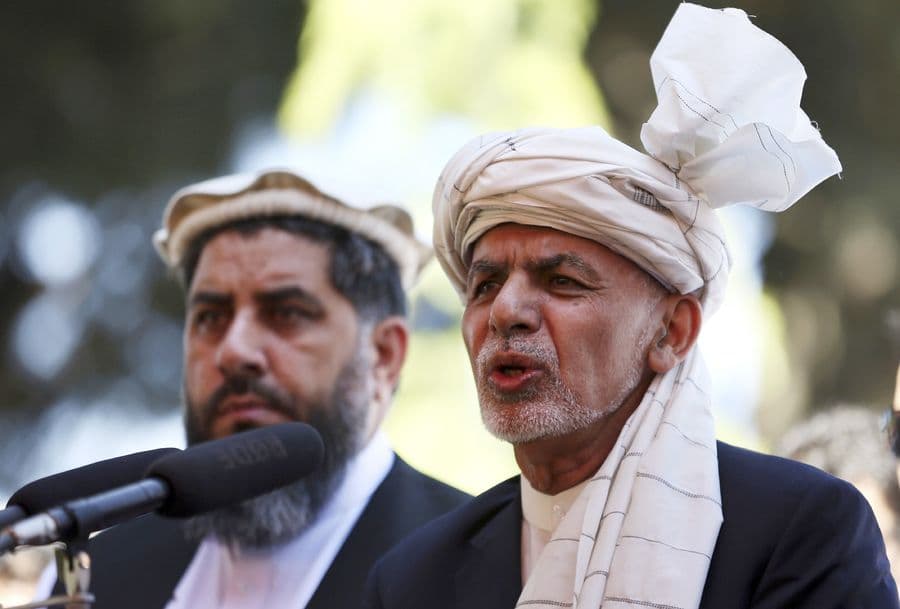
Some in Afghanistan saw it as a response to President Ashraf Ghani, who on Sunday declared that “Our future cannot be decided outside, whether in the capital cities of our friends, nemeses or neighbors. The fate of Afghanistan will be decided here in this homeland. ... We don’t want anyone to intervene in our affairs.”
While Ghani insists that the upcoming Sept. 28 presidential election is crucial for giving Afghanistan’s leader a powerful mandate to decide the country’s future after years of war, Khalilzad is seeking a peace deal by Sept. 1, weeks before the vote.
The Taliban control roughly half of Afghanistan and are at their strongest since the U.S.-led invasion toppled their five-year government in 2001 after the group had harbored al-Qaida leader Osama bin Laden. More than 2,400 U.S. service members have died in Afghanistan since then.
The U.S. and NATO formally concluded their combat mission in Afghanistan in 2014. The some 20,000 American and allied troops that remain are carrying out airstrikes on the Taliban and IS militants, and are working to train and build the Afghan military.
Gannon reported from New York.
© copyright 2019 The Associated Press. All rights reserved.

In Pursuit of Nuclear Abolition
By Peter Huessy • RealClearDefense
Innovation Alone Won’t Prepare the U.S. for the Future Battlefield
By Joshua Segal • RealClearDefense
The sUAS Tactical Trifecta
By Bryan T. Woody • RealClearDefense
The Revolutionary War: When Strategic Options Share the Same Weakness
By Henry Yep • RealClearDefense
The Houthis Are Testing the Limits of Collective Defense
By Saima Afzal • RealClearDefense

Who Shoots Down the Drone Over the Shipyard?
By John Ferrari & Dillon Prochnicki • RealClearDefense
Northrop Grumman Breaks Out the Big Guns at AUSA
By Daniel Terrill, Defense News
Army Pursuing Diverse Array of New Anti-Air Interceptors
By Trevithick, The WarZoneWho Shoots Down the Drone Over the Shipyard?
By John Ferrari & Dillon Prochnicki, RCD
F-35C Lands for the First Time on a Ford-Class Aircraft Carrier
By The Aviationist