
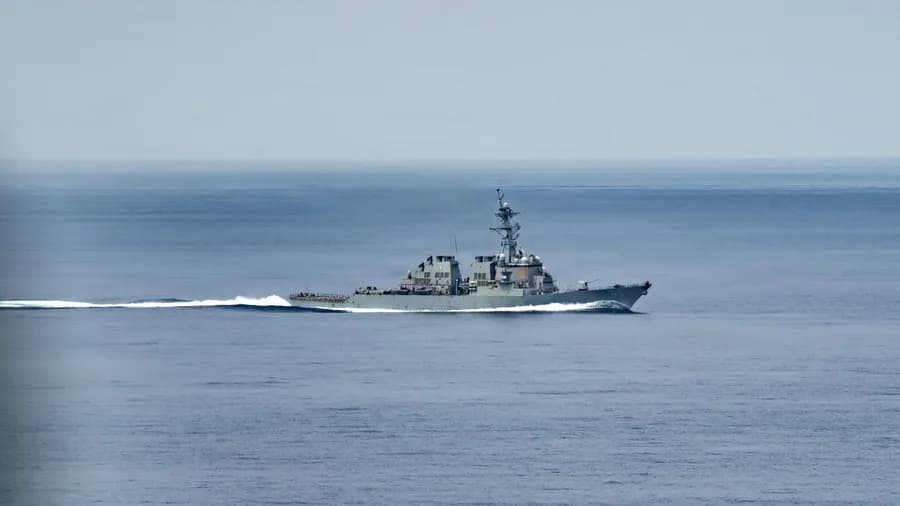
USS Benfold: Harbinger Not Anomaly
Last updated 05:54 AM EDT • Read time: 5m
The recent troubles aboard USS Benfold (DDG 65) have produced precisely the wrong lesson in the public sphere.
The Arleigh Burke-class destroyer lost power in the South China Sea on July 24 and spent four days without normal electrical service before being towed to port in the Philippines. A 10,000-ton American warship adrift in the South China Sea is not an image either the United States or the Navy wishes to project.
But treating Benfold as an embarrassing anomaly misses the larger story.
The more important question is not simply what went wrong with Benfold. It is why we are increasingly asking American warships to operate at a tempo the fleet was never designed to sustain.
The answer has less to do with one destroyer than with how the United States has chosen to use a shrinking Navy.
The American fleet is smaller than it was during the Cold War. Ships were retired, force structure was reduced and the Navy contracted, in part because Americans wanted a peace dividend. But the demands placed upon that smaller fleet did not shrink with it.
Each year, geographic combatant commanders establish requirements for forces around the world. One theater wants continuous carrier presence. Another needs destroyers for ballistic-missile defense. Another requires submarines, amphibious forces or surface ships for deterrence and maritime security.
There is nothing irrational about these requests. It is the combatant commanders' job to identify what they need.
The problem arises when the Navy tries to satisfy those demands as though it still possesses the fleet of 1985.
Ships stay deployed longer, return home later and have less time for proper maintenance before being sent back to sea.
USS Abraham Lincoln illustrates the problem. Not because its crew or leadership failed, but because the ship is being asked to do too much. The carrier has been deployed for more than 250 days after an originally planned seven-month deployment was extended to meet operational requirements.
That is what happens when requirements remain high while the fleet available to meet them does not.
Now consider the larger question: Suppose this were not a war with Iran, but an existential struggle with a nation such as China. What does the Lincoln tell us?
Not necessarily that the force is being mismanaged. It may tell us something more fundamental: the force is simply too small for the demands being placed upon it.
And this is not merely a personnel problem. It is a mechanical one.
A warship is a machine, and machines require maintenance. A fleet cannot operate at an ever-higher tempo, compress maintenance periods and send ships back to sea before they have fully recovered without eventually paying a price.
That is what makes Benfold important.
We do not yet know precisely what caused its power failure. Reports indicate an engineering failure associated with the ship's generators. What we do know is that the loss of electrical power deprived the crew of basic services for four days and ultimately required another ship to tow her to port.
That is serious. It is a humiliation.
But it is not necessarily evidence of an incompetent crew or uniquely defective ship. It may instead be evidence of something much more mundane: wear and tear in a fleet being worked too hard.
Surface ships are particularly vulnerable because they are the workhorses of the fleet. When a combatant commander needs something somewhere, a surface ship is often the answer.
So the ships run.
They run to the Western Pacific, the Middle East and Europe. They conduct exercises, escorts, missile-defense missions, freedom-of-navigation operations and presence patrols. Then they come home, and before long they are asked to prepare to go again.
That creates a vicious circle: the fleet gets smaller while demand remains high; deployments get longer, maintenance gets squeezed and readiness deteriorates; as ships require more maintenance and fewer are available, the remaining ships have to deploy more often.
The obvious response is to build more ships. Of course we should build more ships.
But shipbuilding alone does not solve the problem. A new destroyer must be manned, trained, fueled, supplied, repaired, modernized and operated for decades.
The cost of a fleet is not merely the cost of its hulls. It is the cost of keeping them ready.
We have asked the military to do an extraordinary number of things with a finite budget. We want ships permanently present in multiple oceans, carriers available whenever a crisis erupts, submarines, aircraft, missile defense, cyber and space capabilities, and large stocks of long-range precision weapons.
We want all of it.
But we have been reluctant to make the difficult choices - and provide the resources - required to sustain all of it.
The combatant commanders are not the problem. Their job is to identify military requirements. The admirals are not necessarily the problem either. They are trying to meet those requirements with the force they have.
The problem is the gap between what America asks its military to do and what America is willing to provide it to do those things sustainably.
That gap eventually expresses itself in metal.
It appears in a destroyer that loses power, in ships that spend too long at sea and in maintenance periods that run late. More dangerously, it can produce a Navy that looks powerful on paper but cannot generate enough ready forces when a major war begins.
That is why Benfold should not be treated as an embarrassing anomaly.
We should determine exactly what happened aboard the ship and fix whatever went wrong.
But we should also recognize the larger flashing red light:
You cannot run a fleet indefinitely at wartime tempo without eventually paying a wartime price.
CAPT Eyer is a retired Surface Warfare Officer who served on active duty in the Navy for 27 years. He deployed in seven cruisers and commanded three Aegis cruisers: USS Thomas S. Gates (CG 51), USS Shiloh (CG 67), and USS Chancellorsville (CG 62).
image: Arleigh Burke-class guided-missile destroyer USS Benfold (DDG-65) conducts routine operations while underway in the South China Sea on July 23, 2026. US Navy photo