
Waiting on the Class of 2036
Last updated 04:42 AM EDT • Read time: 8m
Newport News Shipbuilding builds Columbia- and Virginia-class submarines. To become a welder there, a person needs to be eighteen, a United States citizen, willing to work any of three shifts, and able to buy a pair of steel-toed shoes. The training runs three weeks, 120 hours. The application asks for up to seven years of work experience and marks the field “if applicable.” Successful candidates start full time in the yard, usually within one to two weeks of finishing.
That is from the company’s own careers page. The whole trades ladder runs the same way. Eighty hours for deck electricians, painters, insulators, and sheet metal workers. A hundred and twenty for machinists, pipefitters, shipfitters, and welders. Candidates who wash out are pointed toward other entry-level jobs at the yard, “where no experience is required.”
Workforce development, my field, interprets this differently. The field runs from adult job placement to career exploration for teenagers, and practitioners do not agree on where the center of gravity belongs. In defense workforce policy that center of gravity is the long pipeline, and the long pipeline starts in middle school. Find the regions where suppliers concentrate, partner with the districts and the community colleges, introduce fourteen-year-olds to a trade, and follow them for a decade.
Everyone wants to do something for the kids, and that is exactly why nobody examines it. No one has to be talked into a school partnership. A program built around eighth graders asks nothing of anyone currently running a shipyard. No wage has to move. No supervisor’s day has to change. No employer has to explain why half the people he hired last year are already gone. Best of all, it cannot be proven wrong inside anyone’s tenure, because the first cohort cannot be judged until 2036.
The premise underneath all of it is that the trades take years. If a welder takes four years to build, then reaching people earlier is the only lever that matters, and reaching people earlier means the schools.
So where do the four years come from?
Not from the qualification standard. Naval welder qualification runs under Naval Sea Systems Command technical publication S9074-AQ-GIB-010/248, Revision 1. A welder qualifies against an approved procedure and is limited by it. The procedure fixes the process, the position, the base material group, the joint design, and the thickness range. The paragraph titled “Prerequisite” requires that the shop hold qualified procedures, and says nothing about the person. Across 242 pages the words “apprentice” and “journeyman” never appear, and “experience” appears once, in a note about insulation. The only amount of instruction named anywhere is four hours, required only of a welder who has already failed the test twice.
Two qualifications belong here. The standard requires each welder to know the workmanship and inspection requirements of every fabrication document he will work to, so some requirements do live downstream. And NAVSEA Standard Item 009-12 directs shipyards to “maintain a Welding Training Program” under that same publication. Both are real, but neither sets a duration, an hour count, or a term. (This is the standard for conventional naval welding. Nuclear propulsion work carries additional program requirements that are not public, but the argument here does not depend on them.)
None of this will surprise a welding professional. Performance qualification is demonstration by design. The American Welding Society says so on a public page. There are no educational prerequisites and no minimum experience requirements to become a Certified Welder, and if you can make the weld, you are eligible to test. The same organization requires five years of documented experience for a high-school-educated candidate to become a certified welding inspector. Zero years to make the weld. Five to judge it. That asymmetry is deliberate and decades old.
The four-year claim does not live in the welding world. It lives in ours.
The nearest thing to a legal source is apprenticeship regulation, and it does set time. Under 29 C.F.R. 29.5, a registered program must state a term, and a time-based program must run at least 2,000 hours of on-the-job learning. Two thousand hours is about a year. Wisconsin’s registered welder-fabricator standard runs 7,560. Electric Boat’s trades run three to five years. The Department of Labor’s own guidance says the sponsor proposes the term, and the registration agency approves it.
The federal floor is roughly a quarter of the convention. The other three quarters is a choice that employers and programs made.
Which leaves the second justification for spending workforce dollars on middle school, which is that it works. The evidence there is much thinner than the confidence behind it.
The assertion that career interest is set by the eighth grade traces to a 2006 study in Science that asked eighth graders what work they expected to be doing at thirty, then counted who earned a bachelor’s degree in science. The outcome measured was a college degree. Nobody counted jobs, and nobody counted trades. Even the authors declined to claim causation. A 2014 re-analysis of the same data found that the pipeline model fails to describe nearly half of the people who go on to become scientists and engineers.
The largest randomized evidence we have points the same way. MDRC, the education and workforce research organization in New York, followed students through career academies for eight years past high school and found an eleven percent earnings gain and no significant increase in students working in the field their academy had trained them for. Most were working somewhere else. It is still the best evidence anyone has. That trial is a generation old, and none of those career academies were in manufacturing.
Connecticut’s technical high schools do move students into industry. Admission raises the likelihood of working in manufacturing by about ten percentage points and in construction by nine, with the earnings to match. That result is real, and it comes from a four-year, full-time, selective technical high school. It also puts nobody on a deck plate before age eighteen or nineteen, which is the same clock as everything else in this argument.
I do not expect that to change anything. Too many good people have too much invested. But the premise that eighth graders are the center of gravity does not carry the weight we have given it, and someone inside the field ought to say it in public.
None of which means the four years are wasted. Why would a private yard pay for years of below-productivity wages if a short test were the only gate? Firms do not spend at that scale on ceremony. The apprenticeship buys what the standard does not. It buys the range to work across many procedures, positions, and materials rather than the one weld he was tested on. It buys low reject rates and a wage ladder that holds people. And it buys a way of rationing the scarcest input in the yard, which is the time of the experienced hand who has to supervise. The Government Accountability Office reported in February 2025 that a shipyard employee takes three to five years to reach proficiency, and that new employees need closer supervision to avoid the quality problems and late rework that have already hit the lead Columbia-class boat. That is a measure of those four things.
The four years are a purchase, but nobody has priced what they buy.
Two numbers would price it, but neither is published. The first is days from hire to first independent production work. The second is journeyman-hours consumed per qualified worker, because every hour a master welder spends teaching is an hour not welding. The closest published figure is the Navy’s claim that its sixteen-week accelerated program in Danville, Virginia cuts time-to-talent by 300 days. That is a saving measured against a baseline the report does not state, for a term it does not define, and it is not days from hire to independent production work.
The Navy’s Maritime Industrial Base Program already publishes workforce numbers. Its 2025 Year in Review reports fifteen thousand workers placed through six regional Talent Pipeline Programs, and forty thousand K-12 students engaged across thirty states. Those numbers count people reached. The two I am asking for would count what the reaching bought. “Days from hire” probably already sits inside yard quality and personnel systems. “Journeyman-hours” sits nowhere. Collecting it means separating training hours from production hours in labor accounting, which is probably a year’s worth of work rather than a quarter.
I am not the first person to see the gap. Alexander Grey set out the shortfall in War on the Rocks in April 2024. The sector will miss its recruiting goals, he wrote, and the country should plan on diminished capacity through much of the 2030s. He draws the opposite conclusion and argues for building the pipeline early and regionally. We agree about the arithmetic. Where we differ is what the arithmetic requires. That question cannot be answered without those two numbers.
Publish them and we will know whether the years are a constraint or a habit. Keep not publishing them, and the Class of 2036 remains the plan.
Mr. Gilroy is the Vice President for Workforce Development at the Center for Regional Economic Competitiveness in Arlington, Virginia.
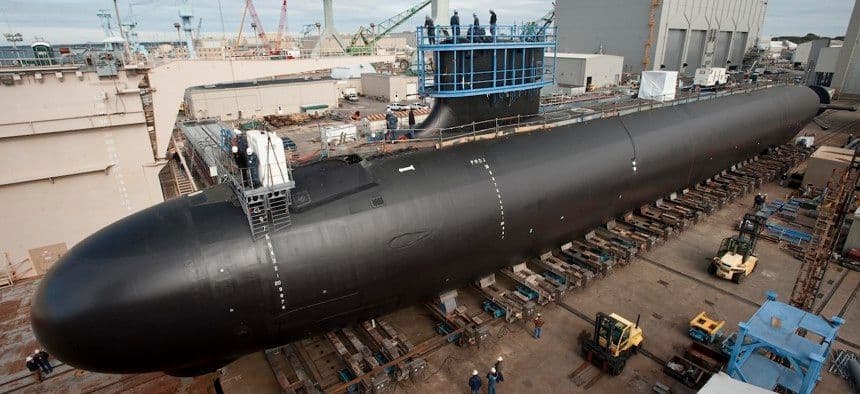
image: The Virginia-class attack submarine Minnesota (SSN 783) under construction at Huntington Ingalls Newport News Shipbuilding in 2012. U.S. Navy photo courtesy of Newport News Shipbuilding