
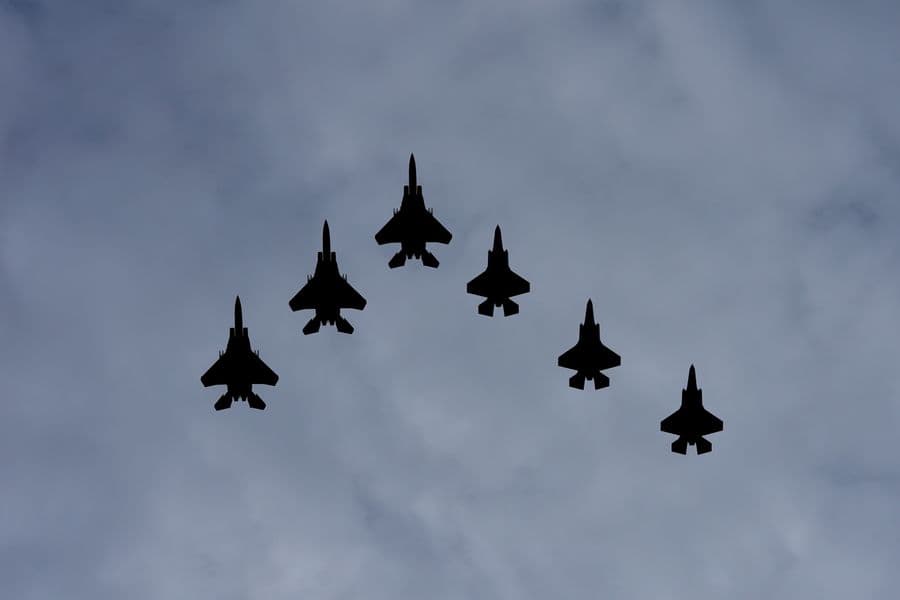
Airpower Can't Occupy a Hill: The Enduring Limits of Victory From the Air
Last updated 07:05 AM EDT • Read time: 10m
‘For good or for ill, air mastery is today the supreme expression of military power”, declared Winston Churchill in 1949. Nearly eighty years later, following Hamas’s attack on October 7, 2023, that expression appeared more dominant than ever. In the ensuring weeks Israeli aircraft and drones conducted a highly intense precision air campaign. Artificial-intelligence systems codenamed Lavender and Gospel sifted through enormous quantities of surveillance footage and communications intercepts, generating and prioritizing tens of thousands of targets -individual fighters, tunnel entrances, weapon caches- at a pace human operators could not match. Precision-guided munitions followed, striking with a speed and claimed accuracy that fulfilled the long-standing dream of aerial warfare: decisive effect delivered from the sky, with minimal risk to the pilots above.
Yet once the intense bombing of Khan Younis and Rafah subsided, the limits of an advanced air campaign became starkly visible. Despite the enormous damage inflicted, Hamas fighters and their infrastructure remained firmly entrenched in the dense urban terrain and extensive tunnel network, and Israeli ground forces still had to conduct large-scale clearing operations on foot. Airpower had prepared the battlefield and degraded Hamas capabilities, but it could not seize or control territory on its own.
This pattern is far older than the drones and AI now in use: for more than a century, proponents of airpower have promised that control of the skies could translate directly into control of the ground, but history suggests otherwise. Air superiority can shatter command nodes and supply lines, but it cannot seize territory, govern populations or break an enemy’s will to resist.
The Allure and Origins of Air-Only Victory
The idea that airpower could win wars on its own was not invented by modern technology. It was born in the horrors of the First World War, when the endless slaughter on the ground made any alternative look like salvation. Italian General Giulio Douhet laid the foundation in his 1921 seminal work The Command of the Air, where he argued that an independent air force, once it had gained command of the skies, could strike directly at an enemy’s cities, factories, and civilian population, shattering their will to resist and forcing surrender in a very short period of time. The vision was seductive: a war won from above, with minimal risk to the troops below.
Despite a century of dramatic technological and tactical progress, the core roles of military airpower have barely changed since Douhet’s time and show little sign of fundamental change. Aircraft, cruise missiles, kamikaze drones, and other aerial platforms are primarily employed to conduct deep strikes against an adversary’s war-making capacity, targeting factories, supply networks, power grids, and other strategic infrastructure far behind the front lines. Airpower is also used to directly engage enemy combat forces in the field and to enable joint operations across land, sea, and other domains. In addition, it continues to deliver essential intelligence, surveillance, and reconnaissance -a mission envisioned for aircraft from the very beginning- as well as rapid airlift and logistical support.
The theory quickly found champions elsewhere. In the United States, Brigadier General William “Billy” Mitchell became its most vocal advocate, insisting that airpower would soon make traditional armies and navies secondary. In the United Kingdom, Air Marshal Hugh Trenchard shaped Royal Air Force doctrine around the same belief: relentless bombing of enemy morale would bring wars to a swift conclusion. Ever since, each new generation of technology, from the heavy bombers of the 1930s to the precision munitions and AI-assisted targeting systems of today, has been hailed as the breakthrough that would finally make the old dream real.
Historical Evidence: When Air Dominance Met Ground Reality
As the promise of air-only victory has been tested repeatedly, the pattern of disappointment has been remarkably consistent, with one of the quintessential examples being the Battle of Monte Cassino in February 1944. The sixth century Benedictine monastery and the town below were anchored the western sector of the Gustav Line, a formidable series of fortifications the Germans had constructed to delay the Allied advance through Italy and prevent the fall of Rome. Allied commanders ordered a massive bombing raid on the monastery and over the course of three days, more than 250 heavy bombers dropped around 1150 tons of explosives, reducing the monastery and surrounding buildings to a wasteland of rubble and craters. The destruction, however, handed defenders a gift: the ruined monastery and town proved far better cover for their emplacements and troops than the intact structures ever could have. German paratroopers quickly occupied the ruins, turning every pile of broken stone into a machine-gun nest and every crater into an anti-tank obstacle. Tanks could not advance through the debris, and infantry became bogged down in house-to-house fighting that lasted weeks longer than planned, and by the time the campaign was over the Allies had suffered roughly 55,000 killed and wounded, while the Germans lost 20,000. What was meant to shorten the battle only made the urban fight far worse.
The same pattern was held in the wider war. The Allied bombing campaign against Germany fell short of winning the war alone: the United States and the United Kingdom dropped nearly 2.7 million tons of bombs, killing at least 350,000 German civilians, crippling key sectors of industrial output -particularly synthetic oil production and rail transport- and reducing the centers of most of Germany’s large cities to rubble. Yet ground troops still had to battle all the way to Berlin, even if airpower made the fight far less costly.
In Vietnam, the U.S. placed enormous faith in airpower across multiple campaigns. Operation Rolling Thunder (1965–68) and the 1972 Linebacker operations sought to break North Vietnamese will and interdict supplies, with Linebacker II alone dropping more than 20,000 tons of bombs in just 11 days. On the surface, it forced Hanoi back to the table and produced the Paris Peace Accords, a diplomatic pause that allowed American withdrawal. The Accords did, however, give North Vietnam strategic breathing space, and barely two years later in 1975 North Vietnamese divisions swept south and conquered Saigon. Airpower had bought the United States the time it needed to withdraw, but it could not secure a lasting peace once U.S. ground forces and political commitment were removed.
By contrast, when airpower is closely integrated with a swift and decisive ground campaign, the results are dramatically more effective. In the 1991 Gulf War the U.S.-led coalition launched an intense 38-day air campaign that destroyed Iraqi command centers, air defenses, supply lines, with precision strikes claiming extraordinarily high hit rates. When the ground offensive finally began, the Iraqi army was defeated in Kuwait in merely 100 hours.
The same pattern repeated when the objective changed in 2003. Operation Iraqi Freedom, as the name implied, aimed to overthrow Saddam Hussein’s regime, and the opening ‘shock and awe’ phase of the Iraqi invasion unleashed more than 8,000 precision-guided munitions and 725 Tomahawk missiles against leadership targets and military infrastructure. Command nodes were shattered and communications disrupted, yet the regime did not collapse from the air alone. Baghdad and other major cities had to be taken by a swiftly advancing ground campaign.
Why Bombs Alone Fail: Three Structural Limits
Why does airpower so consistently fail to deliver decisive victory on its own? It is not primarily a question of technology or tactics but arises from three fundamental structural limits that have persisted for more than a century, regardless of how precise, intelligent, or overwhelming the weapons have become.
First, territory must be occupied. Precision strikes can destroy buildings, vehicles and command posts with remarkable speed, but they cannot hold ground or govern populations. Once the aircraft depart, the enemy frequently returns to the rubble or simply relocates to new positions. Without soldiers physically present to secure key areas, enforce control, protect supply lines and interact with local civilians, the effects of even the most accurate bombing campaign remain temporary and reversible, a dynamic that repeats in every modern urban battlefield: airpower prepares the ground, but it cannot own it.
Second, morale and adaptation defy easy destruction. Early airpower theorists assumed that sufficient destruction would break civilian and military will, producing surrender before ground forces ever arrived. Historical evidence shows the opposite is often true. Bombing campaigns frequently produce short-term fear and disruption, yet they also trigger rapid adaptation and, in many cases, a hardening of resolve. Adversaries learn to disperse forces, move underground, blend with civilians, shift to low-signature logistics and exploit the propaganda value of civilian suffering. The psychological impact of bombing has a clear ceiling, and beyond a certain point further strikes tend to strengthen rather than weaken determination to resist. This is why adversaries under sustained aerial attacks have repeatedly chosen endurance over capitulation.
Third, strategic isolation undermines long-term success. An air campaign waged without effective ground follow-through risks becoming a costly war of attrition. While air forces can impose high costs and disrupt enemy operations for extended periods, adversaries often retain the ability to choose the tempo on the surface, absorb losses, however painful those might be, and wait for the attacker’s political will to erode. Recent conflicts have repeatedly demonstrated this pattern: air superiority can sustain operations for years, yet political objectives remain elusive until ground forces and diplomatic pressure are brought to bear.
These limits explain why the promise of victory from the air has remained unfulfilled for over a century. As T.R. Fehrenbach observed in his 1963 book, This Kind of War: “You may fly over a nation forever, you may bomb it, atomize it, pulverize it and wipe it clean of life. But if you desire to defend it, if you desire to protect it, if you desire to keep it for civilization, you must do this on the ground the way the Roman legions did . . . in the mud.”
Conclusion
Air superiority remains a formidable advantage, yet it has never proved sufficient on its own to deliver victory. The structural limits examined – the inescapable need to occupy ground, the stubborn resilience of human morale under bombardment, and the strategic isolation of campaigns waged solely from above – have outlasted every technological leap from Douhet’s piston engine bombers to today’s AI-guided munitions.
Although overwhelming dominance in the skies can inflict heavy damage and disrupt command structures, it cannot topple a regime, secure territory, or guarantee a political outcome, and history and recent experience alike show that the assumption of a quick, low-cost victory from the air often leads to prolonged and inconclusive conflict rather than a swift resolution. Victory is ultimately won on the ground, through the occupation and control of terrain and the sustained commitment of forces and political will. As such, airpower is most effective when it functions as a powerful enabler, not as a standalone solution.
Gerald Mako is a Research Affiliate at the Cambridge Central Asia Forum at Cambridge University, where his research focuses on Russia, the Middle East, and military technology. He has advised governments in Europe and Asia on cybersecurity and military AI.

In Pursuit of Nuclear Abolition
By Peter Huessy • RealClearDefense
Innovation Alone Won’t Prepare the U.S. for the Future Battlefield
By Joshua Segal • RealClearDefense
The sUAS Tactical Trifecta
By Bryan T. Woody • RealClearDefense
The Revolutionary War: When Strategic Options Share the Same Weakness
By Henry Yep • RealClearDefense
The Houthis Are Testing the Limits of Collective Defense
By Saima Afzal • RealClearDefense

Who Shoots Down the Drone Over the Shipyard?
By John Ferrari & Dillon Prochnicki • RealClearDefense
Northrop Grumman Breaks Out the Big Guns at AUSA
By Daniel Terrill, Defense News
Army Pursuing Diverse Array of New Anti-Air Interceptors
By Trevithick, The WarZoneWho Shoots Down the Drone Over the Shipyard?
By John Ferrari & Dillon Prochnicki, RCD
F-35C Lands for the First Time on a Ford-Class Aircraft Carrier
By The Aviationist