
Lethal Autonomy: Are We Asking the Right Questions?
Last updated 06:40 AM EDT • Read time: 9m
Every generation of military leaders confronts technologies that promise to transform warfare. Some do. Others prove less revolutionary than their advocates predict. The more important question, however, is rarely whether a technology works. It is whether we are asking the right strategic questions before reorganizing military power around it.
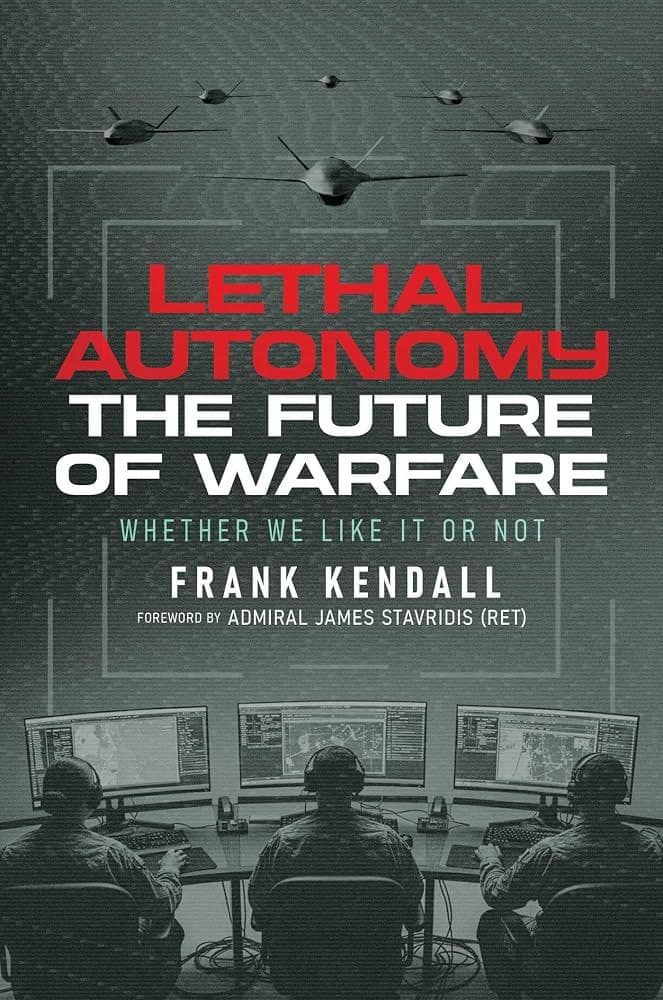
Frank Kendall’s Lethal Autonomy: The Future of Warfare Whether We Like It or Not asks one of the most important questions facing the U.S. military today: how should America harness artificial intelligence and autonomous systems as they become increasingly capable? It is an important question, thoughtfully examined by someone uniquely qualified to ask it.
Kendall entered West Point as the Vietnam War approached its peak and has spent nearly six decades thinking about the relationship between technology and military power. From Army officer to senior Pentagon acquisition executive to Secretary of the Air Force, he has helped shape many of the capabilities now entering the force.
I served in organizations Kendall led during his tenures as Under Secretary of Defense for Acquisition, Technology and Logistics and later as Secretary of the Air Force. I did not work directly for him, but his leadership style was unmistakable. He was known for an extraordinary work ethic, a formidable intellect, and a willingness to challenge conventional wisdom; even his own.
That is the spirit in which Lethal Autonomy deserves to be read. It is also the spirit in which it deserves to be challenged.
Kendall has written an important book. Anyone serious about the future of American military power should wrestle with the questions he raises. My concern is not that he overestimates artificial intelligence or autonomous systems. If anything, he is right to argue these technologies will transform warfare “whether we like it or not.”
My concern is different.
Throughout the book, Kendall primarily treats autonomy as an operational problem. I believe its most consequential effects may ultimately be political.
That distinction matters because war is not fought for operational success. It is fought for political purposes. If we ask only how autonomy changes military operations, we risk overlooking the more fundamental question: how does it change the relationship between military force, democratic societies, and the political objectives for which wars are fought?
The Genie Is Out of the Bottle
Kendall begins with a premise that is difficult to dispute. Artificial intelligence is advancing rapidly. Autonomous systems are becoming more capable. America’s adversaries will pursue these technologies regardless of whether we welcome them. As he writes, “I don’t think the development of lethal autonomy can be stopped or even slowed appreciably.”
He may well be right. The United States cannot opt out of technological competition and hope everyone else follows. Ignoring autonomy would be strategically irresponsible. But inevitability is not strategy.
Even if autonomous warfare is coming, we still face choices about where to invest, what functions to automate, what risks to accept, and where human judgment remains indispensable. Those are strategic decisions, not technological inevitabilities.
Kendall offers another observation that applies well beyond acquisition reform: “haste makes waste.” Moving faster in the wrong direction simply gets us to the wrong destination sooner. The challenge is not merely adopting autonomy quickly. It is ensuring we are asking the right questions before reorganizing military power around it.
The Blank Sheet Isn’t Blank
One of the book’s greatest strengths is Kendall’s willingness to rethink military operations from first principles.
Rather than asking how autonomous systems can be added to today’s force, he asks what military operations might look like if we began with a blank sheet of paper. He systematically examines warfare across land, sea, air, space, and cyberspace, minimizing human participation wherever machines can perform military functions more effectively.'
It is an intellectually rigorous exercise. But it also reveals what I believe is the book’s central limitation. The operational sheet may be blank. History is not. Military organizations inherit more than technology. They inherit alliances, political institutions, strategic cultures, public expectations, and adaptive adversaries. Before committing to new operational concepts, we must first ensure our strategic assumptions remain sound.
Wars are not fought in operational research centers where superior kill ratios produce predictable outcomes. They unfold within political systems, among populations, through alliances, and under the scrutiny of democratic societies. Culture matters. Public opinion matters. Above all, human behavior matters.
Clausewitz understood this when he described war as “a continuation of political intercourse with the admixture of other means.” Military operations exist to serve political objectives, not the reverse.
That is why I keep returning to what I believe is the central question.
If autonomy changes military operations, and it certainly will, we should ask not only whether it makes them more efficient, but whether it changes the relationship between military force and the political purposes for which that force exists.
I believe that is the more consequential question.
Winning Battles Is Not the Same as Winning Wars
Throughout the book, Kendall evaluates military effectiveness through concepts familiar to defense planners: survivability, cost-exchange ratios, persistence, and operational advantage. Those considerations matter. Autonomous systems will almost certainly outperform humans in many dangerous missions through persistence, speed, precision, and lower cost.
But operational effectiveness is not the purpose of war.
War seeks to influence human decisions. It seeks to deter aggression, reassure allies, weaken enemy resolve, strengthen political legitimacy, and shape the choices of governments and populations. Military destruction is a means toward those ends, not the end itself.
Ironically, Kendall himself acknowledges that “the fundamental is human behavior and its limitations.” I agree completely.
The difference is that I believe the most consequential human behavior often occurs far from the battlefield. It resides in presidents deciding whether to initiate conflict, allied governments deciding whether to remain committed, civilians choosing whether to cooperate or resist, enemy soldiers deciding whether to continue fighting, and the American people deciding whether a war remains worth supporting.
These are not secondary considerations. They are the environment within which military force succeeds or fails.
The Human Relationship to War
Kendall introduces one idea that I found particularly thought-provoking: the limits of courage. The argument is straightforward. If autonomous systems can accomplish dangerous military missions as well as, or better than, human beings, why should we continue exposing American servicemembers to unnecessary risk?
As someone who has led soldiers in combat, I have little interest in romanticizing casualties that technology might prevent. We should preserve American lives whenever possible. But removing Americans from physical danger changes more than casualty statistics. It changes the political relationship between the American people and wars conducted in their name.
Removing our people from physical danger might preserve American political support for war in the short term while weakening the deeper connection between society and the purposes for which the war is being fought.
That deeper connection is not merely symbolic. American servicemembers deployed abroad do more than operate weapons or occupy terrain. Their presence reassures allies, builds relationships with local populations, develops understanding that sensors alone cannot provide, and demonstrates that the United States is willing to share the risks created by the policies it pursues. That willingness gives American military power credibility that cannot always be replicated through remotely applied force alone.
This is not an argument for exposing servicemembers to unnecessary danger. We should preserve American lives whenever technology allows us to do so without sacrificing strategic effect. But risk is not always merely an operational cost to be engineered away. In some circumstances, the willingness to accept risk is itself part of the strategic message.
That is why I believe we should begin with the political objective rather than the technology. The question is not how to remove people from military operations wherever machines can perform the task. It is what political outcome we seek, what human presence is required to achieve it, and how autonomous systems can better enable the warfighters executing American foreign policy.
Clausewitz famously described war as a dynamic relationship among the government, the military, and the people. Autonomy does not remove that relationship. It changes it.
The Enduring Advantage Is Adaptability
History also instructs humility. Revolutions in military affairs rarely unfold as predicted. Ukraine has demonstrated how quickly technological advantages emerge, disappear, and reappear. Drones evolve. Countermeasures follow. Software changes. Electronic warfare adapts. Tactical advantages that appear decisive one month may prove temporary the next.
The United States should therefore resist defining success as building the world’s most autonomous military. Instead, it should strive to build the world’s most adaptable military.
Adaptability extends beyond platforms. It depends on resilient industrial capacity, secure digital infrastructure, robust communications, artificial intelligence, cyber resilience, manufacturing, logistics, and the ability to modify systems faster than adversaries can counter them.
Technology matters enormously. But America’s enduring strategic advantage is unlikely to come from predicting the future more accurately than everyone else. It will come from adapting more rapidly when our predictions inevitably prove incomplete.
Asking the Right Question
Lethal Autonomy is an important contribution to one of the defining strategic debates of our time. Kendall forces readers to confront questions many would prefer to postpone. He is certainly correct that autonomous systems will play an expanding role in future warfare, and the United States cannot afford to ignore that reality. But perhaps the most important question is not how autonomy changes military operations. It is how autonomy changes war itself.
Technology will continue transforming the battlefield. It will alter force structure, acquisition, doctrine, logistics, intelligence, and command and control. What it cannot eliminate are the political purposes for which wars are fought. Military power ultimately exists to influence human behavior. Governments still make decisions. People still bear consequences. Political legitimacy still matters. Public support still matters. Wars still begin, and end, because human beings decide they should.
Kendall asks us to look into the bottle because the genie cannot be returned.
He is right. But before we reorganize our military around what we find there, we should ask a broader question. Not simply whether autonomous systems make war more efficient, but whether they strengthen or weaken the political and human foundations upon which military power ultimately rests.
Kendall has challenged us to think differently about autonomy. He is right to do so. But technology has always been a means rather than an end. Our military exists to achieve political objectives, not technological ones. The enduring question is therefore not how to remove humans from war wherever machines can perform the task. It is how autonomous systems can better enable the men and women whose presence, judgment, and willingness to bear risk give American military power its credibility and strategic purpose.
Technology will transform how wars are fought. It will not change why they are fought.
Any theory of lethal autonomy that loses sight of that distinction risks optimizing the conduct of war while neglecting its purpose.
Ryan McDermott is an Iraq War veteran, former Pentagon official, and author of Downriver: Memoir of a Warrior Poet. The views expressed are his own.

In Pursuit of Nuclear Abolition
By Peter Huessy • RealClearDefense
Innovation Alone Won’t Prepare the U.S. for the Future Battlefield
By Joshua Segal • RealClearDefense
The sUAS Tactical Trifecta
By Bryan T. Woody • RealClearDefense
The Revolutionary War: When Strategic Options Share the Same Weakness
By Henry Yep • RealClearDefense
The Houthis Are Testing the Limits of Collective Defense
By Saima Afzal • RealClearDefense

Who Shoots Down the Drone Over the Shipyard?
By John Ferrari & Dillon Prochnicki • RealClearDefense
Northrop Grumman Breaks Out the Big Guns at AUSA
By Daniel Terrill, Defense News
Army Pursuing Diverse Array of New Anti-Air Interceptors
By Trevithick, The WarZoneWho Shoots Down the Drone Over the Shipyard?
By John Ferrari & Dillon Prochnicki, RCD
F-35C Lands for the First Time on a Ford-Class Aircraft Carrier
By The Aviationist