
Russian Submarines Fire Cruise Missiles at IS Stronghold in East Syria
Last updated 05:47 PM EDT • Read time: 4m
ABOARD THE ADMIRAL ESSEN (AP) — Russia’s military fired seven cruise missiles Thursday at Islamic State targets in the eastern Syrian province of Deir el-Zour as pro-government forces closed in on the militants holed up in the eponymous capital.
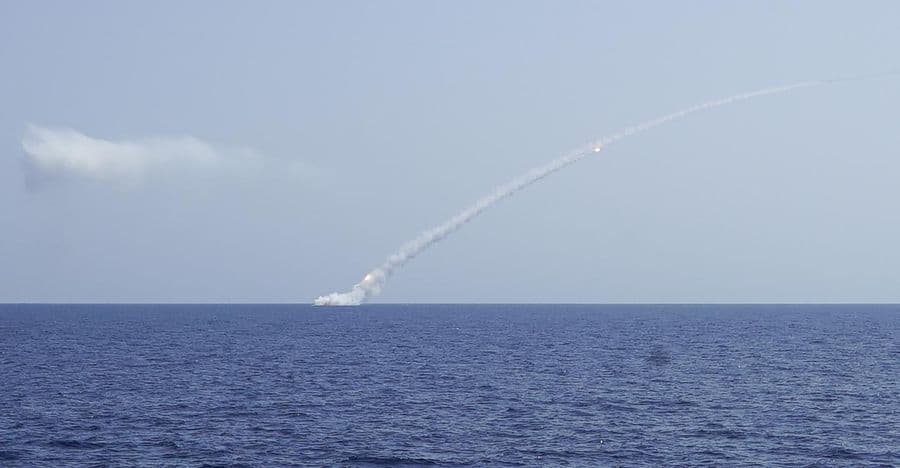
Journalists on a trip organized by the Russian Defense Ministry watched from the deck of Russia’s Admiral Essen frigate as two submarines launched seven missiles from the Mediterranean Sea.
The Syrian government forces, backed by Russian air cover, last week broke a three-year siege around the city on the Euphrates river.
Ministry spokesman Maj. Gen. Igor Konashenkov told reporters later that intelligence showed the missiles hit the targets southeast of Deir el-Zour, destroying a command center, a communications hub, an ammunition depot and an unspecified number of IS fighters.
Russia has provided military backing for Syrian President Bashar Assad’s forces since 2015. It has repeatedly fired salvoes of Kalibr missiles into Syria, from both surface warships and submarines. It has also launched cruise missiles from strategic bombers.
An Associated Press reporter on the deck of the Admiral Essen frigate saw three missiles and later four more flying into the air, leaving trails of smoke. Two submarines emerged and were visible on the horizon shortly after.
Backed by an intense aerial campaign, Syrian and allied forces pushed their way toward the city last week, breaking a nearly three-year siege on its troops on the western edge of Deir el-Zour. It was a major symbolic victory for the pro-government forces. Since then, they have been battling remnants of the militants inside the city, seizing more than 60 percent of it. On Thursday, the pro-government forces were closing in at the extremists from three sides along the river, pounding al-Bogheliyah neighborhood on the northwestern edge of the city.
The militants are currently encircled by Syrian troops from three sides, with their backs to the Euphrates River. However, they still control rural areas outside the city and the border with Iraq.
As IS reels from significant losses in Syria and Iraq, there is a race for control of the border with Iraq, currently still in the militants’ hands. U.S.-backed Syrian forces are meanwhile advancing in the surrounding province from the east and north, on the other side of the river.
Bassem Aziz, a spokesman for the U.S-backed and Kurdish-led Syrian Democratic Forces, said his troops have taken control of an industrial area on the eastern bank of the river, a few miles from the government troops. Aziz said they are about 6 kilometers (4 miles) away from the city’s eastern entrance.
In its statement last week, the U.S-led coalition said it will back its partners on the ground to defeat IS and “will do our utmost to ensure that (IS) terrorists do not move toward the border of our Iraqi partners.
Overnight, a convoy of Islamic State militants and their relatives being evacuated from the border with Lebanon has crossed into Deir el-Zour from a desert area in central Syria, ending a standoff with the U.S-led coalition that briefly overshadowed the race for the province.
The evacuation, negotiated by Lebanon’s Hezbollah group, removed the militants from the Syria-Lebanon border but angered Iraq and the U.S., which said they should have been killed on the battlefield not moved to the Iraq border.
The deal reached at the end of August allowed hundreds of militants and their families to relocate to Boukamal, an IS-held Syrian town near the Iraqi border, in exchange for IS-held prisoners and the remains of Lebanese soldiers captured in 2014. One surviving Hezbollah fighter was returned to Lebanon Thursday.
The head of the Britain-based Syrian Observatory for Human Rights Rami Abdurrahman said buses and vehicles carrying about 400 militants and civilians crossed into Deir el-Zour province Wednesday. It was not clear where the buses went.
The U.S-led coalition struck the road the convoy was traveling on, leaving it stranded in the desert for about two weeks, though some vehicles were able to slip into militant-held territory. The U.S. said it did not strike the convoy itself because of the presence of civilians.
Last week, the U.S-led coalition said it ended surveillance of the convoy after a Russian request, as Syrian troops advanced against IS in eastern Deir el-Zour province.
The proximity of the two forces raises the specter of confrontation, as both sides vie for the border with Iraq and the oil and resources-rich province.
© Copyright 2017 Associated Press . All rights reserved. This material may not be published, broadcast, rewritten or redistributed.

In Pursuit of Nuclear Abolition
By Peter Huessy • RealClearDefense
Innovation Alone Won’t Prepare the U.S. for the Future Battlefield
By Joshua Segal • RealClearDefense
The sUAS Tactical Trifecta
By Bryan T. Woody • RealClearDefense
The Revolutionary War: When Strategic Options Share the Same Weakness
By Henry Yep • RealClearDefense
The Houthis Are Testing the Limits of Collective Defense
By Saima Afzal • RealClearDefense

Who Shoots Down the Drone Over the Shipyard?
By John Ferrari & Dillon Prochnicki • RealClearDefense
Northrop Grumman Breaks Out the Big Guns at AUSA
By Daniel Terrill, Defense News
Army Pursuing Diverse Array of New Anti-Air Interceptors
By Trevithick, The WarZoneWho Shoots Down the Drone Over the Shipyard?
By John Ferrari & Dillon Prochnicki, RCD
F-35C Lands for the First Time on a Ford-Class Aircraft Carrier
By The Aviationist