
The Arrival of Heterogeneous Airpower
Last updated 06:53 AM EST • Read time: 6m
The U.S. Air Force just released a report on what it might look like in 25 years’ time. It’s big takeaway is that the uncertainties are too large for long term planning. That sounds a wise course as air power is transforming. Surprisingly, a major driver of this is what others have been doing in small and large conflicts in the Ukraine and the Middle East.
A notable feature of air operations in the last couple of years has been the extraordinary variety of rocket, missile and drone systems used by Ukraine, Russia, Iran, Hezbollah, the Houthis, and Hamas. The large-scale combat employment of such systems has long-lasting implications.
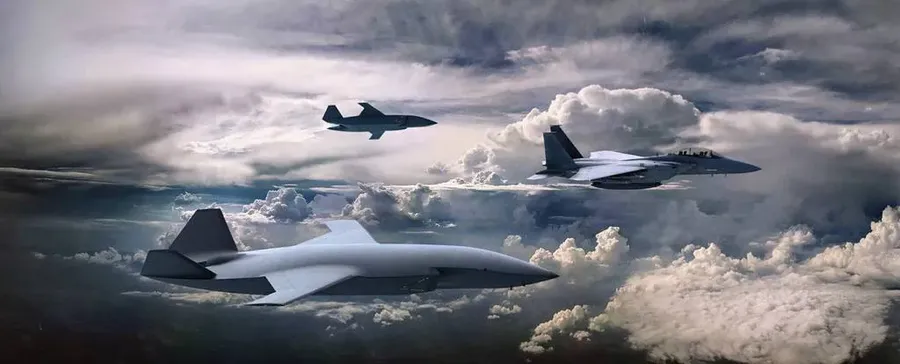
First, air operations have now permanently shifted from being homogeneous in nature to being heterogeneous. Traditionally, air forces principally comprised crewed aircraft and their training and support structures. This model has now expanded, from when initially boost-glide, cruise and ballistic missiles were developed to more recently with the introduction of many different types of uncrewed air vehicles. Such air vehicles are increasingly undertaking a diverse array of functions including surveillance, strike, electronic support, and logistics.
The Ukraine War is an exemplar of this change and what options it now offers traditional air forces. When both the Russian and Ukrainian air forces suffered unsustainable attrition of their crewed aircraft and helicopters in the first few months of the conflict, they quickly transformed to field and operate heterogeneous force structures. If they had struck to their traditional crewed aircraft force structure, they would have soon become irrelevant to the war.
Second, heterogeneous air power can be employed by states and non-states, big and small. Given the complexities inherent in such a diversity of users, it is improbable to stay well-informed about all those that may use such air power in the future. The difficulties in doing this become apparent considering Israel missed Hamas’s preparations for its air assault on the Gaza border barrier. Gaza had been under extensive air, ground, and sea surveillance for decades with much seen and yet seemingly not fully appreciated.
The alternative approach might be for air forces to become more agile in terms of organisation, doctrine, workforce mind-sets and skills, and technology. The intent would then be to accept the possibly of surprise but be able to nimbly adapt to new circumstances quickly and efficiently. This could be a hard ask. Air forces have often not been agile organisations, not the least because the long-term nature of their equipment with service lives of 30 years or more has not required it.
Third, the rise of heterogeneous air power opens many opportunities for innovation. Importantly, innovations in uncrewed systems are inherently simpler to achieve and generally much more affordable than for crewed air vehicles. However, rapid innovation cuts both ways. In Russia’s Ukraine war newly developed drones have been made obsolete within a few weeks as kinetic and electronic counters are equally rapidly devised. The elements comprising heterogeneous air power may experience considerable churn. It is unlikely to be the “set and forget” form of air power that homogeneous air power with its long-life equipment is.
Fourth, heterogeneous air power is difficult to comprehensively defend against. Just counter-drone systems alone can include warning sensors, backpack and vehicle mounted electronic jammers, gun systems, hard-kill interceptors and laser blinding devices. Heterogeneous air power can be matched by heterogeneous counters, but this is inherently a complicated and costly approach that involves many skilled personnel and diverts them from other tasks.
Ideally, defensive systems would be capable against multiple dissimilar air power elements. Generic counters to heterogeneous air power are required. This becomes ever more important given that such counters may need to be deployed tactically on the frontlines and deep in the homeland.
Fifth, Iran exports simplified missiles and drones to those with a limited capacity to manufacture, maintain and operate complicated equipment. This extends to designing equipment others can manufacture under relatively rudimentary conditions such as is done by Hezbollah in Lebanon. Being able to rapidly scale up air power to meet urgent strategic and tactical demands arguably requires adopting a similar simplifying philosophy and, if needs be, accepting a reduced operational performance. The alternative appears a strong likelihood of quickly exhausting the available complicated means of air power when war starts. Any air power is better than none. Iran’s air power export strategy shows what can be done.
Sixth, Ukraine, Russia, Iran, Hezbollah, the Houthis, and Hamas have all conducted heterogeneous air operations but across wildly differing timelines, prompted by both choice and necessity. In building a nation’s air power, the possibility of needing to engage in air operations across extended periods, possibly in a non-linear manner, needs to be included in force structure deliberations. On the other hand, consideration could be given to ways to better shape the pace of the air operations to be of a length and intensity that is preferred.
Seventh, with all using heterogeneous air power to gain reach, perspective and responsiveness, all need to embrace the hider part of the hider/finder dictum. Ways to disperse military entities and some civilian capabilities into smaller and smaller elements where each presents a less attractive to target, together with measures to deceive, confuse and obfuscate hostile heterogeneous air power are needed, and in the near term.
Lastly, air forces as organisations will need to change as crewed aircraft start to share centre stage with glide bombs, cruise and ballistic missiles, surface-to-air missiles and countless type of drones. The air domain has always been a crowded place where all wish to be involved but the situation has expanded dramatically.
Air forces need to fit into a new era in which most can use air power albeit to varying degrees. Air forces may need to be comprehensively reimagined. Ukraine’s new Unmanned Systems Forces branch and Russia’s Unmanned Systems Forces appears harbingers of fundamental change not one-offs. The U.S. Air Force is arguably right to leave its options open for 2050.
Peter Layton is Visiting Fellow at the Griffith Asia Institute and a RUSI Associate Fellow. He has considerable military aviation experience, and is the author of Grand Strategy and co-author of Warfare in the Robotic Age.
A Defense Win for Americans and Israelis in Arkansas
By Bradley Bowman • RealClearDefense
A Path to Success Against Iran
By Michael Schwartz • RealClearDefense
The World Cup Is Over. The Drone Threat Isn’t.
By Mitzi Perdue • RealClearDefense
AI Should Speed Veterans’ Benefits, Not Decide Them
By Rob Schroder • RealClearDefense
Don’t Be Swayed by Tactical Nukes
By Benjamin Giltner • RealClearDefense

Big Surface Combatants are so Hot Right Now
By CDR Salamander
USS Stout Loses Power During Port Visit Due to ‘Engineering Casualty’
By USNI News
Air Force Lessons Learned From Operation Epic Fury
By Tabitha Reeves, National Defense
Marines Need Nine More Amphibious Warships To Carry Out Its Missions
By TWZ
AFRL, ACC Fly XQ-67A Drone To Test Autonomous Teaming
By Airforce Technology