
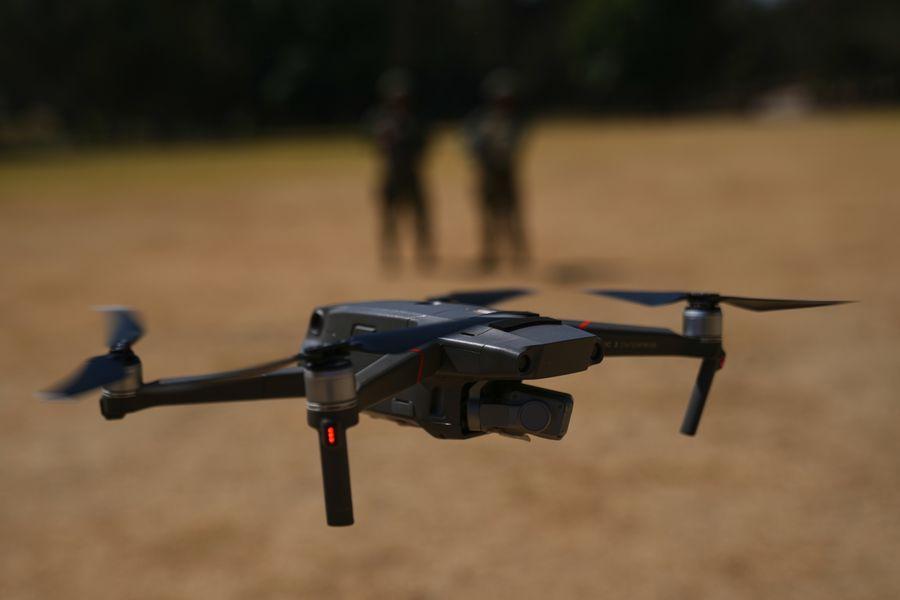
Soldiers from the Mexican Army's anti-drone squadron display equipment and tactics to be used during the 2026 FIFA World Cup, during a media presentation in Mexico City, Friday, Feb. 27, 2026. (AP Photo/Marco Ugarte)
The World Cup Is Over. The Drone Threat Isn’t.
Last updated 05:09 AM EST • Read time: 5m
This summer’s FIFA World Cup was wildly successful in many respects. For one, there was no major security incident, thanks in part to federal and local law enforcement working together to seize more than 700 unmanned aircraft systems (UAS), or drones, flying without authorization near U.S. tournament venues.
Thankfully, the tournament finished without a serious drone incident, but the potential for harm was nevertheless real. Under the control of a malicious pilot, a drone could have dropped lethal explosives over a crowded stadium or fan festival, killing or maiming hundreds or even thousands. A weaponized drone could potentially have created 9/11-level carnage.
In this case, we didn’t dodge a bullet; we dodged drones.
Chuck Wexler, executive director of the Police Executive Research Forum (PERF), a Washington, D.C.-based organization dedicated to improving policing, warns that the drone threat is growing more urgent by the day.
“We see the warning signs, and we need everyone to have the necessary sense of urgency to prepare for this very real threat.”
In September, PERF published a report on the danger posed by malicious drones and steps that police agencies can take to mitigate that threat. While police once could protect crowds at large events using fences, checkpoints, bag searches, and sometimes magnetometers, securing the ground is no longer enough.
Three-dimensional danger
The danger is now three-dimensional, and law enforcement needs to protect the airspace above crowds. Police need to detect an approaching drone, assess its purpose, and respond quickly. That requires specialized training, reliable equipment, and rehearsed coordination among agencies—preparations that must be in place long before the first spectator arrives.
While there were 700 unauthorized drones seized during the World Cup, there’s no indication that any of 700 was an attempted attack. Some operators may have wanted nothing more sinister than a spectacular photograph. But authorities could not assume that every flight was harmless. When a drone appears near a packed stadium, responders must distinguish between a hobbyist seeking a photograph and someone planning an attack.
From the world stage to the county fair
The World Cup commanded international attention and years of security preparations. A county fair, outdoor concert, or high school football game will not.
Yet the people attending those events have the same expectation as the World Cup fans—to enjoy themselves and go home safely.
Picture families spreading blankets near a concert stage. Children waiting for a ride at the fair. Parents cheering from football bleachers. If an unfamiliar drone appears overhead, who decides whether it poses a threat? Who has the training—and the legal authority—to respond?
Until recently, only the federal government had that authority. However, as PERF’s report explains, “In 2025, Congress passed the SAFER SKIES Act, creating, for the first time, a pathway for state and local agencies to obtain real counter-UAS authority—the ability not just to detect a malicious drone but also to take action against it. That legislation included $500 million in grant funding for training and equipment and helped spur the creation of the FBI’s National Counter-UAS Training Center in Huntsville, Alabama, which now trains officers from around the country.”
Wexler said that federal, state, and local law enforcement now must coordinate to establish everyone’s roles in mitigating the drone threat. “An emergency is a terrible time to find out that everyone thought someone else was in charge," says Wexler. "Law enforcement must sort out federal, state, and local agencies’ authorities, training, and plans before the first family walks through the gate.”
A failure of imagination
But police cannot do this work alone. To protect us, they need a public that understands why preparation matters—and supports the budgets for the training, resources, and cooperation it requires. Wexler wants communities to recognize the clear and present danger drones pose before a major attack occurs.
“One of the lessons of 9/11 is that a failure of imagination can leave us unprepared. We cannot end up in a situation where we say, ‘We never thought anyone would do that,’ after a drone attack. Police need the public to understand the danger and support preparation now—not after lives have been lost.”
The success nobody notices
Unfortunately for a mayor or police chief, preparedness can be hard to sell. A new patrol car is visible. Months of planning for a disaster that was prevented is invisible, even though it's desperately needed.
Members of communities need to be asking: What training do your officers need? How are you coordinating with federal law enforcement?
The point is not to make families afraid of the next fair or football game. It is to do the work that lets them enjoy the event and safely return home.
The World Cup gave millions of people memories of goals, celebrations, and shared excitement. Law enforcement’s security preparations helped keep the story about football. The next crowd similarly deserves a day remembered for what happened on the field—not what came out of the sky.
Mitzi Perdue is a fellow at the Institute of World Politics and the Co-Founder of Mental Help Global, a philanthropy that uses AI to support mental health.

A Path to Success Against Iran
By Michael Schwartz • RealClearDefense
The World Cup Is Over. The Drone Threat Isn’t.
By Mitzi Perdue • RealClearDefense
Don’t Be Swayed by Tactical Nukes
By Benjamin Giltner • RealClearDefense
How Seoul’s Break With Kyiv Serves Trump’s Russia Turn
By Sang Won Pyo • RealClearDefense
When the Grid Goes Down, the Mission Must Go On. Solar and Storage Can Help.
By John Szoka • RealClearDefense

USS Stout Loses Power During Port Visit Due to ‘Engineering Casualty’
By USNI News
Air Force Lessons Learned From Operation Epic Fury
By Tabitha Reeves, National Defense
Marines Need Nine More Amphibious Warships To Carry Out Its Missions
By TWZ
AFRL, ACC Fly XQ-67A Drone To Test Autonomous Teaming
By Airforce Technology
F-35B Releases Meteor BVRAAM for the First Time
By Parth Satam, The Aviationist