
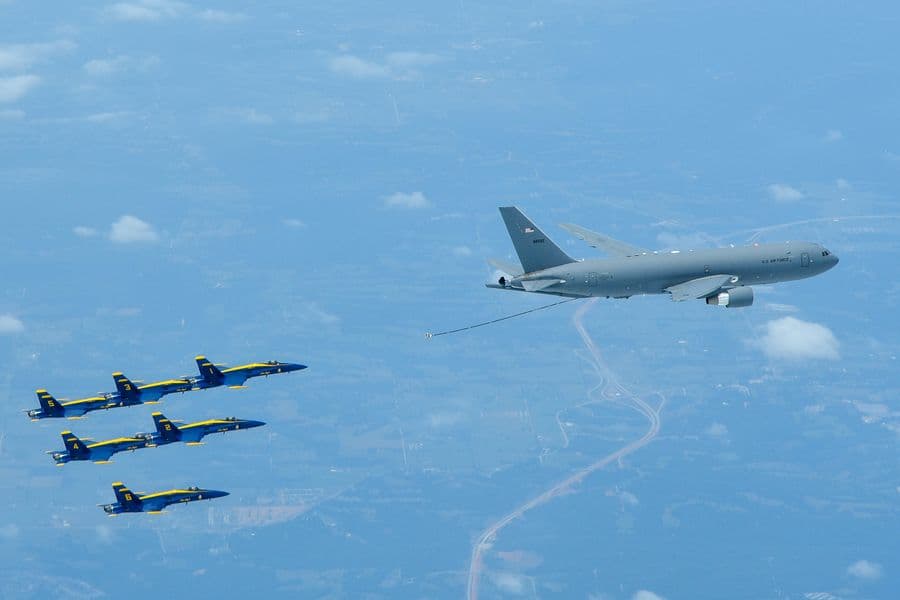
The KC-46's Long & Winding Road
Last updated 11:54 PM EDT • Read time: 7m
In fleeting up from head of Air Mobility Command to lead U.S. Transportation Command, Air Force Gen. Jacqueline Van Ovost will suffer a recurring headache: how to replace the nation’s fleet of aging air refueling tanker aircraft. Ironically, by stepping from a position where she had made progress in prodding the Air Force to finally begin to employ the KC-46A “Pegasus” tanker in limited operations to one where she must rely on the service to provide refueling resources, Van Ovost’s malady may get worse. Her problem remains, but she can no longer directly fix it.
The “Pegasus” tale is long and tangled, encapsulating the Pentagon’s post-Cold-War procurement problems. As early as 2001, the Air Force knew it had a looming tanker crisis. In particular, the backbone of its fleet, the KC-135 Stratotanker, a variant of the venerable 707 airliner first introduced in June 1957, was nearing the end of its service life. Despite engine and design upgrades, the cost of further overhauls had tripled through the 1990s, and the need for depot maintenance doubled. However, in the era of defense budget reductions, the Air Force lacked the funds to buy a replacement. Thus, the service leadership hit upon a lease-to-buy plan for 100 new tankers based on the Boeing 767.
But when Sen. John McCain, a powerful member of the Senate Armed Services Committee and a staunch advocate of defense procurement reform, objected, the Air Force moved toward a more traditional approach. The program was then frozen, and a new project for a "KC-X" tanker was initiated, in which the European consortium Airbus partnered with Northrop Grumman to offer a version of the larger A330 airliner against the Boeing 767. The prize was initially awarded to the Airbus-Northrop Grumman team. But a Boeing protest revealed that the bidding process was flawed, and in 2011, fully a decade after the initial lease effort was initiated, the Air Force selected the Pegasus as best meeting the service's requirements.
The path since selection has been rocky as well. The Air Force, still under the gun from McCain, insisted on a fixed-price contract, a decision entirely at odds with the original impetus to field a timely replacement for hundreds of 1950s-era refuelers. With a fixed cost in hand and the squeeze of sequestration on service budgets, the Air Force was more than happy to delay taking final deliveries of the new tanker when various issues with the tanker were brought to the fore. To date, Boeing has announced about $5.1 billion in cost overruns. "The tanker's been a drag on us for three or four years," admitted company CEO David Calhoun in an October 2020 earnings report.
Not surprisingly, given the nature of the contract, the Air Force has been aggressive in not fielding anything other than the perfect Pegasus. That behavior is far from the norm in past or other current procurements – witness the F-35 fighter, for example – and belies the operational need for new and more capable tankers. The principal bone of contention has been the “remote vision system,” the system of seven cameras and a display that allows the tanker’s boom operator to remain forward in the aircraft, just outside the flight deck, while the refueling process takes place. The original RVS was less than crystalline when a setting or rising sun shone directly in line with the lens. When boom operators face a similar glare problem in legacy tankers when they look out the rear window, tanker pilots will often execute a subtle turn to change the angle of the sun’s ray entering. But the Air Force is holding the KC-46 to the standard that the RVS system will work in all lighting conditions.
Now, the new system includes a suite of "4K HD" color cameras, new displays, and upgraded video processors for the boom operator to assist with docking. Rather than begin to field the KC-46, and possibly allowing its pilots similar flexibility as pilots of older tankers when dealing with the sun, and bring the new tanker in later for the fix, the Air Force has chosen to procure the tanker at a contractual minimum, with full-rate production of the KC-46 probably not until 2024.
During her short tenure as chief of Air Mobility Command – which she only assumed in August 2020 – Van Ovost had, to her credit, pushed to jump-start the fielding of the Pegasus with the result that TRANSCOM has okayed KC-46s for limited operation taskings. However, she remained adamant that the current operational need should not interfere with the full RVS redesign. When Boeing offered to accelerate a partial solution, a “RVS 1.5,” Van Ovost declared that “if it slips [the complete] RVS 2.0 at all, I would not be in favor of slipping because that’s the end game that’s the requirement that we set out and that Boeing agreed to deliver.”
A second problem the Air Force wants fixed is the difficulty the A-10 close air support aircraft has in generating sufficient thrust to receive fuel from the Pegasus boom when operating at max altitude and with a max load. This fix might cost as much as $300 million – from the Air Force, not the company. Given that the Air Force has been attempting to retire the A-10 for several years and the forthcoming defense budget is almost certain to mark another such attempt, the value of such an investment is doubtful, at best.
It’s also been said that the new tanker cannot gas up the all-important F-22s and F-35s. That’s not totally accurate. Air Force Material Command has certified the KC-46 for those aircraft. The remaining issue is whether the boom operator in a KC-46 is able to reliably detect an inadvertent scrape of a fighter's stealth coating, which could trigger a decision on whether to proceed with a mission or not. Scrapes, of course, occur with legacy tankers as well and reliable, reported scrapes are a matter of training and experience. How much more a problem it is with the newer KC-46 and the learning curve associated with the RVS, however, is difficult to know from the outside.
As TRANSCOM commander, Van Ovost will remain at Scott Air Force Base, but her perspective will likely change: instead of wringing the last dollar out of Boeing, she’ll be trying to wring the last possible refueling sortie from the Air Force. “The [operations] tempo is quite high,’ observed her predecessor, Army Gen. Stephen Lyons, last summer. “We still have not met our program objective of 479 tankers.” Indeed, Lyons had objected to the Air Force’s plans to retire older KC-10 and KC-135 tankers this year as “premature and risky.” The official TRANSCOM Twitter account complained that KC-46 delays had put “America’s ability to effectively execute day-to-day operations and war plans at risk.”
The fact is, the KC-46 is more than just a replacement for the KC-135s: it can offload more fuel, has greater operational range and expanded cargo capacity, and can refuel multiple aircraft at the same time. If day-to-day operations and war plans are indeed at risk, part of the blame is making the perfect the enemy of the good in this program.
Giselle Donnelly is a resident fellow in defense studies and Gary Schmitt is a resident scholar in strategic studies at the American Enterprise Institute.

In Pursuit of Nuclear Abolition
By Peter Huessy • RealClearDefense
Innovation Alone Won’t Prepare the U.S. for the Future Battlefield
By Joshua Segal • RealClearDefense
The sUAS Tactical Trifecta
By Bryan T. Woody • RealClearDefense
The Revolutionary War: When Strategic Options Share the Same Weakness
By Henry Yep • RealClearDefense
The Houthis Are Testing the Limits of Collective Defense
By Saima Afzal • RealClearDefense

Who Shoots Down the Drone Over the Shipyard?
By John Ferrari & Dillon Prochnicki • RealClearDefense
Northrop Grumman Breaks Out the Big Guns at AUSA
By Daniel Terrill, Defense News
Army Pursuing Diverse Array of New Anti-Air Interceptors
By Trevithick, The WarZoneWho Shoots Down the Drone Over the Shipyard?
By John Ferrari & Dillon Prochnicki, RCD
F-35C Lands for the First Time on a Ford-Class Aircraft Carrier
By The Aviationist