
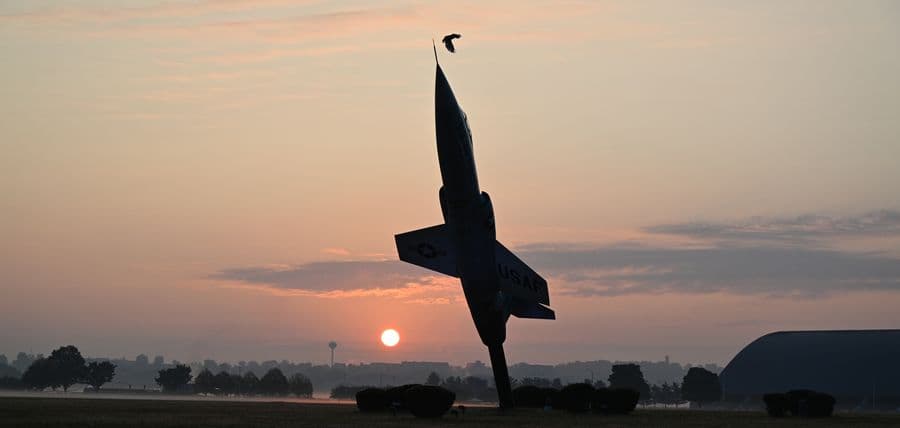
The Misunderstood F-104 Starfighter
Last updated 04:55 AM EDT • Read time: 5m
In one of my recent articles on the F-35, I compared it to the Lockheed F-104 Starfighter, and declared that both aircraft were “turkeys” that nevertheless enjoyed brisk sales to foreign countries, despite themselves. Based on the teachings of the late military reformer and aircraft designer, Pierre Sprey, I do maintain that the F-35 is indeed an expensive piece of junk, but I have reconsidered what I said about the F-104. Given the high number of accidents in its service to Germany, and its very short career in the U.S. Air Force, I posited that the Starfighter was basically a failure. Now, I have something more constructive to say.
I have just finished reading a 2021 book called Mach Two: Flying the F-104 Starfighter, by a retired F-104 pilot in the West German Navy named Rolf Stunkel, and his candor has forced me to change my mind. Firstly though, he establishes that the West German military was none too keen about the acquisition of the aircraft, and he quotes a flag officer who says “‘The navy didn’t want it – incidentally, neither did the air force. We were looking for an aircraft with two engines, but the procurement was decided for political reasons, to support our industry and the German nuclear participation. The new aircraft had to be the same for the navy and the air force.’” (p. 275) This might support the original claim I repeated in my article that Lockheed allegedly bribed West German officials to purchase an unwanted aircraft.
However, Stunkel then moves on to debunk the idea that the German F-104s were cursed by saying that while the first months of flying were marred by many accidents and many dead pilots, “The Federal Armed Forces procured a total of 916 Starfighters. 292 were lost in accidents, 116 German pilots died. Technical problems such as faulty ejection seats were the main cause, but quite a few aircraft were lost due to inexperience or over-confidence and the fact that pilots had not been sufficiently trained for the challenging aircraft with its narrow aerodynamic operational capabilities and limitations. A three-week downtime imposed late in 1966 by General Steinhoff, chief of the German Air Force, allowed [us] to revise training procedures and operational concepts. The drastic measure put an end to the series of horrors, and the number of accidents dropped dramatically. From then on, the aircraft was regarded as challenging but controllable, as long as it was treated with respect.” (p. 75)
He also argues, with solid evidence based on his flying days, that “Despite its early reputation as [a] widow maker, at least in the eyes of its pilots the Starfighter was a legend long before its decommissioning. They valued the F-104’s outstanding acceleration, the stable flight characteristics as a weapons platform and formation aircraft as well as the robust J-79 engine – and of course the particular flair of the aircraft and the pilot’s privileges as [a] ‘single seater’ and part of a sworn-in fraternity.” (p. 76)
Indeed, many Allied pilots loved flying the Starfighter, and that includes the Canadian pilot and author Lieutenant Colonel (ret.) David Bashow, who told me many years ago that he enjoyed great success against U.S. Air Force F-15s and USN F-14s in simulated combat. “‘I personally acquired quite a bit of gun camera film of Eagles and the like over the years. The trick was to fight that class of jets on your terms, not theirs. On the plus side, the ’104 was very tiny and difficult to visually acquire. It was also blindingly fast, especially at low level, with a tremendous acceleration capability. However, it did take just about all the airspace over the Province of Alberta to do a decent turn, so you did not normally enter a turning engagement with just about anything. That said, below 5000 feet, light and in full afterburner, it could sustain 7Gs, but that was way up at around 480 knots, so we are still talking big turns (and lots of gas pissing out the back end), so you did not do even that for long. The idea was to use the vertical a lot and go for quick kills of opportunity, unobserved, better still. However, you would be surprised how often that would occur, particularly in a multi-bogey environment, and that would certainly have been the case in an air war over Central Europe, for which we trained.’” (p. 112)
After reading Stunkel’s account, and then refreshing my memory on Canadian successes with the F-104, I think the Starfighter does not deserve its bad reputation, especially in the United States. When flown by experienced pilots who respected its nature, the F-104 Starfighter achieved great success and should be considered a classic Cold War fighter that helped protect NATO for decades. Unlike the U.S. Air Force, many other air forces gave the Starfighter a chance to really prove itself, and it did, by beating U.S. Air Force champions like the F-15, no less. To put it simply, the F-104 Starfighter deserves our respect -- even if Lockheed allegedly bribed foreign governments to green light the sale.
Roger Thompson is a Fellow of the Inter-University Seminar on Armed Forces and Society, a Research Fellow at Dalhousie University’s Centre for the Study of Security and Development, the author of "Lessons Not Learned: The U.S. Navy’s Status Quo Culture", and a former researcher at Canada’s National Defence Headquarters.
Notes:
Rolf Stünkel. Mach 2: Flying the F-104 Starfighter. Tredition. Kindle Edition.
Roger Thompson. Lessons Not Learned: The U.S. Navy's Status Quo Culture. Naval Institute Press. Kindle Edition.

In Pursuit of Nuclear Abolition
By Peter Huessy • RealClearDefense
Innovation Alone Won’t Prepare the U.S. for the Future Battlefield
By Joshua Segal • RealClearDefense
The sUAS Tactical Trifecta
By Bryan T. Woody • RealClearDefense
The Revolutionary War: When Strategic Options Share the Same Weakness
By Henry Yep • RealClearDefense
The Houthis Are Testing the Limits of Collective Defense
By Saima Afzal • RealClearDefense

Who Shoots Down the Drone Over the Shipyard?
By John Ferrari & Dillon Prochnicki • RealClearDefense
Northrop Grumman Breaks Out the Big Guns at AUSA
By Daniel Terrill, Defense News
Army Pursuing Diverse Array of New Anti-Air Interceptors
By Trevithick, The WarZoneWho Shoots Down the Drone Over the Shipyard?
By John Ferrari & Dillon Prochnicki, RCD
F-35C Lands for the First Time on a Ford-Class Aircraft Carrier
By The Aviationist