
The Rise of the Light Fighter
Last updated 07:00 AM EDT • Read time: 8m
The dawn of a new global defense procurement cycle leaves smaller and mid-tier air forces facing a critical, highly expensive crossroad. For nations seeking to transition away from aging, legacy fleets of Northrop F-5 Tiger IIs or Cessna/Northrop T-38 Talons, the natural strategic urge is to look toward the apex of Western military aviation. Defense ministries are often tempted by the prestige of acquiring "exquisite" fifth-generation platforms like the Lockheed Martin F-35 Lightning II, or high-end, twin-engine heavyweights like the Boeing F-15EX Eagle II.
However, when the primary adversary is not a global superpower—when a nation is not attempting to deter a massive, integrated aerospace force like those fielded by Russia or China—leaping straight to top-tier heavy fighters is a profound strategic miscalculation. If the potential aggressor is a regional neighbor operating older Mikoyan MiG-29s, Sukhoi Su-24s, or early-block fourth-generation fighters, buying a handful of premium Western strike platforms does not guarantee security. Instead, it creates a fragile, top-heavy force structure. For these nations, the goal is not global power projection; it is credible, localized deterrence. They need the absolute maximum "bang for the buck” a fleet capable of dominating regional threats without bankrupting the domestic treasury.
The Prestige Trap
The illusion of the high-end heavy fighter lies in its total lifecycle cost and the "readiness debt" it imposes on smaller defense budgets. Buying a premium combat aircraft is merely the down payment on a long-term liability. True low-observable platforms and heavy twin-engine fighters demand highly specialized infrastructure, including climate-controlled hangars, secure digital network architectures, and pristine radar-absorbent material (RAM) maintenance facilities.
When a smaller nation exhausts its procurement budget to acquire just six exquisite platforms, they fall into the prestige trap. A fleet of six high-end fighters looks impressive on a tarmac, but it lacks the critical mass required for persistent deterrence. If two aircraft are down for scheduled depot-level maintenance, one is grounded for an unexpected software glitch, and one is relegated to pilot proficiency training, the nation is left with exactly two combat-ready airframes to defend its sovereign airspace.
Furthermore, if a regional adversary relies heavily on volume—deploying swarms of low-cost uncrewed aerial vehicles (UAVs) or older, expendable strike aircraft—a tiny fleet of heavy fighters becomes a massive liability. Scrambling a $90 million twin-engine heavyweight to intercept a stray regional aircraft or a low-slow drone is a staggering operational inefficiency. It burns through the aircraft's finite, highly expensive structural design life for missions that require a fraction of its kinetic potential.
"Bang for the Buck": Deterrence Through Mass
Credible deterrence against a regional threat requires a different philosophy: fielding enough modern, lethal hulls to ensure a persistent, distributed defense grid. This operational vacuum is increasingly being filled by a new generation of platforms that purposefully blur the line between advanced trainers and light combat aircraft (LCA).
This tier of aircraft has matured into a robust, global market. Leading the charge are the Korea Aerospace Industries (KAI) T-50/FA-50 family, the Boeing-Saab T-7A Red Hawk, the Leonardo M-346FA, and the Turkish Aerospace Industries (TAI) Hürjet.
By retaining digital fly-by-wire controls, supersonic capability, and robust +8g maneuvering envelopes, these airframes achieve roughly 70% percent of the baseline kinetic performance of a standard fourth-generation fighter—but at a dramatic financial discount.
They offer strong value as a lighter, cheaper platform (around half the acquisition/operating cost).
- The KAI FA-50 stands as the mature incumbent, offering a proven, supersonic baseline that integrates seamlessly with existing Western weapons stores. Its transition to the single-seat F-50 will further cement its status as a viable light fighter for nations that need long-range endurance and serious punch.
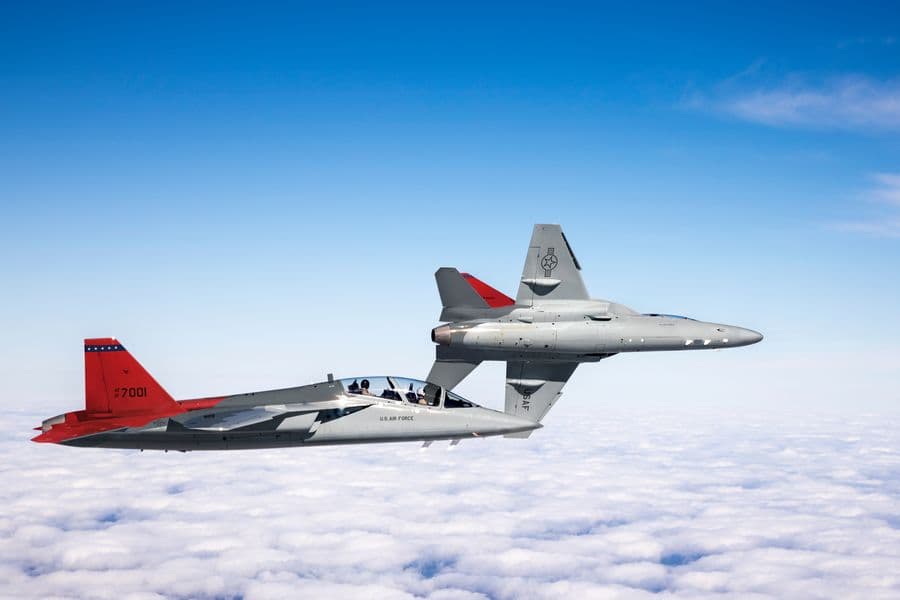
- The Boeing T-7A Red Hawk leverages a digital-engineering-first approach, reducing the industrial footprint required to build and sustain the fleet. Its planned F-7 single-seat derivative promises to bring this same high-speed, digital-architecture capability to the international market as a direct competitor to traditional legacy fighters.
- The Leonardo M-346FA provides a unique twin-engine approach, utilizing the Honeywell F124 turbofan to offer exceptional reliability and safety in a light package. Its "Fighter Attack" variant is a fully realized light combat solution, integrating the Grifo-M-346 multi-mode radar and a comprehensive Defensive Aids Sub-System (DASS), making it a formidable tool for air policing and close air support.
- The TAI Hürjet has rapidly emerged as a potent contender, utilizing the General Electric F404 engine to achieve Mach 1.4 performance. Its rapid progression into serial production and its design for open-architecture integration position it as a flexible, modern platform that effectively competes with established LCA heavyweights.
For a smaller state, this mathematics alters the strategic balance. A nation can secure a full, combat-ready squadron of 12 to 16 of these light fighters for about the same capital layout required to buy a mere handful of heavier assets. In a regional conflict, a dozen LCAs dispersed across multiple airfields presents a much more complex targeting problem for an aggressor than six heavy fighters sitting at a single, centralized base. This distributed lethality ensures that a localized first strike cannot instantly blind or ground the defending air force.
The Operational Footprint
The true brilliance of the LCA philosophy is found in the lifecycle savings. Mainline fourth-generation fighters like the F-16 cost roughly $20,000 to $25,000 per flight hour to operate, while advanced twin-engine heavies climb significantly past $30,000 per hour. Light combat aircraft avoid this financial trap through propulsion efficiency.
Whether utilizing the GE F404 engine (as seen in the FA-50, T-7A, and Hürjet) or the twin Honeywell F124 (M-346FA), these platforms drop the hourly operating cost to an estimated $5,000 to $10,000. This creates an operational footprint of one-half or less compared to standard single-engine fighters. Defense ministries can comfortably sustain vital pilot training hours, build deep bench strength in their aviator corps, and execute daily deterrence patrols without exhausting domestic treasury reserves. An air force that can afford to train constantly is an air force that wins.
Hardware and Sensor Parity
Crucially, opting for a light fighter no longer forces a nation to compromise on modern lethality or sensor integration. The factor that truly deters a regional adversary is not the size of the airframe, but the capability of its radar and the reach of its missiles. Modern LCA variants bridge the historical electronic capability gap by integrating sub-systems that were once the exclusive domain of heavy fighters.
Compact Active Electronically Scanned Array (AESA) radars, such as Raytheon’s PhantomStrike or Leonardo’s Grifo-M-346, are now standard. These air-cooled Gallium Nitride (GaN) systems weigh less than 150 pounds but match the advanced target detection, tracking, and electronic warfare resilience of much larger legacy radar suites. If an LCA can see the adversary's older MiG or Sukhoi first, the physical size of the aircraft carrying the radar ceases to matter.
Furthermore, targeting and precision strike capabilities have reached total parity. These platforms feature native compatibility with systems like the AN/AAQ-33 Sniper Advanced Targeting Pod. The Sniper pod operates completely independently of the aircraft's internal radar. It integrates directly through the aircraft's mission computer, allowing light fighters to identify, track, and laser-designate targets for precision-guided munitions autonomously, without needing a massive onboard sensor suite.
When combined with modern tactical data links like Link 16, these aircraft can share a unified battlespace picture. They utilize advanced air-to-air ordinance, including the within-visual-range AIM-9X Sidewinder, and are actively moving toward full integration of beyond-visual-range (BVR) missiles like the AIM-120 AMRAAM. An adversary flying a third-generation jet will find themselves out-ranged and out-networked by a lightweight airframe carrying top-tier effectors.
The Gateway to the Single-Seat Fighter
Buying a two-seat dual-role aircraft serves a purpose far greater than just immediate training and light attack; it acts as a foundational strategic gateway. By adopting platforms like the FA-50 or T-7A, a smaller nation establishes the logistics pipeline, the ground support equipment, and the pilot training ecosystem required for a modern digital architecture.
Once that ecosystem is firmly in place, the air force is perfectly positioned to procure dedicated, single-seat light fighter variants—like the F-50 or the proposed F-7—built on the exact same airframe and utilizing the exact same engines. This eliminates the need to establish a second, distinct logistics chain.
By deleting the rear cockpit entirely, designers can repurpose the vacated space to house increased internal fuel or advanced mission electronics.
This single structural modification expands the combat radius and payload-range profile, bringing these aircraft remarkably close to that of an older block F-16.
The Ultimate Strategic Bargain
By stepping through this two-seat dual-use gateway, smaller air forces do not just acquire an airplane, they build a scalable, economically sustainable air combat enterprise. Against a regional aggressor lacking top-tier air superiority assets, deterrence is not achieved by showcasing a few expensive, hangar-bound showpieces. Deterrence is achieved through modern sensors, long-range weapons, and enough affordable airframes to keep the sky constantly contested. The modern light combat aircraft delivers precisely that, ensuring that sovereignty remains economically viable for the next generation of airpower.
Bruce Allen Lubbering held several management positions with aerospace manufacturing companies in a career that lasted over 30 years.

In Pursuit of Nuclear Abolition
By Peter Huessy • RealClearDefense
Innovation Alone Won’t Prepare the U.S. for the Future Battlefield
By Joshua Segal • RealClearDefense
The sUAS Tactical Trifecta
By Bryan T. Woody • RealClearDefense
The Revolutionary War: When Strategic Options Share the Same Weakness
By Henry Yep • RealClearDefense
The Houthis Are Testing the Limits of Collective Defense
By Saima Afzal • RealClearDefense

Who Shoots Down the Drone Over the Shipyard?
By John Ferrari & Dillon Prochnicki • RealClearDefense
Northrop Grumman Breaks Out the Big Guns at AUSA
By Daniel Terrill, Defense News
Army Pursuing Diverse Array of New Anti-Air Interceptors
By Trevithick, The WarZoneWho Shoots Down the Drone Over the Shipyard?
By John Ferrari & Dillon Prochnicki, RCD
F-35C Lands for the First Time on a Ford-Class Aircraft Carrier
By The Aviationist