
'What Is That, Man?' Navy Confirms Videos of Flying Objects
Last updated 04:58 PM EDT • Read time: 3m
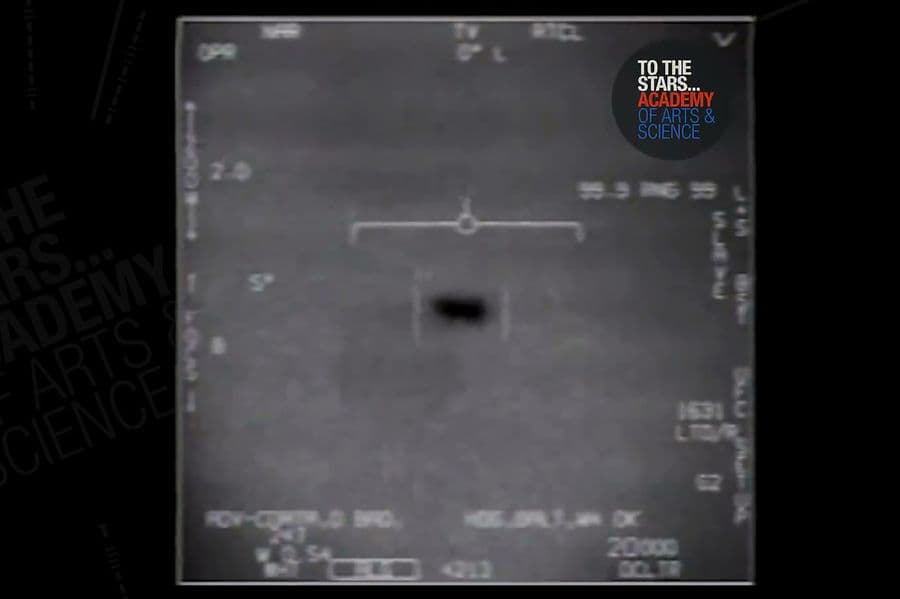
NORFOLK, Va. (AP) — In one of the videos, a small object streaks across the sky before the U.S. Navy fighter jet’s tracking system locks on and follows it.
“Whoa. Got it,” the pilot yells, laughing as the dot moves on his screen. “Woohoo!”
Another pilot asks: “Wow. What is that, man?”
The Navy isn’t offering an explanation — at least not publicly — for exactly what that object was. But the service is confirming the authenticity of that video and two others taken from its planes in 2004 and 2015.
The release of the videos, which have been circulating online and in news reports, was not authorized, Navy officials said. But the footage has prompted the Navy to publicly discuss an ongoing investigation into sightings by its pilots of what it describes as “unidentified aerial phenomena” or UAPs in U.S. airspace on both coasts.
“We are not going to try to characterize anything that may have been seen out there,” Navy Spokesman Joseph Gradisher said. “But the number of sightings has increased since about 2014 when the advent of new technologies such as drones and quadcopters have come into being.”
Meanwhile, lawmakers are calling for more information on the so-called UAPs, saying some of their movements seem to challenge the laws of physics.
“Based on pilot accounts, encounters with these UAPs often involved complex flight patterns and advanced maneuvering, which demand extreme advances in quantum mechanics, nuclear science, electromagnetics and thermodynamics,” North Carolina Congressman Mark Walker wrote in a letter to Navy Secretary Richard Spencer in July.
“If the accounts are true, the unidentified crafts could pose a serious security risk to our military personnel and defense apparatus,” wrote Walker, a Republican on the U.S. House’s Homeland Security Committee. “They could also represent a tremendous opportunity for advancements in science in technology that can contribute to the public good.”
The Navy is updating its guidelines to encourage pilots to more thoroughly report what they see, Gradisher said. And Navy investigators have been traveling to bases such as Naval Air Station Oceana in Virginia Beach, Virginia, where squadrons of F/A-18 Super Hornets are based, to talk to aviators.
“We need reports and data and things we can analyze, and that’s where our aviators come into play,” Gradisher said. “We need them to participate. In years past they didn’t necessarily do that because there was a stigma to reporting on something being unidentified.”
Gradisher said the issue, ultimately, is the safety and security of the Navy’s operations.
“Our aviators train as they fight,” he said. “And we don’t like the idea of someone or something observing how we train.”
© copyright 2019 The Associated Press. All rights reserved.

In Pursuit of Nuclear Abolition
By Peter Huessy • RealClearDefense
Innovation Alone Won’t Prepare the U.S. for the Future Battlefield
By Joshua Segal • RealClearDefense
The sUAS Tactical Trifecta
By Bryan T. Woody • RealClearDefense
The Revolutionary War: When Strategic Options Share the Same Weakness
By Henry Yep • RealClearDefense
The Houthis Are Testing the Limits of Collective Defense
By Saima Afzal • RealClearDefense

Who Shoots Down the Drone Over the Shipyard?
By John Ferrari & Dillon Prochnicki • RealClearDefense
Northrop Grumman Breaks Out the Big Guns at AUSA
By Daniel Terrill, Defense News
Army Pursuing Diverse Array of New Anti-Air Interceptors
By Trevithick, The WarZoneWho Shoots Down the Drone Over the Shipyard?
By John Ferrari & Dillon Prochnicki, RCD
F-35C Lands for the First Time on a Ford-Class Aircraft Carrier
By The Aviationist