
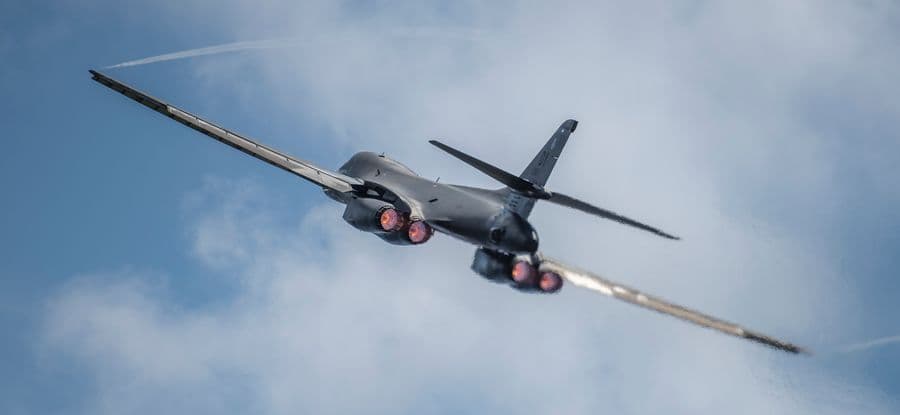
Why The Entire B-1B Bomber Fleet Is Grounded
Last updated 10:52 PM EDT • Read time: 3m
The Rockwell B-1B Lancer bomber has been flying high since the 1980s and the United States Air Force has recently conducted tests to determine how the Cold War-era aircraft could carry hypersonic weapons. The bombers played a crucial role in operations in Afghanistan and Iraq, and while ten of the aircraft were lost between 1984 and 2001, none were shot down by enemy fire.
However, none of the Air Force’s B-1B fleet will be taking to the skies for a while – and it isn’t because of threats from an adversary, but due to problems related with an augmenter fuel pump filter housing, the Air Force Times reported. After an incident at Ellsworth Air Force Base (AFB), South Dakota, where one of the bombers experienced a ground emergency, the entire fleet has been grounded.
Last week, Gen. Tim Ray, head of Air Force Global Strike Command, ordered an indefinite safety stand-down to conduct maintenance inspections on the fuel filter housing, according to a command statement. It is the third time in three years that the entire fleet of the aging Cold War bombers has been kept out of service.
“During the inspection process following a B-1B ground emergency on April 8 at Ellsworth Air Force Base, South Dakota, a discrepancy with an Augmenter Fuel Pump Filter Housing was discovered,” Global Strike Command said in a statement on Friday.
The Ellsworth-based B-1B began to leak fuel on the ground while taxiing to its parking area after landing.
“As a precautionary measure, the commander directed one-time inspections on all B-1B aircraft to resolve this issue,” the statement added. “After further analysis, the commander stood down the fleet because it was determined a more invasive inspection was needed to ensure the safety of aircrews.”
While the command didn’t provide a timeline, it was announced that each aircraft will be returned to flight status when it is deemed safe. It is unknown how many bombers might be affected by the fuel filter housing issue, or when all the bombers could return to normal operations.
The process to inspect the housing will involve a “disassembly of the Augmenter Fuel Pump Filter Housing,” followed by an inspection using the latest X-ray and blue light techniques. After it is determined that each unit is free of defects, the fuel pump housing will be reassembled, pressure checked and the bomber will be returned to service.
“There is zero operational impact providing bomber task force support to combatant commands across the globe,” the spokesperson added. “Air Force Global Strike bombers will continue to support anytime, anywhere if called upon.”
This latest stand-down of the B-1Bs comes as the Air Force continues to seek to retire the bombers from service. It has reduced the active fleet to just forty-five aircraft in order to better sustain the most functional bombers, which have also been continually updated. Lawmakers in Congress have authorized the service to divest seventeen of B-1Bs, which will be used for test purposes or sent to a museum. The entire fleet is set to be retired by 2036, depending on when its replacement, the Northrop Grumman B-21 Raider, enters service.
Peter Suciu is a Michigan-based writer who has contributed to more than four dozen magazines, newspapers and websites. He regularly writes about military small arms, and is the author of several books on military headgear including A Gallery of Military Headdress, which is available on Amazon.com.

In Pursuit of Nuclear Abolition
By Peter Huessy • RealClearDefense
Innovation Alone Won’t Prepare the U.S. for the Future Battlefield
By Joshua Segal • RealClearDefense
The sUAS Tactical Trifecta
By Bryan T. Woody • RealClearDefense
The Revolutionary War: When Strategic Options Share the Same Weakness
By Henry Yep • RealClearDefense
The Houthis Are Testing the Limits of Collective Defense
By Saima Afzal • RealClearDefense

Who Shoots Down the Drone Over the Shipyard?
By John Ferrari & Dillon Prochnicki • RealClearDefense
Northrop Grumman Breaks Out the Big Guns at AUSA
By Daniel Terrill, Defense News
Army Pursuing Diverse Array of New Anti-Air Interceptors
By Trevithick, The WarZoneWho Shoots Down the Drone Over the Shipyard?
By John Ferrari & Dillon Prochnicki, RCD
F-35C Lands for the First Time on a Ford-Class Aircraft Carrier
By The Aviationist