
The Nuclear Posture Review, Bomber Capability, and Extended Deterrence
Last updated 05:49 PM EDT • Read time: 26m
Immediately after his recent retirement from the position of commander of the Air Force Air Combat Command, General Herbert J. “Hawk” Carlisle told Air Force Magazine, “The Air Force also must have a follow-on to the Joint Direct Attack Munition (JDAM) satellite guided bomb that is stealthy and maneuverable enough to survive the last few miles of an attack on ever-improving air defense systems.”[1] Today, the release of a weapon within range of its intended target, even from a stealth aircraft, does not guarantee that the weapon will actually reach its target. The relatively cheap Israeli Iron Dome system routinely intercepts small rockets in flight. The U.S. Navy is now testing a stealthy Norwegian conventional cruise missile, designed against “heavily armed Russia,” “which performs “evasive maneuvers to counter terminal defense weapons.”[2]
Russia has said that its short-range Pantsir-S air defense systems will defend the long-range S-400 air and missile defense systems.[3] The S-400 is the most effective Russian defense system against stealthy attackers. They have already exercised this synergy, which impacts the feasibility of defense suppression.[4] Interfax reports that the Pantsir-S can intercept “airborne precision weapons.”[5] Izvestia says that it can defend against “smart bombs.”[6] The 2017 DIA report on Russia Military Power indicates the Panthir-S was designed to defend against “precision guided missiles and cruise missiles.”[7] The commander of the Russian Air Force (Aerospace Force), Colonel General Viktor Bondarev, has said that 20 battalions of Pantsir-S missile-gun systems will join the Russian Aerospace Defense Forces by 2020.[8]
Presently, the U.S. has no air-delivered nuclear munitions with either stealth or maneuverability, much less both. In 2007, a bad decision was made to retire the U.S. nuclear stealth cruise missile, the AGM-129.[9] It saved virtually no money but significantly decreased our ability to counter advanced air defenses. Unless the current Nuclear Posture Review (NPR) changes the legacy Obama nuclear weapons program, this will continue until at least 2030. If the program to develop the nuclear Long Range Stand Off missile (LRSO) is terminated, as Minimum Deterrence advocates are pressing for, this will be permanent. In June 2017, General John Hyten, commander of the U.S. Strategic Command, said replacing the existing AGM-86B Air Launched Cruise Missile (ALCM) is particularly needed because it is so old, “It’s a miracle that it can even fly,” and its reliability was “already unacceptable” and would get worse every year.[10]
The B61 Mod 12 nuclear bomb, near initial deployment, is a nuclear JDAM.[11] Conventional JDAMs were fielded about 20 years ago. In addition to enhanced accuracy, JDAMs have a small standoff range that helps stealth aircraft penetrate defenses. However, the B61 Mod 12 is just as vulnerable to short-range intercept as the conventional JDAM General Carlisle was discussing. Moreover, JDAM technology is hardly cutting edge. Aviation Week reports, “US. forces will keep buying [conventional] JDAMs well into the 2020s but are looking for successor weapons to the venerable guidance kit.”[12] Late in the Obama administration, nuclear deterrence was given higher priority, but nuclear modernization was not comparable to that of the conventional forces.
Existing U.S. conventional cruise missiles and glide bombs have stealthy standoff capability, and some have terminal sensors.[13] The B61 Mod 12 will not have any of this.[14] If the U.S. deploys the B-21 bomber a decade from now, but terminates the LRSO program, in 2030, we will have a sixth generation bomber delivering a 1960s vintage nuclear bomb with a 1990s vintage JDAM tail kit. The impact of potential vulnerability to advanced short-range air defenses is greater for the nuclear deterrent. Each successful intercept of a nuclear delivery vehicle or nuclear weapon in flight has much greater impact. According to analysis by Hans Kristensen and Robert Norris, the U.S. has only about 280 deployed strategic nuclear bombs and cruise missiles with the bomber force.[15] A high-intensity conventional war might involve tens of thousands of air-delivered conventional weapons or even 100,000+.
Current U.S. air-delivered nuclear capability consists of “dumb” B61 and B83 gravity bombs and the old AGM-86B nuclear ALCM. The AGM-86B, deployed in 1981, was designed for a ten-year life span.[16] An Air Force fact sheet states that as far back as 1982 “it became clear that the AGM-86B would soon be too easy to detect by future air defense systems.”[17] This is why the Air Force developed and deployed the AGM-129 advanced stealth cruise missile. Before the AGM-86B is replaced by the LRSO (assuming it is replaced), it will have to deal with the SA-10, SA-12, SA-20, S-350, S-400, S-500, new Russian short-range defenses and probably one or more Russian systems that Russia has not talked about yet.[18] It will face similarly advanced defenses in China.[19]
During the first 2017 Red Flag exercise, emphasis was placed on high-intensity warfare and countering advanced integrated air defenses. The F-35, which had not yet been given a conventional standoff capability, was able to suppress its air defense targets with direct attack weapons. Where there was a choice, the Air Force used “the F-22’s standoff capability...” [20] The F-22 carries up to eight small diameter glide bombs.[21] Unless the NPR changes the legacy program, the U.S. will never have a similar nuclear capability. Keep in mind that Red Flag 2017-1 was against current advanced defenses, not 2030-2060 advanced defenses.
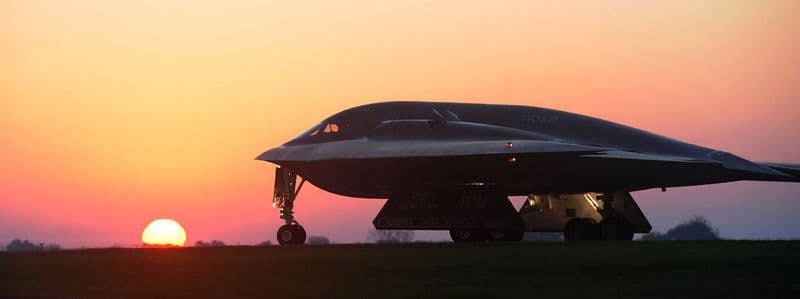
Without the LRSO, the nuclear deterrence capability of our bomber force will significantly decline. Brigadier General Alex Grykewich, USAF, who headed an Air Force study of Air Superiority in 2030, recently wrote, “The pairing of both stand-in [penetrating] and standoff capabilities, according to many analyses, is critical to defeating a future adversary’s anti-access/area denial (A2/AD) strategy.”[22] The B-52, which now constitutes two-thirds of the U.S. nuclear capable bombers, is dependent upon cruise missiles in high-intensity conflict. Indeed, it will not even be given the ability to deliver the B61 Mod 12.[23] Absent the LRSO, the best case in 2030 will be a nuclear bomber force reduced to 20 B-2s and a probably a smaller number of B-21s.
Today, the major function of heavy bombers is conventional attack. In light of the small size of the force, in all probability, only a fraction of nuclear capable bombers can be devoted to the nuclear deterrence mission during a major conventional conflict. This problem is made worse by the fact that on any given day only a few B-2 bombers are in “pristine condition” (i.e., at maximum stealth level) and every time they fly they need stealth maintenance.[24] The B-2 bomber was originally supposed to shoot supersonic Short Range Attack Missiles (SRAMs) against heavily defended targets or to suppress Soviet defenses.[25] U.S. SRAMs were eliminated decades ago while Russia reportedly retained its counterpart to the SRAM.[26] If the U.S. loses its nuclear cruise missile capability, Russia may conclude that it can defend critical facilities, such as leadership facilities in the Moscow region, against a U.S. retaliatory nuclear attack. Indeed, in 2015, Major General Kuril Makarov, Deputy Commander of Russia’s Aerospace Forces Command stated, “Moscow’s layered air defense grants 99% effective defense against air attack…” due to deployment of SA-20 and S-400 defenses.[27] A 2017 Russian surprise air defense exercise involved 150 simulated strikes on Moscow which the Russian Defense Ministry said were defeated.[28] In May 2017, Russian Defense Minister General of the Army Sergei Shoigu said, “Deliveries of the T-50 prospective frontline aircraft [stealth fighters] to the Armed Forces starting from 2019 and S-500 air defense weapons from 2020 will boost their efficiency in countering modern aerospace attack weapons.”[29]
The 2010 NPR recognized the role of bombers in extended deterrence. It noted, “When the Cold War ended, the United States withdrew its forward deployed nuclear weapons from the Pacific region, including removing nuclear weapons from naval surface vessels and general purpose submarines. Since then, it has relied on its central strategic forces and the capacity to redeploy nuclear systems in East Asia in times of crisis….[We will] Retain the capability to forward-deploy U.S. nuclear weapons on tactical fighter-bombers and heavy bombers, and proceed with full scope life extension for the B-61 bomb including enhancing safety, security, and use control.”[30] The ability to destroy threatening targets with low collateral damage is very important to extended deterrence. Without the LRSO, extended deterrence is clearly less credible, almost irrespective of the stealth level of the F-35, the B-2 and the B-21. Attacking heavily defended targets without any standoff capability is a bad idea.
There is concern about the limits of U.S. nuclear capability in Asia. For example, a 2010 Japanese government report listed some of the U.S. nuclear force requirements that Japanese officials saw as necessary for credible assurance and deterrence: “… not only possess and deploy an invulnerable nuclear force, but must also put in place an escalation control capability that will force potential aggressors to take the threat of nuclear retaliation seriously. Such capabilities must be underpinned by a superior damage-limiting capability made possible by a strong counterforce capability against the potential aggressor (the ability to effectively destroy the enemy’s nuclear strike force) and an effective strategic defense force.”[31]
Soon after the first North Korea nuclear test in 2006, the Government of South Korea insisted on language in the annual Joint Communiqué which read, “Secretary Rumsfeld offered assurances of firm U.S. commitment and immediate support to the ROK, including continuation of the extended deterrence offered by the U.S. nuclear umbrella, consistent with the Mutual Defense Treaty.”[32] The credibility of extended nuclear deterrence may well depend on whether U.S. nuclear capable bombers, fighters, and cruise missiles are assessed by a near peer adversary as being promptly available, able to survive an attack and penetrate their air defenses.
Russian nuclear doctrine, originally developed by Vladimir Putin when he was Secretary of the Russian National Security Council, allows for the first use of nuclear weapons in local and regional war.[33] Russia characterizes its first use of nuclear weapons as “de-escalation” of war.[34] In his September 2017 Minot speech, then-Secretary of Defense Ashton Carter observed, it’s a sobering fact that the most likely use of nuclear weapons is not the massive nuclear exchange of the classic Cold War-type, but rather the unwise resort to smaller but still unprecedentedly terrible attacks, for example, by Russia or North Korea to try to coerce a conventionally superior opponent to back off or abandon an ally during a crisis.”[35] A declassified Clinton-era CIA report noted, “Moscow’s military doctrine on the use of nuclear weapons has been evolving and probably has served as the justification for the development of very low-yield, high-precision nuclear weapons.”[36]
It is clear that Russia has a vastly more diverse arsenal of nuclear weapons, both strategic and tactical, including low-yield nuclear weapons, than the U.S. There are Russian press reports that some sub-kiloton nuclear weapons have been deployed on Russian strategic ballistic missiles.[37] Colonel (ret.) Viktor Litovkin, deputy editor of the Russian military newspaper Nezavisimoye Voyennoye Obozreniye, reported that Russian strategic ballistic missiles with the low-yield warheads had accuracies in the 20-30 meter range.[38] (This is far in excess of the reported accuracies of U.S. strategic missiles.[39]) Igor Safranchuk of the Moscow office of the Washington-based Policy Analysis Center has said that in 1999 Russia launched an effort to develop nuclear warheads with adjustable yields.[40] In 2002, Viktor Mikhaylov, former Russian Atomic Energy Minister and then-Director of the Sarov nuclear weapons laboratory (the All-Russian Scientific-Research Institute), said, “The scientists are developing a nuclear ‘scalpel’ capable of ‘surgically removing’ and destroying very localized targets. The low-yield warhead will be surrounded with a superhardened casing which makes it possible to penetrate 30–40 meters into rock and destroy a buried target—for example, a troop command and control point or a nuclear munitions storage facility.”[41] In 2003, he reported the existence of thermonuclear weapons “yielding hundreds of tons.”[42] In 2009, Vice Admiral Oleg Burtsev, Deputy Commander of the Russian Main Navy Staff said, “Probably, tactical nuclear weapons (on submarines) will play a key role in the future...There is no longer any need to equip missiles with powerful nuclear warheads. We can install low-yield warheads on existing cruise missiles.”[43] In 2009, the U.S. Strategic Commission report said Russia was developing “low-yield tactical nuclear weapons including an earth penetrator.”[44] In April 2014, Academician Yevgeniy Avrorin, a former Director of the Sarov nuclear weapons laboratory, said the 152-mm nuclear artillery shell with “a kiloton yield” has been “broadly deployed” throughout the Russian Army.[45] In 2015 it was reported that Russian Backfire bombers had been given “guided nuclear bombs...”[46]
A key problem in deterring Russian use of these weapons is that in most cases we do not have anything similar, and, hence, cannot retaliate in-kind. The only current U.S. low-yield retaliatory capability is in the bomber and fighter force. Any degradation in that capability risks erosion of deterrence. Absent credible low-yield options, our deterrent is reduced to the incredible threat of a massively escalatory strike with high yield ballistic missile warheads.[47]
The effectiveness of a forward deployed nuclear deterrent, and the assurance it can provide may depend upon whether we have the LRSO. Beyond refueled fighter aircraft range (now F-16 and F-15 and eventually the F-35), bombers are now the only available low-yield option to respond to a Russian low-yield attack. If bombers are forced to penetrate to within JDAM release range of the most heavily defended targets, the possibility of them being shot down increases significantly compared to even a modest standoff capability. The U.S. may be forced to commit more scarce stealth bomber assets to the mission, hence reducing our conventional strike capability. In addition, elimination of the LRSO would reduce U.S. conventional capabilities because it will be fielded with both nuclear and conventional warheads.[48] The performance characteristics of a conventional LRSO version are likely to be well in excess of existing U.S. conventional cruise missiles. The U.S. has no counterpart to the ultra long-range stealthy Russian KH-101 which, according to President Putin, “can be equipped either with conventional or special nuclear warheads.”[49]
One of the most shortsighted decisions in the 2010 NPR was the elimination of our nuclear ship-launched cruise missile (SLCM) capability, the nuclear Tomahawk. It saved virtually no money but degraded our theater nuclear deterrent potential. Two key players in that decision process, Admiral (ret.) Sandy Winnefeld, U.S. Navy and Dr. James N. Miller who was Principal Deputy Under Secretary of Defense for Policy at the time, have called for a reversal of that decision in order to respond to Russian violation of the INF Treaty and Russian aggression in Europe.[50] They pointed out that nuclear SLCMs are a relatively low cost and would be a highly survivable augmentation of existing dual capable fighter aircraft. The CSIS Project Atom report advocated modifying the LRSO into a nuclear SLCM.[51]
The LRSO has significant implications for the deterrence of China which is also increasing its nuclear capabilities. The 2017 Pentagon report on China recognizes that China now has a prompt precision nuclear strike capability. It stated that the DF-26 IRBM is now operational and “is capable of conducting conventional and nuclear precision strikes against ground targets and conventional strikes against naval targets in the western Pacific Ocean.”[52] The 2011 Pentagon China report revealed that the Chinese carrier killer missile, the DF-21D, was part of the Chinese nuclear force.[53] Lee Fuell, a technical intelligence specialist with the Air Force’s National Air and Space Intelligence Center (NASIC) testified before the Congressional China Commission saying, “At this point, we think that’s [the Chinese hypersonic glide vehicle] associated with their nuclear deterrent forces,” although it could also be used for conventional strikes.”[54] The Chinese DH-10 ground-launched cruise missile is assessed by NASIC as capable of delivering either a conventional or a nuclear warhead.[55] These precision strike capabilities are unmatched by any existing U.S. nuclear weapon. In addition, China has a nuclear ALCM capability.[56] In December 2013, state-run Chinese media wrote about the ability of China’s new H-6K bombers to launch nuclear-armed cruise missiles against U.S. bases in South Korea and Japan.[57]
The LRSO will considerably extend the strike range of any aircraft that carries it and will enhance our capability to defeat advanced air defenses and destroy nuclear targets that threaten the U.S. and our allies. The LRSO will be stealthy and could be made highly maneuverable.
The NPR should look at the issue of whether it is prudent to leave the U.S. with only a single type of nuclear bomb. Today, the U.S. has the B83, the B61 Mod 11 earth penetrator and several other strategic and tactical versions of the B61.[58] If a serious problem develops with the B61 Mod 12, the U.S. could be left without a strategic or tactical nuclear bomb. In this case, if the LRSO had been canceled, the U.S. would be left without any low yield capability.
If a decision is made to life-extend another nuclear bomb, the choice is between the B83 and the B61 Mod 11. The B61 Mod 11 was reportedly developed during the Clinton administration on a “fast track” basis because of the urgent need “to replace the aging B53 ‘laydown’ weapon, the much smaller and less powerful B61 can produce the same destructive ground shock as the massive B53, but without the collateral damage associated with a surface blast. The B61-11 was not designed to penetrate rock but to attack only certain targets in hard or frozen soil in Russia.”[59] During the Bush administration, Congress prevented the development of a robust nuclear earth penetrator capable of destroying hard and deeply buried targets (HDBTs) built in hard rock. The 2005 National Academy of Science report on the Effects of Nuclear Earth-Penetrator and Other Weapons said, “More than 100 HDBTs could be candidates for targeting with a robust nuclear earth penetrator (RNEP) weapon if one were developed.”[60] The higher yield B-83 may have more capability against facilities built in hard rock.
Certainly, nothing has happened with regard to the threat that negates the need for a capability against HDBTs. Indeed, in August 2016, Bill Gertz reported, “Russia is building large numbers of underground nuclear command bunkers in the latest sign Moscow is moving ahead with a major strategic forces modernization program. U.S. intelligence officials said construction has been underway for several years on ‘dozens’ of underground bunkers in Moscow and around the country.”[61] The chief of the General Staff’s Main Operations Directorate, Lieutenant General Andrey Kartapolov, said the new National Defense Management Center in Moscow is safe from a nuclear strike.[62]
Obama administration decisions regarding nuclear bomb life extensions will eliminate almost completely the U.S. capability against the deepest HDBTs. Russian HDBTs “are hundreds of meters deep.”[63] Capability against HDBTs depends mainly on yield in the absence of earth penetration capability.[64] Reportedly, “the B61-12 has a maximum setting of 50 kt, compared to the B61-7’s [a strategic version of the B61] 360 kt.”[65] For most targets this is fine, but it reduces our capabilities against HDBTs. This saves essentially no money and is inconsistent U.S. requirements for counterforce capability against HDBTs.
Reduced capability against HDBTs impacts extended deterrence. The 2005 U.S. National Academy of Sciences report recognized that “Potential adversaries worldwide are using underground facilities to conceal leaders, military and industrial personnel, weapons, equipment, and various other assets.”[66] The report noted that some of these facilities could not be destroyed even if several nuclear weapons were targeted against them.[67]
In addition to the relative capability of the two weapons against HDBTs, the issue of the relative robustness of the two weapons should be examined. Our nuclear testing moratorium is creating doubts about the reliability of our nuclear weapons stockpile.[68] Hence, the in the absence of nuclear testing, relative robustness is a serious consideration.
In June 2017, the House Armed Services Committee underscored, “The ability of Air Force bomber fleets to hold targets at risk around the globe with conventional or nuclear weapons is diminishing as adversary countries add highly sophisticated air defense weapons systems to their arsenals.”[69] In light of current Russian and Chinese behavior, is that what we really want to happen? If not, as a recent study by the National Institute for Public Policy concluded, “The NPR also should consider possible changes to the current modernization program to achieve greater adaptability suitable for circumstances in which threats are emerging beyond what has been expected, more funding becomes available, new technological opportunities appear, or threat conditions dictate that US capabilities must be improved at a faster-than-planned pace.”[70]
Dr. Mark Schneider is a Senior Analyst with the National Institute for Public Policy. Before his retirement from the Department of Defense Senior Executive Service, Dr. Schneider served in a number of senior positions within the Office of Secretary of Defense for Policy including Principal Director for Forces Policy, Principal Director for Strategic Defense, Space and Verification Policy, Director for Strategic Arms Control Policy and Representative of the Secretary of Defense to the Nuclear Arms Control Implementation Commissions. He also served in the senior Foreign Service as a Member of the State Department Policy Planning Staff.
Notes:
[1] John A. Tirpak, “Combat Forces in Peril,” Air Force Magazine, July 2017, available at http://www.airforcemag .com/MagazineArchive/Pages/2017/July%202017/Combat-Forces-in-Peril.aspx.
[2] Edward J. Walsh, “Adding Lethality to LCSs, Frigates,” Proceedings, April 2017, p. 91.: “Naval Strike Missile 5th Gen Over-The-Horizon Tech. Ready Now,” Raytheon, no date, available at http://www. raytheon.com/capabilities/ products/naval-strike-missile-over-the-horizon-solution/.
[3] “Army; Pantsir-S anti-aircraft systems being delivered to Russian Aerospace Defense Forces,” Interfax, September 19, 2012, available at http://dialog.proquest.com/professional/docview/1041160087?accountid=155509.
[4] “S-400, Pantsir-S firing drills to be held in Astrakhan region - Russian Aerospace Forces commander-in-chief,” Interfax, February 20, 2017, available at http://dialog.proquest.com/professional/docview/1870253631?accou ntid=155509.
[5] “Pantsir-S anti-aircraft systems being delivered to Russian Aerospace Defense Forces,” op. cit.
[6] Aleksey Ramm, Nikolay Surkov, and Yevgeniy Dmitriyev, “Pantsirs Will Wipe Out Saboteurs With Fire. Antiaircraft Missile and Gun System Adapted To Combat Ground Targets,” BBC Monitoring Former Soviet Union, July 6, 2017, available at http://dialog.proquest.com/ professional/ docview/1916135405?accountid=155509.
[7] Defense Intelligence Agency, Russia Military Power Building a Military to Support Great Power Aspirations, (Washington D.C.: Defense Intelligence Agency, 2017), p. 80, available at http://www.dia.mil/Portals/27/ Documents/News/Military%20Power%20 Publications/ Russia%20 Military%20Power%20Report%202017.pdf.
[8] “Five S-400 regiments, 20 Pantsir-S battalions to reinforce Russian aerospace defense by 2020 (Part 2),” Interfax, December 8, 2014, available at http://dialog.proquest.com/professional/docview/16344 29834? accountid=155509.
[9] “PRESENTATION TO SENATE ARMED SERVICES COMMITTEE SUBCOMMITTEE ON STRATEGIC FORCES UNITED STATES SENATE SUBJECT: ICBMs, Helicopters, Cruise Missiles, Bombers and Warheads STATEMENT OF: Maj Gen Roger Burg (AF/A3S),” p. 7, available at http://studylib.net/doc/10723363/not-for-publication-until-released-by-the-senate-armed-se....
[10] “Hyten Says Nuclear Modernization Cannot be Delayed,” Air Force Magazine, June 20, 2017, available at http:// www.airforcemag.com/Features/Pages/2017/June%202017/Hyten-Says-Nuclear-Modernization-Cannot-be-Delayed.aspx.: “Space, Nuclear, and Missile Defense Modernization General John Hyten, Commander, US Strategic Command,” Tuesday, June 20, 2017, Video of presentation, available at http://www.mitchellaerospacepower. org/strategic-deterrence-breakfast-series.
[11] “B61 bombs in Europe and the US Life Extension Program,” British American Security Information Council, March 2016, available at http://www.basicint.org/sites/default/files/BASIC_B61_briefing_Mar2016.pdf.
[12] “Wonder Weapons,” Aviation Week & Space Technology, May 1-14, 2017, p. 55.
[13] Ibid., pp. 54-47.
[14] “B-2 Spirit Stealth Bomber, USA,” Air Force Technology.com, available at http://www.airforce-technology. com/projects/b2/.: “SDB-II: The Program,” Defense Industry Daily, November 15, 2010, available at http:// www.defenseindustrydaily.com/Raytheon-Wins-USAs-GBU-53-Small-Diameter-Bomb-Competition-06510/.; “JSOW Family of Precision Strike Weapons,” Raytheon, 2008, available at http://www.raytheon.com/capabilities /products/stellent/groups/public/documents/content/cms01_055754.pdf.; “Lockheed Martin AGM-158 JASSM,” Strategic Air Command.com, no date, available at http://www.strategic-air-command.com/missiles/Aircraft-Launched_Missiles/AGM-158_JASSM_missile.htm.
[15] Hans M. Kristensen and Robert S Norris, “United States Nuclear Forces,” Bulletin of the Atomic Scientists, December 14, 2016, available at http://www.tandfonline.com/doi/full/10.1080/00963402.2016.1264213.
[16] “060617 Air Force Association, Reserve Officers Association, and National Industrial Association Capitol Hill Forum with Frank Miller, President of the Scowcroft Group, on “Lessons of World War II and D Day: Nuclear Deterrent and Missile Defense Strategies,” June 6, 2017, available at http://docs.wixstatic.com/ugd/2dd91_c20c6e7 e9ff74050a46783981ebbf285.pdf.
[17] “AGM-129A Advanced Cruise Missile,” U.S. Air Force, May 24, 2010, available at http://www.af.mil/ information/factsheets/factsheet.asp?id=3548.
[18] For a discussion of Russian air and missile defenses, see Mark B. Schneider, “Russian Nuclear Weapons, Strategic Defenses and Nuclear Arms Control Policy,” in Fred Fleitz, Editor, Putin’s Reset, (Washington D.C.: Center for Security Policy Press, 2016), pp. 44-46, available at https://www.centerforsecuritypolicy.org/wp-content/uploads/2016/11/Putins_Reset.pdf. Also see “Russia: State trials of new missiles for S-350 Vityaz air defense systems to be over soon,” Asia News Monitor. May 25, 2017, available at http://dialog.proquest.com/ professional/docview/1901736413?accountid=155509.
[19] ANNUAL REPORT TO CONGRESS Military and Security Developments Involving the People’s Republic of China 2017, (Washington D.C.: US. Department of Defense, 2017), pp. 28-29, available at https://www.defense. gov/Portals/1/Documents/pubs/2017_China_Military_Power_Report.PDF?ver=2017-06-06-141328-770.
[20] “F-35As Red Flag Debut,” Air International, March 2017, p. 66.
[21] “F-22 Raptor stealth fighter sports low-visibility bomb markings,” Theaviationist.com, May 18, 2016, available at https://theaviationist.com/2016/05/16/f-22-raptor-stealth-fighter-sports-low-visibility-bomb-markings/.
[22] Brig Gen Alex Grynkewich, “An Operational Imperative: The Future of Air Superiority,” Mitchell Institute, July 2017, available at http://docs.wixstatic.com/ugd/a2dd91_4638a708c6a14f18ab9922d1c07930b3.pdf.
[23] Hans M. Kristensen, “B-52 Bomber No Longer Delivers Nuclear Gravity Bombs,” Federation of American Scientists, May 25, 2017, available at https://fas.org/blogs/security/2017/05/b-52-bombs/.
[24] Rebecca Grant, “Promise Fulfilled.” Air Force Magazine, February 2015, available at http://www.Airforce mag.com/MagazineArchive/Pages/2015/February%202015/Promise-Fulfilled.aspx.
[25] Richard Halloran, “Stealth Bomber Takes Shape: A Flying Wing and Crew of 2,” New York Times, May 16, 1988, available at http://www.nytimes.com/1988/05/16/us/stealth-bomber-takes-shape-a-flying-wing-and-crew-of-2.html? pagewanted=all.: Carlo Kopp, “NORTHROP B-2A - The 70 Billion Dollar Bomber?,” Australian Aviation, March 1990, available at http://www.ausairpower.net/Analysis-ATB-1990.html.
[26] “Russia Working on Extremely Long-Range Cruise Missile for White Swan,” Sputnik News, February 25, 2017, available at https://sputniknews.com/military/201702251051034246-russia-new-cruise-missile/.
[27] Alexander Mladenov, “Access Denied Fortifying Putin’s Skies,” Air Forces Monthly, Issue 334, January 29, 2016, pp. 68-69.
[28] Karl Soper, “Putin checks combat readiness of Russia’s air defences,” IHS Jane's Defence, February 13, 2017, available at http://www.janes.com/article/67685/putin-checks-combat-readiness-of-russia-s-air-defences.
[29] “T-50 aircraft, S-500 air defense weapons to ensure non-nuclear deterrence of any hi-tech aggressor – Shoigu,” Interfax, May 24, 2017, available at http://dialog.proquest.com/professional/docview/1902113012?.
[30] U.S. Department of Defense, 2010 Nuclear Posture Review Report, (Washington D.C.: U.S. Department of Defense, 2010), p. xiii, available at https://www.defense.gov/Portals/1/features/defenseReviews/NPR/2010_ Nuclear_Posture_Review_Report.pdf.
[31] The National Institute for Defense Studies, East Asian Strategic Review 2010, (Tokyo, Japan: The Japan Times,
2010), p. 33, available at http://www.nids.go.jp/english/publication/east-asian/pdf/2010/east-asian_e2010_01.pdf.
[32] “The 38th Security Consultative Meeting Joint Communiqué,” October 20, 2006, Washington D.C., available at http://www.nukestrat.com/korea/JointCommunique2006.pdf.
[33] “Russia to broaden nuclear strike options,” RT, October 14, 2009, available at http://rt.com/news/russia-broaden-nuclear-strike/.
[34] Robert Work and James Winnefeld, Testimony before the Committee on Armed Services, U.S. House of Representatives, June 25, 2015, p. 4, available at http://docs.house.gov/meetings/AS/AS00/20150625/103669/ HHRG-114-AS00-Wstate-WorkR-20150625.pdf.
[35] Ashton Carter, “Remarks by Secretary Carter to troops at Minot Air Force Base, North Dakota,” Defense.gov,
September 26, 2016, available at https://www.defense.gov/News/Transcripts/Transcript-View/Article/956079/ remarksby-secretary-carter-to-troops-at-minot-air-force-base-north-dakota/.
[36] “Evidence of Russian Development of New Subkiloton Nuclear Warheads [Redacted],” Intelligence Memorandum, Central Intelligence Agency, August 30, 2000, approved for release October 2005, p. 6, available at http://www. foia.cia.gov/sites/default/files/document_conversions/89801/DOC_0001260463.pdf.
[37] Ilya Kramnik, “Nevsky and Novomoskovsk: Two Submarines for Putin,” Sputnik News, December 12, 2010, available at http://sputniknews.com/analysis/20101215/161784522.html: Andrey Kislyakov, “Does Russia Need a ‘Wet’ Missile and One More Tank?,” Ria Novosti, January 19, 2008, available at http://dialog.proquest.com/ professional/docview/460496008?accountid=155509.; “Russian Pundit Litovkin argues case of Bulava,” Ekho Moskvy Radio, July 17, 2009, available at http://dialog.proquest.com/professional/docview/460444757? accountid=155509.
[38] “Russian pundit Litovkin argues case of Bulava,” Russian and Miscellaneous Documents (provided by World News Connection),” July 20, 2016, available at http://search.proquest.com/professional/docview/85514692 9?accountid=155509.
[39] Keith B. Payne and John S. Foster, et al., A New Nuclear Review for a New Age (Fairfax, VA: National Institute Press, 2017), p.8, available at http://www.nipp.org/wp-content/uploads/2017/ 06/A-New-Nuclear-Review-final.pdf.
[40] Paul Webster, “Russia Revives Sagging Research Program,” Science, Vol. 301, Issue 5629, July 4, 2003, p. 34, available at http://science.sciencemag.org/content/301/5629/34/tab-pdf.
[41] Mark Schneider, “The Future of the U.S. Nuclear Deterrent,” Comparative Strategy, Vol. 27, No. 4, (October 31, 2008), p. 348, available at http://www.tandfonline.com/doi/abs/10.1080/01495930802358539.
[42] Ibid.
[43] “Russia favors attack subs, tactical nukes,” UPI, March 23, 2009, available at http://www.upi.com/Russia-favors-attack-subs-tactical-nukes/73091237832120/?spt=su.
[44] William J. Perry and James R. Schlesinger, America’s Strategic Posture - The Final Report of the Congressional Commission on the Strategic Posture of the United States, (Washington D.C.: U.S. Institute of Peace, 2009), p. 12, available at http://media.usip.org/reports/strat_posture_report.pdf.
[45] “???????? Ð??????? ?????????Ñ? ??Ñ??Ñ???: «??Ñ??? — ?Ñ?? Ñ??, Ñ?Ñ?? ????? ?????Ñ?Ñ?, ? Ñ??Ñ???Ñ??????
??Ñ??? — ?Ñ?? Ñ??, Ñ?Ñ?? ?Ñ???? ?????Ñ?Ñ?»,” atomic-energy.ru, April 10, 2013, available at http://www.atomicenergy.
ru/interviews/ 2013/04/10/41068. (In Russian).
[46] “Russia deploying nuclear weapons in Crimea - Ukrainian security supremo,” BBC Monitoring Former Soviet Union, May 30, 2015, available at http://dialog.proquest.com/professional/docview/1684185638?.accountid= 155509.
[47] . John R. Harvey, “ Nuclear Modernization: Six Months Under Trump—How Are We Doing?,” Presented to the AFA-Peter Huessy Breakfast Seminar Series Capitol Hill Club, Washington, DC, 13 June 2017, p. 5.
[48] Michaela Dodge and John Venable, “Why the United States Needs an LRSO Capability,” The Heritage Foundation, Backgrounder No. 4580 June 17, 2016, available at http://thf-reports.s3.amazonaws.com/2016/ IB4580.pdf.
[49] “Meeting with Defence Minister Sergei Shoigu,” Kremlin.ru, December 8, 2015, available at http://en.Kremlin .ru/events/ president/news/50892.
[50] Admiral Sandy Winnefeld, U.S. Navy (Retired) and Dr. James N. Miller, “Bring Back the Nuclear Tomahawks,”
Proceedings Magazine, Vol. 143/5/1,371, May 2017, available at https://www.usni.org/magazines/proceedings/.
[51] CSIS, Project Atom, Center for Strategic and International Studies, May 2015, p. 110, available at csis.org/ analysis/project-atom.
[52] ANNUAL REPORT TO CONGRESS Military and Security Developments Involving the People’s Republic of China 2017, op. cit., p. 31.
[53] ANNUAL REPORT TO THE Congress Military and Security Developments of the Peoples Republic of China 2011, (Washington D.C. U.S. Department of Defense, 2011, p. 34, available at http://www.defense.gov/pubs/pdfs/ 2011_cmpr_final.pdf.
[54] Bill Gertz, “Inside the Ring: Pentagon goes hypersonic with long-range rapid attack weapon,” The Washington Times, March 19, 2014, available at http://www.washingtontimes.com/news/2014/mar/ 19/inside-the-ring-pentagon-goes-hypersonic-with-long/?page=all#pagebreak.
[55] National Air and Space Intelligence Centers, “Ballistic and Cruise Missile Threat,” Wright-Patterson Air Force Base Oh: NASIC-1031-0985-09, 2013), p. 29, available at http://www.fas.org/programs/ssp/nukes/NASIC2009.pdf.
[56] Lt Gen James M. Kowalski Commander, “Air Force Global Strike Command,” May 7, 2013, p. 5, available at http://blogs.fas.org/security.
[57] Paul Joseph Watson, “New Bomber Can Nuke US Military Bases, Brags Chinese State Media,” Infowars.com, December 26, 2013, available at http://www.infowars.com/new-bomber-can-nuke-us-military-bases-brags-chinese-state-media/State Media Boasts of China’s Ability to Nuke US Cities.
[58] Frank Kendall et al., Testimony before the Subcommittee on Strategic Forces, Committee on Armed Services, U.S. Senate, March 4, 2015, pp. 2 and 4, http://www. armed-services.senate.gov/imo/media/doc/Kendall-Haney-Klotz-McKeon-Elliott_03-04-15.pdf.
[59] “B61-11 Earth-Penetrating Weapon,” Global Security.org, no date, available at http://www.global security.org/ wmd/systems/b61-11.htm. http://www.globalsecurity.org/wmd/systems/b61-11.htm.
[60] National Academy of Sciences, Committee on the Effects of Nuclear Earth-Penetrator and Other Weapons, National Research Council, Executive Summary Effects of Nuclear Earth Penetrator and Other Weapons (Washington, DC: National Academy of Sciences, 2005), p. S-3, available athttps://www.nap.edu/read/11282/ chapter/2.
[61] Bill Gertz, “U.S. intelligence detects dozens of hardened bunkers for leaders,” The Washington Free Beacon, August 15, 2016, available at http://freebeacon.com/nationalsecurity/russia-building-new-underground-nuclear-command-posts/.
[62] Russia Military Power Building a Military to Support Great Power Aspirations, op. cit., p. 45.
[63] Ibid., p. 44.
[64] Executive Summary Effects of Nuclear Earth Penetrator and Other, op. cit., p. S-2.
[65] Dr Rowan Allport, “The Case for a New US Tactical Nuclear Weapon,” November 19, 2016, available at
http://www.hscentre.org/asia-and-pacific/case-new-us-tactical-nuclear-weapon-system/.
[66] Executive Summary Effects of Nuclear Earth Penetrator and Other Weapons, op. cit., p. 5-2.
[67] Ibid., p. S-1.
[68] Kathleen Bailey et. al., The Comprehensive Test Ban Treaty: An Assessment of the Benefits, Costs, and Risks (Fairfax, VA: National Institute Press, 2011), pp. 27, 36, 42, and 58, available at http://www.nipp.org/wp-content/uploads/ 2014/12/CTBT-3.11.11-electronic-version.pdf.
[69] “REFORM AND REBUILD: NATIONAL DEFENSE AUTHORIZATION ACT FOR FY18,” House Armed Services Committee, no date (June 2017), available at http://docs.house.gov/meetings/AS/AS00/20170628/ 106123/HMKP-115-AS00-20170628-SD001.pdf.
[70] Payne and Foster, op. cit., p.9.

In Pursuit of Nuclear Abolition
By Peter Huessy • RealClearDefense
Innovation Alone Won’t Prepare the U.S. for the Future Battlefield
By Joshua Segal • RealClearDefense
The sUAS Tactical Trifecta
By Bryan T. Woody • RealClearDefense
The Revolutionary War: When Strategic Options Share the Same Weakness
By Henry Yep • RealClearDefense
The Houthis Are Testing the Limits of Collective Defense
By Saima Afzal • RealClearDefense

Navy Civilianizes Six Former Flag Billets, Reduces Six to Captains
By Mongilio, USNI N.
Raytheon's $8B Contract for Strategic Comms Terminal Modernization
By M+A El
America’s Maritime Moment Will Not Wait
By CDR Salamander
Armor Up?
By Marine Corps Compass Points
Who Shoots Down the Drone Over the Shipyard?
By John Ferrari & Dillon Prochnicki • RealClearDefense