
Alfred Thayer Mahan: America's Greatest Public Intellectual
Last updated 07:45 AM EST • Read time: 6m
The most perceptive observers of international relations are able to view contemporary events through a geo-historical lens that enables them to discern—at least dimly—the future course of events. Alfred Thayer Mahan, who died 106 years ago on December 1, 1914, was America’s most brilliant public intellectual in the late 19th-early 20th century.
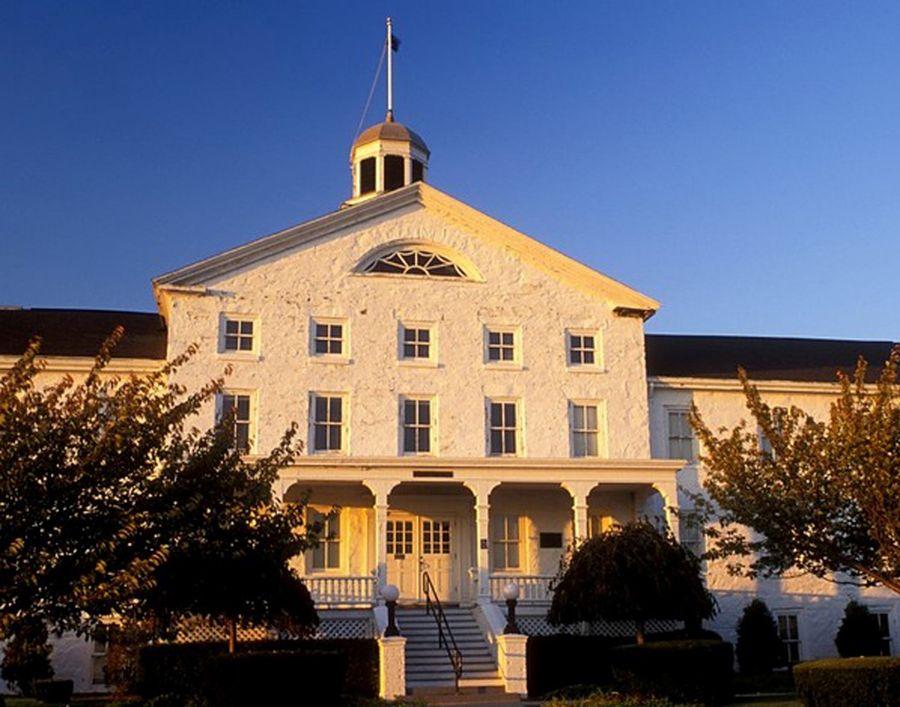
Mahan was born on the grounds of the U.S. Military Academy at West Point on September 27, 1840. His father, Dennis Hart Mahan, was an instructor at West Point who taught many of the men who would later serve as generals on both sides of the American Civil War. Alfred Thayer Mahan graduated in 1859 from the U.S. Naval Academy and soon thereafter served in the Union Navy during the Civil War, mostly on blockade duty.
Mahan’s naval career, as he recounted in his autobiography From Sail to Steam, took him to many parts of the world, including Japan and China. He was, as one author noted, a reluctant seaman—his primary interest was intellectual. In 1884, the U.S. Naval War College was established in Newport, Rhode Island, and Mahan joined the faculty of the War College a year later in October 1885. In preparation for that assignment, Mahan prepared his lectures, which formed the basis of his seminal work The Influence of Sea Power Upon History, 1660-1783, which was published in 1890. The book was an international success and launched Mahan on a career as an influential public intellectual. He would go on to write 19 more books and more than 130 articles on history, international relations, and current affairs.
Mahan began his career as a public intellectual just as the United States was becoming an overseas power—indeed, Mahan soon became one of our nation’s greatest advocates for overseas expansion. Mahan’s study of history, especially Theodore Mommsen’s multi-volume History of Rome, convinced him that “sea power” in its broadest sense—naval and commercial—was the key to national greatness. He was a great admirer of the British Empire and believed that the United States was destined to supplant Britain as the world’s greatest sea power.
Mahan understood that geopolitically the United States was an insular or island power, a continental giant with weak countries to its north and south and separated from Eurasia-Africa by two great oceans. However, he viewed the oceans not as impenetrable barriers but rather as a “great common” or highway. America’s shores were distant from the Old World, but those shores were vulnerable without a strong navy. America’s first line of defense, he believed, was along the coasts of the Old World and America needed continental allies to be able to project power onto continental Eurasia. Eurasia was the world’s dominant landmass, containing most of the world’s people and resources. Mahan was the first observer to use the term “Middle East” to refer to the region of the world where Europe, Asia, and Africa meet.
In 1898, the United States won a swift victory in the Spanish-American War, taking possession of Puerto Rico, Guam and the Philippines. America became an Asian power. That same year, the United States formally annexed Hawaii, a move that Mahan had been advocating for several years. U.S. forces participated in suppressing the Boxer Rebellion in China in 1900 and exchanged diplomatic notes with Britain and other European powers advocating equal trade privileges in China that became known as the “Open Door” policy.
Mahan began writing articles for Atlantic Monthly, The Forum, Century Magazine, North American Review, Scribner’s Magazine, Harper’s Monthly, and other publications. He wrote about the Sino-Japanese War of 1894-95; the U.S. war with Spain; the importance of Hawaii to U.S. naval power; British-American relations; America’s interests in the Philippines; the South African War; the importance of the Persian Gulf in international politics; the construction of the Panama Canal; and other current events. He also wrote works of history and historical biographies, including The Influence of Sea Power upon the French Revolution and Empire, Sea Power in its Relation to the War of 1812, The Life of Nelson, and Admiral Farragut.
Mahan’s most insightful work on international relations appeared initially as a series of articles in Harper’s in March and August 1900, which were later compiled in a book entitled The Problem of Asia, published later that year. Mahan’s analysis in the articles and book was not only timely given events then occurring in Asia, but he also foresaw the general structure of global developments in the 20th century—including the Cold War—even as he foreshadowed China’s rise to world power in the 21st century.
Forty-five years before the Cold War began, Mahan in The Problem of Asia predicted that the United States, Britain, France, Germany, and Japan would become allies to contain Russia's vast power in Asia. More than 100 years before China's economic and military ascendancy in Asia, Mahan warned that an effectively organized and armed China could pose a threat to the global balance of power.
Mahan was in his last year when the First World War broke out in Europe in August 1914—Mahan had also predicted that conflict in his book The Interest of America in International Conditions (1910). He wrote one article on the naval aspects of the war before his pen was silenced by President Woodrow Wilson, who did not want America's most well-respected public intellectual advocating against Wilson’s policy of strict neutrality. Wilson’s Republican predecessors—Taft, Theodore Roosevelt, and McKinley—had not prevented Mahan from writing about events that occurred during their administrations.
In September 1914, Mahan suffered a heart attack. His health got worse in November—he was now in constant pain. He died on the morning of December 1, 1914, at the age of 74. Upon hearing of his death, biographer Robert Seager writes, “[a]dmirals and generals, statesmen and historians, politicians . . ., editors and publishers, kinsmen and causal acquaintances all joined in the chorus of praise and sorrow.” Former President Theodore Roosevelt, who frequently corresponded with Mahan, called him “one of the greatest and most useful influences in American life.”
Francis P. Sempa is the author of Geopolitics: From the Cold War to the 21stCentury, America’s Global Role: Essays and Reviews on National Security, Geopolitics and War, and Somewhere in France, Somewhere in Germany: A Combat Soldier’s Journey through the Second World War. He has written lengthy introductions to two of Mahan’s books, and has written on historical and foreign policy topics for The Diplomat, the University Bookman, Joint Force Quarterly, the Asian Review of Books, the New York Journal of Books, the Claremont Review of Books, American Diplomacy, the Washington Times, and other publications. He is an attorney, an adjunct professor of political science at Wilkes University, and a contributing editor to American Diplomacy.
A Defense Win for Americans and Israelis in Arkansas
By Bradley Bowman • RealClearDefense
A Path to Success Against Iran
By Michael Schwartz • RealClearDefense
The World Cup Is Over. The Drone Threat Isn’t.
By Mitzi Perdue • RealClearDefense
AI Should Speed Veterans’ Benefits, Not Decide Them
By Rob Schroder • RealClearDefense
Don’t Be Swayed by Tactical Nukes
By Benjamin Giltner • RealClearDefense

Big Surface Combatants are so Hot Right Now
By CDR Salamander
USS Stout Loses Power During Port Visit Due to ‘Engineering Casualty’
By USNI News
Air Force Lessons Learned From Operation Epic Fury
By Tabitha Reeves, National Defense
Marines Need Nine More Amphibious Warships To Carry Out Its Missions
By TWZ
AFRL, ACC Fly XQ-67A Drone To Test Autonomous Teaming
By Airforce Technology