
The Aircraft Carrier Question: Obsolete or Not?
Last updated 08:16 PM EDT • Read time: 5m
If aircraft carriers are obsolete, then why do so many countries continue to build and buy them?
The question goes to the core of modern naval procurement, and not just in the United States. The People’s Liberation Army has assembled a vast array of systems designed to destroy aircraft carriers and thus deter them from entering contested waters. At the same time, the PLAN is in the process of fitting out its third (and largest) carrier, with additional vessels apparently on the way.
And China is hardly alone; in the last decade, the United Kingdom has built and commissioned two large carriers, Japan has modified two existing flat-decked aviation ships to operate modern fighters, and India has acquired a refurbished Russian carrier and built one of its own. South Korea is strongly considering its own carrier program, despite living in a neighborhood with plenty of terrestrial threats.
So to reiterate: When every new analysis seems to indicate that carriers can be found by satellites and killed by missiles, why do navies continue to acquire carriers? The fact that countries continue to build them does not necessarily prove the enduring military relevance of carriers because, of course, navies continued to build battleships well into World War II, after it became clear that they could not offer a good return on investment. Two answers are worth considering.
Utility
The first answer is that they believe aircraft carriers to remain militarily useful.
The anti-access/area defense system-of-systems (A2/AD) developed by China may not be nearly as lethal in operation as it is in principle, and in any case, there are many targets softer than the littoral of the PRC. Aircraft carriers still provide mobile airfields that are arguably more survivable than static facilities. Even if carriers are at risk in specific high-intensity combat scenarios, they remain effective in dozens of other conceivable military operations.
Part of the story is the availability of the F-35B, a fifth-generation fighter that can operate from the decks of small, affordable aircraft carriers. While the fighter itself is expensive and has a necessarily limited customer base (due to US technology controls), it does offer a small carrier an unprecedented opportunity to contest air superiority and to conduct medium-range strike operations. The fighter fleets of British, Italian, and Japanese naval aviation depend entirely on the F-35B. Spain, Turkey, and Australia all operate ships that could carry F-35Bs, although fiscal, legal, and organizational issues respectively have prevented the acquisition of the jets.
Prestige
The second answer is that operating an aircraft carrier is a moment of great prestige for a navy and for a country.
There’s crossover logic with the utility-based answer here, because the supercarrier (and big amphibs) of the United States Navy are indeed helpful in their “showing the flag” role as they visit ports around the globe. The People’s Liberation Army Navy certainly relishes showing off its carriers, even if they would have relatively limited relevance for operations such as the conquest of Taiwan. Russia took the trouble of sending its creaky carrier all the way to Syria for no other reason than to demonstrate that it could.
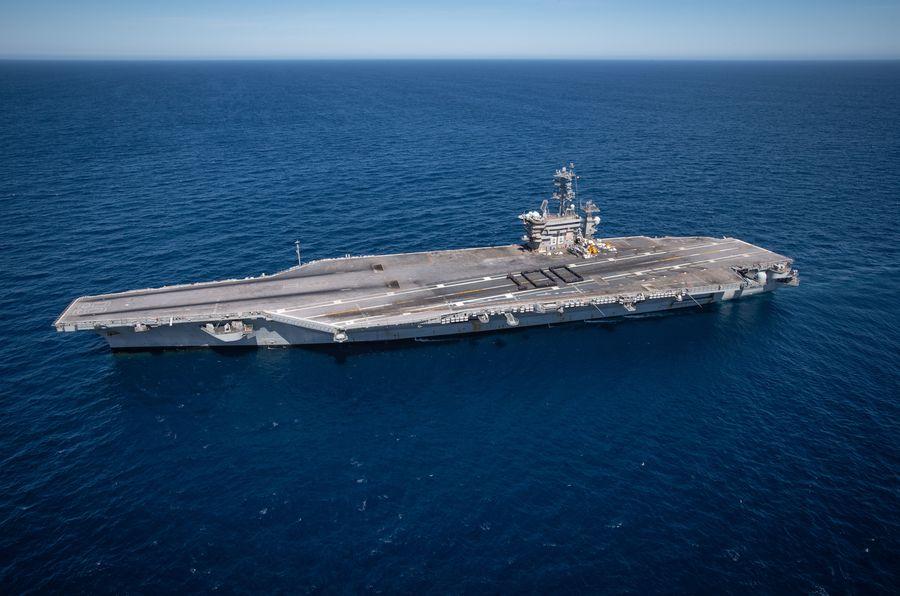
PACIFIC OCEAN (Jan. 28, 2021) Nimitz-class nuclear aircraft carrier USS Carl Vinson (CVN 70) is currently underway in the Pacific Ocean conducting routine maritime operations. (U.S. Navy photo by MCSS Olympia O. McCoy)
For a country like the United States, the United Kingdom, or even Russia, an aircraft carrier conveys the appearance of military might and continued global relevance. For China and India, aircraft carriers convey modernity and demonstrate great power status. While the price these countries are paying may appear very high, such demonstrations have long been part of great power defense statecraft.
Final Shots
Not everyone is enamored with aircraft carriers.
On the negative side of the ledger, Russia seems likely to opt-out of the naval aviation game for the foreseeable future, as the Admiral Kuznetsov does not appear likely to return to service soon and the cadre of naval aviators capable of operating from carriers is rapidly disappearing. Brazilian naval aviation does not seem to have survived the failed effort to rehabilitate the Sao Paulo (the former French Foch), although Brazil’s acquisition of the former HMS Ocean means that a helicopter platform is still available. Russia and Brazil have determined that the cost of building (or buying) and maintaining an aircraft carrier is too high for the likely return in power and prestige. However, many other countries continue to come to the opposite conclusion, and that should give the analysts who’ve been predicting the impending demise of the carrier since 1945 some pause.
A 19FortyFive Contributing Editor, Dr. Robert Farley has taught security and diplomacy courses at the Patterson School since 2005. He received his BS from the University of Oregon in 1997, and his Ph. D. from the University of Washington in 2004. Dr. Farley is the author of Grounded: The Case for Abolishing the United States Air Force (University Press of Kentucky, 2014), the Battleship Book (Wildside, 2016), and Patents for Power: Intellectual Property Law and the Diffusion of Military Technology (University of Chicago, 2020). He has contributed extensively to a number of journals and magazines, including the National Interest, the Diplomat: APAC, World Politics Review, and the American Prospect. Dr. Farley is also a founder and senior editor of Lawyers, Guns and Money.
This article appeared originally at 1945.

A Defense Win for Americans and Israelis in Arkansas
By Bradley Bowman • RealClearDefense
A Path to Success Against Iran
By Michael Schwartz • RealClearDefense
The World Cup Is Over. The Drone Threat Isn’t.
By Mitzi Perdue • RealClearDefense
AI Should Speed Veterans’ Benefits, Not Decide Them
By Rob Schroder • RealClearDefense
Don’t Be Swayed by Tactical Nukes
By Benjamin Giltner • RealClearDefense

Big Surface Combatants are so Hot Right Now
By CDR Salamander
USS Stout Loses Power During Port Visit Due to ‘Engineering Casualty’
By USNI News
Air Force Lessons Learned From Operation Epic Fury
By Tabitha Reeves, National Defense
Marines Need Nine More Amphibious Warships To Carry Out Its Missions
By TWZ
AFRL, ACC Fly XQ-67A Drone To Test Autonomous Teaming
By Airforce Technology