
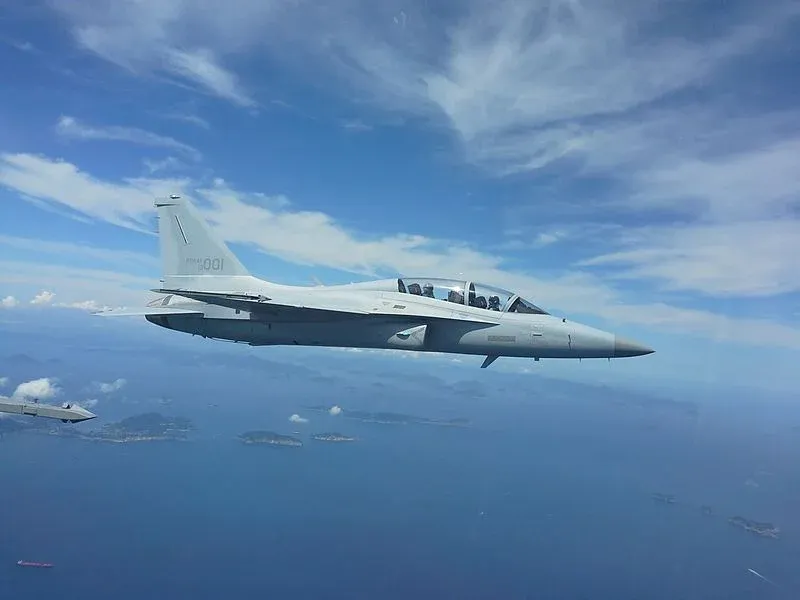
Golden Eagle Soaring: Malaysia's FA-50 Decision
Last updated 01:00 AM EDT • Read time: 6m
Last month, Malaysia announced the FA-50 Golden Eagle as the winner of the tender to supply 18 aircraft for the Fighter Lead In Trainer–Light Combat Aircraft (FLIT–LCA) program. The deal is worth US$920 million and initial delivery of the aircraft to the Royal Malaysian Air Force (RMAF) is scheduled for 2026.
The FA-50, the weaponized variant of the T-50 trainer, is a signature product of Korea Aerospace Industries (KAI), and it reportedly beat the Tejas, made by India’s Hindustan Aeronautics Limited (HAL), during the final round of selection. This was despite the latter being more capable in areas such as range and service ceiling. With a price tag of about $28 million, the Tejas also costs less than the FA-50 ($30m). So what could account for Malaysia opting for the Golden Eagle?
Brand Name
The primary one is that the aircraft is a tried-and-tested platform. When Malaysian then-defense minister Hishammuddin Hussein praised the Golden Eagle last year as a ‘reliable platform based on good reputation’, it was probably a sign of things to come. And earlier this week, Defense Minister Mohamad Hasan said in parliament that the FA-50 decision was based on the platform’s ‘service record’, adding that Malaysia does not want its military personnel to be involved in a ‘laboratory test’.
Tellingly, some 200 of the aircraft are in service with South Korea and Iraq as well as Association of South East Asian Nations (ASEAN) members Philippines, Indonesia and Thailand. Indeed, the latter two are repeat customers of the Golden Eagle. Another upcoming operator is Colombia with an order of 20 aircraft. KAI is also confident of striking an FA-50 deal with Egypt in the firm’s first venture into the African market. That Poland concluded a deal last year to procure 48 FA-50s to complement its ageing ‘heavy’ MIG-29 fighters and SU-22 attack planes cannot but help enhance the Golden Eagle brand name.
What is more, the aircraft is combat tested. The Philippine Air Force had deployed it for various missions in recent years against militants, including the 2017 Marawi campaign. That the Golden Eagle is operationally proven is particularly important for the RMAF given that it is likely to use the aircraft for air patrols and interceptions amid the service’s low availability rates of its mainstay fighters, the F/A-18 Hornet and SU-30 Flanker, as well as the suspension of the Multi-Role Combat Aircraft (MRCA) program over budgetary issues.
On the other hand, the Tejas is largely untested. Though it first flew in the early 2000s, delays plagued the Tejas program such that the Indian Air Force (IAF) received its first such aircraft only in 2015. The IAF is the sole Tejas operator with just 16 aircraft in service according to The Military Balance 2023 and they are the Mark 1 (first) variant at that. It is also worth noting that the aircraft was foisted to some degree onto the IAF by Prime Minister Narendra Modi with his ‘Make-in-India’ policy to encourage domestic industry. Tellingly, the Indian Navy rejected the navalized version of the Tejas despite the platform being offered to the service. That HAL is not as well received in a general sense as KAI probably also contributed to Malaysia’s decision not to opt for the Tejas. After all, the Indian defense firm has been trying to improve its reputation since the Ecuadorian Air Force’s Dhruz helicopter fiasco.
Better as a Trainer and Fighter
It is also plausible that Malaysia opted for the FA-50 as it better suits the RMAF’s FLIT-LCA requirements. Kuala Lumpur wants an asset that can function as a trainer-cum-combat aircraft. Indeed, of the RMAF’s initial 18 aircraft in the FLIT-LCA program, ten would be configured as trainers and the rest for operations. The FA-50 is designed as a trainer aircraft that can be outfitted with fighting capabilities with little modifications, and this is a key element of KAI’s Golden Eagle sales pitch. In other words, it can transition seamlessly between the training and combat roles. This flexibility significantly reduces training time and costs.
Meanwhile, the Tejas Mark 1 is an out-and-out fighter, and as such, it would be overkill for the FLIT role. Its high performance specifications, including great maneuverability, renders it less than ideal as a trainer aircraft. Configuring the Indian aircraft for training purposes would invariably add costs. Moreover, that its parent company decides to design a new trainer jet – the HLFT-42 similar in many ways to the Tejas – lends credence to the notion that the latter is not suited for FLIT.
Logistics Matter
Contributing to Malaysia’s preference for the FA-50 would probably be the fact that it has various commonalities with the RMAF inventory. This is crucial as logistical problems and the associated downstream costs would be reduced. For instance, the Golden Eagle uses the reliable F404 engine that also powers the F/A-18. The Block 20 FA-50 that Malaysia will procure is armed with the same munitions that the Hornet uses, like the AIM-9 Sidewinder and AMRAAM for air-to-air combat, as well as the AGM-65 Maverick and Joint Direct Attack Munition (JDAM) for attacking surface targets. Should Malaysia follow through with its reported interest to significantly expand its Hornet fleet, having the FA-50 on hand would streamline the RMAF’s training and maintenance needs.
To be sure, the Tejas, too, has a number of commonalities with the RMAF fleet. The aircraft is also powered by the F404 engine, and it can deploy the JDAM. In addition, it is possible that the HAL sales pitch included the Tejas’s compatibility with Russian weapons similar to those the RMAF SU-30 carries. However, the Malaysians had reportedly expressed dissatisfaction with their Flanker jets. This coupled with the Moscow’s abject performance in the Ukraine war as well as the sanctions imposed on Russia’s defense industry could see Kuala Lumpur pivoting away from Russian arms and towards Western ones. In such circumstances, the ‘Tejas is compatible with Russian weapons’ argument has less weight.
Looking Ahead
The acquisition of the FA-50 marks the RMAF’s first step on its Capability Development Plan 2055 (CAP55) transformational journey. This roadmap sees Malaysia acquiring a total of 36 aircraft under the FLIT-LCA initiative; hence the RMAF could procure another 18 FA-50s. As part of CAP55, the service also plans to streamline the types of combat aircraft from five to two (the MRCA and FLIT-LCA) to reduce operating costs. Given Malaysia’s economic travails, the fate of the MRCA program remains uncertain. Nevertheless, when it enters service, the FA-50 with its proven capabilities should alleviate any ‘heavy’ fighter gap Malaysia would face.
In addition, with the FA-50 in RMAF service, there will be four ASEAN members operating the Golden Eagle. A regional Golden Eagle community could thus surface where it partakes in confidence-building measures such as personnel exchanges and the sharing of best practices. This development should enhance Southeast Asian security by increasing interoperability and supporting defense diplomacy amongst regional states especially as tensions continue to simmer in the South China Sea.
Ben Wan Beng Ho is an Associate Editor with the International Institute for Strategic Studies, where he helps leads in project management and editing. Ben has research interests in airpower and naval matters of the Indo-Pacific.

In Pursuit of Nuclear Abolition
By Peter Huessy • RealClearDefense
Innovation Alone Won’t Prepare the U.S. for the Future Battlefield
By Joshua Segal • RealClearDefense
The sUAS Tactical Trifecta
By Bryan T. Woody • RealClearDefense
The Revolutionary War: When Strategic Options Share the Same Weakness
By Henry Yep • RealClearDefense
The Houthis Are Testing the Limits of Collective Defense
By Saima Afzal • RealClearDefense

Who Shoots Down the Drone Over the Shipyard?
By John Ferrari & Dillon Prochnicki • RealClearDefense
Northrop Grumman Breaks Out the Big Guns at AUSA
By Daniel Terrill, Defense News
Army Pursuing Diverse Array of New Anti-Air Interceptors
By Trevithick, The WarZoneWho Shoots Down the Drone Over the Shipyard?
By John Ferrari & Dillon Prochnicki, RCD
F-35C Lands for the First Time on a Ford-Class Aircraft Carrier
By The Aviationist