
Breaking the Chain
Last updated 07:37 PM EDT • Read time: 8m
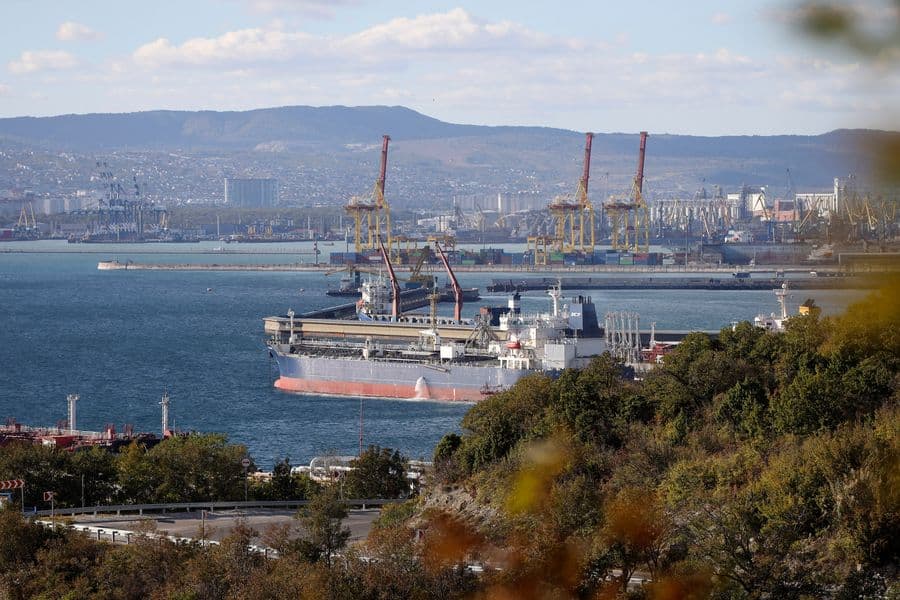
An oil tanker is moored at the Sheskharis complex, part of Chernomortransneft JSC, a subsidiary of Transneft PJSC, in Novorossiysk, Russia, on Oct. 11, 2022, one of the largest facilities for oil and petroleum products in southern Russia. (AP Photo, File)
Why U.S. military reliance on Russian oil is its most acute threat in a European conflict
As the invasion of Ukraine stretches into a third year of large-scale, modern combat, the evolving character of the war with battlefield innovations and subsequent counters, is drawing the attention of countries on the sidelines. This has created excited chatter in the American military about the need to develop countermeasures to drones, prioritizing hypersonic missile development to gain parity with Russian Zircons, and even reworking combined arms strategy to account for lessons learned. The war in Ukraine has certainly exposed technical challenges for the United States. However, the most significant threat the U.S. military faces in future conventional operations in Europe is not emerging battlefield technology or tactics but continued reliance on Russian oil. Overreliance on local oil, which still mainly originates from Russia, to sustain military operations, leaves U.S. forces and infrastructure vulnerable to Russian grey-zone warfare and Strategic Operations for the Destruction of Critically Important Targets (SODCIT), while constraining the United States's freedom of maneuver when developing military response options.
Oil and Gas: Russia's stranglehold on Europe
Petroleum, Oil, and Lubricants (POL) are the lifeblood of today's advanced, mechanized armies and are the primary means for modern armies to sustain operations. This thirst for oil and its distillates causes a conundrum for the United State and NATO. Prior to the full-scale invasion of Ukraine in 2022, Europe was literally and figuratively tied to Russia via four pipelines. These arteries provided nearly 40% of Europe's natural gas, with some nations, such as Latvia and Germany, depending on Russia for 80% and 60% of their oil supply, respectively. These levels dropped dramatically in the wake of February 2022 as European countries scrambled to sever dependence on Russian oil and gas, with many countries reducing reliance on Russian fuels down to single-digit numbers. However, these efforts only addressed Russia’s historically marginal 4-5% stake in European Liquid Natural Gas (LNG) imports. But Russian crude oil and petroleum distillates continue their grip on Europe. As of 2023, the EU remains the number three importer of Russian crude oil, while Turkey is the number one purchaser of Russian oil products, much of which they resell to EU and NATO countries.
But why does this matter to the United States? The main issue with Russian gas and oil flowing into Europe means the United States will need this same oil to sustain operations. For example, a 2022 report for a House Armed Services Committee's hearing demonstrated that U.S. bases around the continent attributed 30% of their annual operating energy supply to Russian fossil fuels. They extrapolated this percentage from the estimated imports of Russian fossil fuels by the base's host country. If the United States were to wage military action in Europe today in the event of a NATO Article 5 event, it would need locally procured fuel to sustain operations from its point of arrival eastward, much of which originated in Russia.
Unquenchable Thirst: The Sustainment of U.S. Military Operations
Continued European reliance on Russian oil also, in part, means an American reliance.
But, how thirsty would the American military be in combat operations, and how much would it drink from a Russian pipeline? Consider a scenario where a U.S. response involves the employment of three ABCTs. Within these ABCTs there are six M1 Abrams companies and six infantry or reconnaissance companies utilizing the Bradley Fighting Vehicle (BFV), totaling 108 tanks and 84 BFVs. Using a consumption formula (Figure 1) outlined in "Logistics Forecasting and Estimates in the Brigade Combat Team" we can determine that in 24 hours, the maneuver companies of three ABCTs will consume approximately 279,000 gallons of fuel (Figure 2). This consumption, in turn, translates to just over 6,600 barrels of oil per day or more than 204,000 for a month of combat operations, all supplied by local sources in Romania, Germany, or Poland. This incredible thirst and need for fuel, coupled with a reliance on local sources hooked on Russian oil imports, exposes the most significant vulnerability for the U.S. in a European war.
Figure 1: Fuel Consumption Estimation Formula
Figure 2: Estimated 24-hour fuel consumption for a fraction of one ABCT
Glaring Vulnerabilities
There are two principal vulnerabilities that the massive consumption of oil required by the U.S. military and the dependence of European nations on imports create. First, Russia can exploit this dependence through grey-zone operations and SODCIT by their established doctrine. Russia, acting within its active defense doctrine, could stop the flow of oil and POL to the EU and Turkey and subsequently target fuel-storage and supply infrastructure in Europe with precision missile strikes. If this were to occur, using the numbers above, the EU oil supply would drop by nearly 25% solely from Russia retaining its supply and not accounting for further damage by Strategic Operations for the Destruction of Critically Important Targets on refineries or storage facilities. A 25% reduction in oil availability in the theater would translate to a 25% decrease in available supply for the U.S. ABCTs equating to the U.S. losing 25% or nine companies' worth of combat power.
The second vulnerability comes from limitations that oil dependence will place on U.S. operational planning. Even if Russia does not sever oil supply in the opening phases of conflict, the reliance on Russian oil will reduce freedom of maneuver, operational flexibility, and the ability for the U.S. to project power in the region. Much like the shock effect of losing 25% of combat capability due to loss of supply, dependence on Russian oil will force the American military to adjust its combat operations. Commanders will need slow operations or reduce the size of operational forces to conserve fuel. Ultimately, this means the U.S. will not have complete independence to choose the size, scope, and duration of a possible military response in Europe.
Each of these vulnerabilities is pressing and impactful; however, recall that the example demonstrating how significant the oil burden truly is, was solely based on one fraction of a likely U.S. response force. If we now zoom out and consider that 25% of aircraft, 25% of logistics, or 25% of medical assets will be impacted, one can rapidly see that dependence on Russian oil for a U.S. response can have serious consequences if not properly mitigated.
Breaking the Chain
Europe has succeeded in reducing its reliance on Russian LNG. However, Russian crude oil and POL remain large imports for EU and NATO allies such as Turkey. As long as Europe remains hooked on Russian oil, the United States will also subject to that tether, as European NATO nations would need to provide the majority of POL necessary to sustain U.S. and allied combat operations. The vulnerability of a thirsty U.S. war machine and dependence on Russian fuel has two consequences. The United States and its allies are vulnerable to the devastating effects of grey-zone warfare use of energy as a weapon coupled with SODCIT, which could rapidly reduce U.S. combat power. Additionally, remaining chained to Russian supply limits the effectiveness of U.S power projection as it cannot freely dictate the size, scope, and duration of response without self-imposed restrictions based on fuel supply.
The United States government can begin to address this vulnerability by working with allies to increase their stockpiles of on-hand reserves and subsequently hardening these facilities from missile strikes. The U.S. military, specifically the U.S. Army, should also consider employing Navy oilers, commonly used for Carrier Strike Group sustainment, to support ground operations in Europe. One ship can carry 162,000 barrels of oil, which the military can use as a stopgap to sustain initial operations until further assets arrive. Ultimately, Russia's oil stranglehold on NATO and the United States will have wider ramifications than emerging battlefield technology and tactics if left unmitigated.
Major Eric J. Uribe is a U.S. Army Foreign Area Officer, with an area concentration in Europe, and currently a graduate student at Georgetown University’s Walsh School of Foreign Service. He has served in a variety of armor assignments, including command at the company level and has deployed to Afghanistan and Eastern Europe. He holds a BS in political science from the United States Military Academy.
The views expressed in this article are the author's own and not that of the U.S. Army or Department of Defense.

Iranian Cyber Operations
By Michael Groen • RealClearDefense
Reflecting on an Epic Horse Campaign in the Mountains of Afghanistan
By Brian Glyn Williams • RealClearDefense
The Godfather of American Foreign Policy Realism Speaks to Today’s World
By Francis P. Sempa • RealClearDefense
In Pursuit of Nuclear Abolition
By Peter Huessy • RealClearDefense
Innovation Alone Won’t Prepare the U.S. for the Future Battlefield
By Joshua Segal • RealClearDefense

26th MEU – U.S. Needs Crisis Response MAGTF
By Marine Corps Compass Points
The Influence of History on a Sea Power
By CDR Salamander
Navy Civilianizes Six Former Flag Billets, Reduces Six to Captains
By Mongilio, USNI N.
Raytheon's $8B Contract for Strategic Comms Terminal Modernization
By M+A El
America’s Maritime Moment Will Not Wait
By CDR Salamander